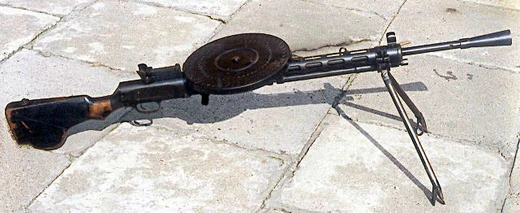
MG 15
German aircraft defensive machine gun later adapted for infantry use.
The MG 15 was a German 7.92 mm machine gun built in the early 1930s for use as a flexible defensive weapon on combat aircraft. Its design came from the MG 30, which relied on a locking system created by Louis Stange and produced by Rheinmetall. Although it shares a designation with an earlier Bergmann gun from World War I—the MG 15nA (neuer Art)—the two are unrelated; the older model used a tipping lock, while the World War II version employed a rotating bolt and lockring. The MG 15 was standard equipment on nearly all Luftwaffe aircraft in flexible-mount positions.
By late 1940, the MG 15 began to be phased out in favor of belt-fed alternatives like the Mauser MG 81, the twin MG 81Z, the MG 131 13 mm machine gun, or the MG 151/20 20 mm cannon. As these newer weapons took over, many MG 15s were adapted for infantry use, and a carrier for three saddle-drum magazines was issued. Official records show about 17,648 conversions by January 1, 1944, though the real number may have been higher. The MG 15 was also exported to Romania as the ST 61, but it was never used and remained in storage.
The gun was modular, with attachments that could be quickly swapped. It fired from an open bolt, meaning the bolt stayed back when ready to fire—this made it unsuitable for synchronized forward firing through a propeller. When the trigger was pulled, the bolt moved forward, stripped a round from the magazine, and pushed it into the chamber. The lockring then rotated, locking the bolt and barrel extension together, and a trip lever released the firing pin. Recoil pushed the barrel, lock, and bolt backward until the lockring hit a cam, unlocking them. Inertia carried the bolt back, and the ejector flung the empty case out. If the trigger was held, the cycle repeated; releasing it left the bolt in the rear position.
The saddle-drum magazine straddled the gun with two spiral drums on either side of the receiver. It held 75 rounds total (not 150, as is often mistaken), shared evenly between the drums. Spring tension fed the ammunition toward the center and down into the action. With a firing rate over 1,000 rounds per minute, the gun could empty a magazine in 4.5 seconds or less. Aircraft typically carried at least ten spare magazines per gun, but reloading in combat left the gunner vulnerable to enemy fighters.
Quick Facts
- Origin
- Weimar Republic / Nazi Germany
- Is Ranged
- yes
- Service
- 1933–1950s (MG 15)
- Wars
- World War II / Korean War
- Designer
- Theodor Bergmann
- Design Date
- 1932
- Length
- 1078 mm (without attachments)
- Part Length
- 600 mm
- Cartridge
- 7.92×57mm Mauser
- Cartridge Weight
- 35.5 grams (Full round)Cartridge: 24 grams; Bullet: 11.5 grams
- Caliber
- 7,9 (7.92 / +0.04 / ) mm
Facts from the source article.
Lore & Background
The MG 15 was developed from the MG 30, designed by Rheinmetall using the locking system invented by Louis Stange in the mid to late 1920s. Though it shares the MG 15 designation with an earlier Bergmann gun from World War I, the two have nothing in common except the model number; the World War I gun used a tipping lock system while the World War II aircraft gun uses a rotating bolt and lockring. The MG 15 was used in nearly all Luftwaffe aircraft with a flexible-mount defensive position.
Starting in late 1940 the MG 15 was replaced by the belt-fed Mauser 7.92 mm MG 81, MG 81Z, MG 131 13 mm machine guns, or MG 151/20 20 mm cannons. As they became redundant, many MG 15s were modified for infantry use, and a carrying device was issued that held three saddle-drums. The official total of conversions was about 17,648 by January 1, 1944, although the actual number may have been greater. During the war, the MG 15 was exported to Romania as the ST 61, but it was never used and was kept in storage.
The MG 15 fires from an open bolt, meaning the bolt stays back when ready to fire, making it unsuitable for synchronized forward firing through a propeller. The saddle-drum magazine held 75 rounds (not 150 as often mistakenly claimed), shared evenly by both drums. With a firing rate of over 1,000 rpm, the magazine could be emptied in 4.5 seconds or less, and typical practice was to provide at least 10 spare magazines for each gun on the aircraft.
Reader's Guide
The MG 15's significance lies in its role as the standard flexible defensive machine gun for Luftwaffe aircraft in the early years of World War II, before being superseded by more modern designs. Its modular design allowed various attachments to be quickly fitted or removed. The open-bolt operation, while unsuitable for synchronized forward firing, was typical for flexible-mount guns. The saddle-drum magazine, often misidentified as holding 150 rounds, actually contained 75 rounds, and the high rate of fire meant reloading was a frequent and vulnerable task for gunners. After being replaced in aircraft, the MG 15 found a second life as an infantry weapon, with over 17,000 officially converted by early 1944. The gun was also license-produced in Japan as the Type 98 flexible-mounted machine gun for the Imperial Japanese Army and as the Type 1 for the Imperial Japanese Navy. Type 98 machine guns were later used by Communist forces during the Korean War. The export to Romania as the ST 61, though never used, shows the gun's reach beyond German service.
Did You Know?
- The MG 15's saddle-drum magazine held 75 rounds, not 150 as is often mistakenly claimed.
- The official total of MG 15s converted for infantry use was about 17,648 by January 1, 1944.
From Captured Blueprints to Postwar Standard
The end of the Second World War left Rheinmetall in an unusual position: the original technical documentation for the legendary MG 42 had fallen into Soviet hands, eventually finding its way to Czechoslovakia and Yugoslavia. Rather than starting from scratch, the German arms manufacturer had to reverse-engineer the weapon by studying a surviving original MG 42 specimen. This constraint shaped the entire postwar lineage. In 1958, the Bundeswehr requested a general-purpose machine gun chambered for the new 7.62×51mm NATO cartridge, and Rheinmetall responded with the MG 1 at its arms factory. Quick refinements followed: a chrome-lined barrel and recalibrated sights produced the MG 1A1, also catalogued as the MG 42/58. The next iteration, the MG 1A2 (or MG 42/59), introduced a substantially heavier bolt weighing 950 grams to tame the cyclic rate down to 700–900 rounds per minute, paired with a redesigned friction ring buffer and bolt-bounce-preventing catches that addressed ignition timing quirks. It also gained compatibility with both the German non-disintegrating DM1 belt and the American M13 disintegrating belt. By 1968, the refined MG 3 entered production with an improved belt retaining pawl, an anti-aircraft sight, and a new ammunition box, cementing a design that would serve for decades.
Engineering Philosophy: Open Bolt and Interchangeability
The MG 3 operates from an open bolt position, a design choice inherited from its wartime ancestor that keeps the chamber clear of hot brass and reduces the risk of a cookoff when the weapon is cycled. Its trigger mechanism is automatic-only, governed by a cross-bolt safety button operated by the shooting hand; in the safe position the bolt release is mechanically disabled. One of the most practical engineering features is the ability to alter the cyclic rate simply by swapping the bolt and recoil spring. A standard-weight bolt of roughly 650 grams yields a rate of 1,000–1,200 rounds per minute, while an extra-weight bolt near 900 grams absorbs more recoil energy to overcome its greater inertia, slowing the action accordingly. This modular approach to rate control is elegant in its simplicity. Perhaps most remarkably, the MG 3 and all its variants maintain a high degree of parts interchangeability with the original MG 42, meaning spare components, tools, and maintenance procedures developed over decades remain relevant. This continuity has made the weapon exceptionally easy to sustain in the field, a factor that has kept it in active service far longer than many contemporaries.
Discipline of Fire: Barrel Management and Burst Doctrine
German military doctrine treats the MG 3 not as a firehose but as a precision tool demanding strict thermal discipline. In the bipod-mounted light machine gun role, operators are trained to deliver short bursts of three to five rounds, re-aiming between each successive burst. On the tripod for the medium machine gun role, bursts stretch to 20–30 rounds, but the principle remains: optimize aim between bursts rather than laying down continuous suppressive fire. The effective rate of fire is capped at roughly 250 rounds per minute in practice. After 150 live rounds (or 100 blanks) of sustained heavy fire, the barrel must be swapped for a cooler one. The old barrel may only be reused once it has cooled to hand-warm temperature—specifically, when a soldier can hold it bare-handed for thirty seconds without discomfort. The procedure is deliberately simple, but the stakes are high: ignoring the thermal limit renders the barrel prematurely unusable, and after extended cyclic fire the metal can approach white-hot temperatures. Crew members performing a hot barrel change are issued protective asbestos gloves or a heavy cloth to guard against severe burns.
A Global Footprint and Enduring Service
The MG 3's influence extends well beyond German borders. Over forty nations have acquired the weapon or its derivatives, and production rights were formally purchased by Italy (where it appeared as the MG 42/59), Greece, Iran (designated MGA3), Pakistan (as the MG 1A3), Sudan, Spain, and Turkey. Rheinmetall manufactured the gun for Germany and export customers until 1979, with Heckler & Koch handling some additional domestic production. Even today, Turkey and Pakistan continue manufacturing the weapon. Within the Bundeswehr, the MG 3 remains the standard secondary armament on heavy platforms such as the Leopard 2, PzH 2000, and Marder, while serving as the primary weapon on lighter vehicles including the ATF Dingo and MAN gl-trucks. In 2019, German planners announced intentions to produce several thousand new MG 3 receivers to sustain vehicle-mounted (MG 3A0A1) and turret-mounted (MG 3A1A1) roles in the near future. Although the Heckler & Koch MG5 has supplemented the MG 3 in infantry roles since 2015, the machine gun's presence in armored and vehicle-mounted configurations shows no sign of fading.
Gallery


More in Machine Guns, Part 2 1-24
Spotted an error? Know more?
Reader corrections go straight into our review queue. Suggest an edit · How this site is sourced