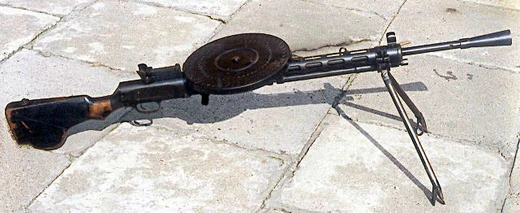
Type 99 light machine gun
Japanese light machine gun firing the 7.7×58mm Arisaka round.

The Type 99 light machine gun served the Imperial Japanese Army during World War II. Its design closely followed the earlier Type 96, but it was built around the newer, more powerful 7.7×58mm Arisaka cartridge, which delivered over 50% more energy than the previous round. The weapon also dropped the oiling mechanism found on earlier models, making it more reliable overall. Despite these improvements, the Type 99 never fully replaced the Type 11 and Type 96 light machine guns, and all three saw service together until 1945.
Development began because the Japanese Army was adopting a larger, rimless 7.7mm cartridge (producing 3,136 J of energy compared to the 6.5mm round’s 1,966 J) to improve handling and power. This required a stronger firearm with more steel, heavier springs, and a sturdier bolt—leading to the Type 99 rifle and, in turn, a new light machine gun that could share ammunition with infantrymen. The Type 99 was produced at Kokura, Nagoya Arsenal, and Mukden, with total output reaching about 53,000 weapons.
The Type 99 retained the basic layout of the Type 96 and shared many parts with it. It used a top-mounted, curved 30-round detachable box magazine with a round counter, and had a finned barrel that could be swapped quickly to prevent overheating. Early versions included a monopod at the stock and a screw-on flash suppressor at the muzzle. The gun featured a blade front sight and a leaf rear sight adjustable from 200 to 1,500 meters, with windage adjustment. A 2.5X telescopic sight with a 10-degree field of view could be mounted on the right side, and these were sometimes issued to top marksmen for use like a sniper rifle. A standard infantry bayonet could attach to the gas block below the barrel, though this feature proved impractical in combat due to the weapon’s weight and the flash hider blocking the blade.
The Type 99 entered active service in 1939 and fought alongside the Type 11 and Type 96, which remained in widespread use because large numbers had already been produced and many troops still carried Type 38 rifles chambered for 6.5mm ammunition. All three guns stayed in service until the war ended. After World War II, the Type 99 was used by Chinese and North Korean communist forces during the Korean War, and later by the Viet Minh and North Vietnamese forces in the First and Second Indochina Wars.
Quick Facts
- Origin
- Empire of Japan
- Is Ranged
- yes
- Service
- 1939–1945
- Designer
- Kijiro Nambu
- Design Date
- 1939
- Manufacturer
- Nambu Arms Manufacturing Company / Kokura Arsenal / Nagoya Arsenal
- Unit Cost
- 1,350 yen ($316 USD) in December 1941
- Number
- 53,000
- Weight
- 10.4 kg (22.9 lbs)
- Length
- 1181 mm (46.5 in)
- Part Length
- 550 mm (21.7 in)
- Cartridge
- 7.7×58mm Arisaka
Facts from the source article.
Lore & Background
Prior to the Type 99's development, the Japanese Army was using the Type 96 light machine gun, a successor to the Type 11. The Type 96 had been introduced into combat service in 1936, and quickly proved versatile for covering fire. Both the Type 11 and Type 96 used the same 6.5×50mmSR Arisaka cartridges as the Type 38 infantry rifle, simplifying supply. In 1939, the Japanese army was switching to a larger, rimless 7.7mm cartridge with 3,136 J energy, requiring a firearm with more steel, bigger springs, and a heavier bolt. This led to the Type 99 rifle and the Type 99 light machine gun, maintaining common ammunition between riflemen and machine gunners.
The Type 99 was basically the same design as the Type 96, with many common parts, but dispensed with the oiler and had better primary extraction, increasing reliability. Early models had a monopod at the stock and a flash suppressor on the muzzle. A finned barrel could be rapidly changed. A standard infantry bayonet could be attached to the gas block, though this feature proved inconsequential due to the gun's weight and the flash hider obstructing the blade. A 2.5X telescopic sight could be attached on the right side, often issued to the best marksmen and occasionally used like a sniper rifle.
The Type 99 came into active service in 1939, used alongside the Type 11 and Type 96, as these models had been produced in large quantities and many troops still used Type 38 rifles with 6.5mm ammunition. All three remained in service until the end of the war. The Type 99 was used by Communist forces during the Korean War, and by the Viet Minh and North Vietnamese forces during the First and Second Indochina Wars.
Reader's Guide
The Type 99 light machine gun represents Japan's attempt to standardize on a more powerful cartridge while retaining the proven gas-operated, top-fed design of the Type 96. Its 7.7×58mm round delivered over 50% more energy than the earlier 6.5mm cartridge, improving range and stopping power. The omission of the oiling mechanism addressed a reliability issue common to earlier Japanese light machine guns. Despite these improvements, the Type 99 never fully replaced the Type 11 and Type 96, and all three served concurrently through World War II. Production of about 53,000 units was modest compared to other nations' machine guns. The weapon saw continued use after the war, employed by Communist Chinese and North Korean forces in the Korean War, and by Viet Minh and North Vietnamese forces in the Indochina Wars. A limited paratrooper variant with a detachable stock and folding pistol grip was produced. The Type 99 also influenced later Japanese machine gun development, as the first prototype of the Type 62 GPMG (completed in 1956) closely resembled the Type 99. The Type 99 can be modified to fire 7.62×51mm NATO ammunition with only a barrel replacement, and it saw limited use by the Worker-Peasant Red Guards as late as 1980.
Did You Know?
- The Type 99 fired a 7.7×58mm cartridge with 3,136 J energy, compared to 1,966 J for the earlier 6.5mm round.
- The Type 99 omitted the oiling mechanism present on earlier Japanese light machine guns, improving reliability.
- A 2.5X telescopic sight could be attached to the right side, and the gun was occasionally used as a sniper rifle.
- The Type 99 was used by Communist forces in the Korean War and by North Vietnamese forces in the Indochina Wars.
More in Machine Guns, Part 2 1-24
Spotted an error? Know more?
Reader corrections go straight into our review queue. Suggest an edit · How this site is sourced