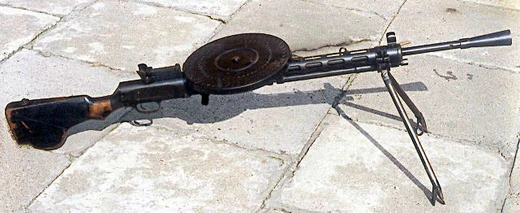
Type 97 aircraft machine gun
Standard fixed light machine gun of the Imperial Japanese Navy.

The Imperial Japanese Navy’s standard fixed light machine gun for aircraft during World War II was the Type 97. It was a licensed copy of the British Vickers Class E, closely related to the Army’s Type 89 machine gun. The Type 97 was well suited for synchronized firing and served as the cowling armament on the A6M Zero. Unlike the Type 89, which used a new Japanese-developed .303-inch cartridge, the Type 97 kept the original British .303-inch round, so ammunition between the two was not interchangeable.
Introduced in 1937, the Type 97 saw service on numerous aircraft, including the Nakajima B6N, Yokosuka K5Y, Yokosuka D4Y, Aichi D3A, Aichi E16A, Kawanishi E7K, Kawanishi N1K and its land-based N1K-J variant, Mitsubishi J2M, Mitsubishi F1M2, the A6M Zero, and its floatplane derivative, the Nakajima A6M2-N. Ground troops also used the Type 97 after adding a bipod and spade grips. During the Indonesian National Revolution, Republican forces employed captured Japanese Type 97s for ground combat.
Quick Facts
- Origin
- Empire of Japan
- Is Ranged
- yes
- Service
- 1937–1945
- Used By
- Imperial Japanese Navy
- Wars
- Second Sino-Japanese War, World War II
- Design Date
- 1937
- Manufacturer
- KK Nihon Seikoujo / Suzuka Naval Arsenal / Toyokawa Naval Arsenal
- Weight
- 12.6 kg
- Length
- 1033 mm
- Part Length
- 600 mm
- Cartridge
- 7.7x56mmR
- Cartridge Weight
- 106 gr projectile weight
Facts from the source article.
Lore & Background
The Type 97 entered service in 1937 and was derived from the Vickers Class E machine gun under license. It was chambered for the British 0.303 in cartridge, which made its ammunition non-interchangeable with the Army Type 89 machine gun, which used a new 0.303 in cartridge developed in Japan. The weapon was highly suitable for synchronization and was used as the cowling armament on the Mitsubishi A6M Zero.
Deployment of the Type 97 extended to numerous aircraft types, including the Nakajima B6N, Yokosuka K5Y, Yokosuka D4Y, Aichi D3A, Aichi E16A, Kawanishi E7K, Kawanishi N1K and its land-based derivative N1K-J, Mitsubishi J2M, Mitsubishi F1M2, and the Zero's floatplane derivative, the Nakajima A6M2-N. The weapon was also adapted for ground use by adding a bipod and spade grips, as seen in a captured example from Balikpapan in July 1945.
Indonesian Republican forces later used ex-Japanese Type 97s for ground combat during the Indonesian National Revolution. The Type 97 is distinct from the Type 97 heavy tank machine gun used by the Imperial Japanese Army and the Type 97 automatic cannon used as an anti-tank rifle.
Reader's Guide
The Type 97 aircraft machine gun served as the standard fixed light machine gun for Imperial Japanese Navy aircraft throughout World War II, notably arming the cowling of the A6M Zero. Its design as a licensed copy of the Vickers Class E made it well-suited for synchronization, allowing it to fire through the propeller arc without damage. The weapon's chambering in the British 0.303 in cartridge, however, created a logistical complication: its ammunition was not interchangeable with the Army Type 89 machine gun, which used a different Japanese-developed 0.303 in round. This distinction highlights the separate procurement paths of the Imperial Japanese Navy and Army. The Type 97 saw extensive deployment across a wide range of Navy aircraft, from trainers like the Yokosuka K5Y to fighters like the Kawanishi N1K-J and bombers like the Nakajima B6N. Its adaptation for ground use with a bipod and spade grips demonstrates its versatility, and its continued use by Indonesian Republican forces after the war underscores its durability and availability. The Type 97 remains a key example of Japanese licensed production of foreign designs, adapted to the specific needs of naval aviation.
More in Machine Guns, Part 2 1-24
Spotted an error? Know more?
Reader corrections go straight into our review queue. Suggest an edit · How this site is sourced