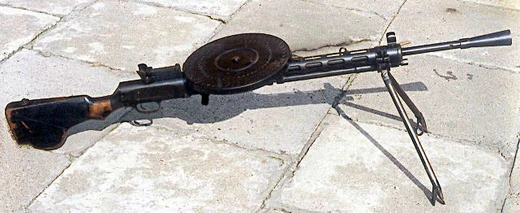
Type 96 light machine gun
Japanese light machine gun, 1936, 6.5mm, top-mounted magazine.

The Type 96 light machine gun served the Imperial Japanese Army from the interwar period through World War II. Introduced in 1936, it used the 6.5×50mm Arisaka cartridge fed from a 30-round top-mounted magazine. Poor ballistic performance and frequent reliability issues led the army to seek a replacement with the Type 99, but both weapons remained in widespread use until the war ended.
Combat during the 1931 Manchurian Incident and later operations in Manchuria and northern China showed Japanese forces the value of machine guns for covering infantry advances. The earlier Type 11 light machine gun was light and portable, but its open hopper design let in dust and grit, causing jams in muddy or dirty conditions due to poor dimensional tolerances. This gave the Type 11 a bad reputation and prompted a redesign. The Army's Kokura Arsenal examined captured Czechoslovak ZB vz. 26 machine guns from Chinese National Revolutionary Army stocks, borrowed certain elements, and issued the Type 96 in 1936. Production took place at Kokura, Nagoya Arsenal, and Mukden from 1936 to 1943, totaling about 41,000 units. Some sources call the Type 96 a slightly modified copy of the ZB vz. 26, while U.S. military manuals note it combined features of both the Hotchkiss machine gun and the ZB vz. 26. Kijiro Nambu designed its unique bolt lock system.
The Type 96 was largely a reworking of the Type 11, blending Hotchkiss and ZB vz. 26 features. It kept the same 6.5×50mm Arisaka cartridge as the Type 38 rifle, but the later adoption of the 7.7×58mm round for the Type 99 rifle spurred demand for a new light machine gun using that ammunition—the Type 99. Because the Type 96 resembles the British Bren light machine gun, it is often mistaken for a copy. Major changes from the Type 11 included a top-mounted curved detachable box magazine instead of the problematic hopper, removal of the receiver-mounted oiler (though cartridges still needed lubrication before loading), and a quick-change barrel to prevent overheating. The Nambu-designed bolt lock used a square frame that moved up and down to lock and unlock the barrel. The gun had a blade front sight and a leaf rear sight graduated from 200 to 1,500 meters with windage adjustment. A 2.5X telescopic sight with a 10-degree field of view could be mounted on the right side.
Quick Facts
- Origin
- Empire of Japan
- Is Ranged
- yes
- Service
- 1936–1945
- Wars
- Second Sino-Japanese War / Soviet–Japanese border conflicts / World War II / Indonesian National Revolution / Chinese Civil War / Korean War / First Indochina War / Vietnam War
- Designer
- Kijiro Nambu
- Design Date
- 1936
- Unit Cost
- 1,125 yen ($263 USD) in December 1941
- Production Date
- 1936–1943
- Number
- 41,000
- Weight
- 9 kg
- Length
- 1,070 mm
- Part Length
- 550 mm
Facts from the source article.
Lore & Background
Combat experience in the Manchurian Incident of 1931 and subsequent actions in Manchuria and northern China reaffirmed to the Japanese army the utility of machine guns in providing covering fire for advancing infantry. The earlier Type 11 light machine gun was lightweight and transportable, but its open hopper design allowed dust and grit to enter, causing jams in muddy or dirty conditions due to poor dimensional tolerances. This gave the weapon a bad reputation and led to calls for its redesign. The Army's Kokura Arsenal tested the Czechoslovak ZB vz. 26 machine gun, samples of which had been captured from the National Revolutionary Army of the Republic of China, and after borrowing certain elements issued a new design, designated the Type 96 light machine gun, in 1936.
The Type 96 was almost a complete reworking of the Type 11, combining features of the Hotchkiss machine gun with some of the ZB vz. 26. Major differences from the Type 11 included a top-mounted curved detachable box magazine replacing the problematic ammunition hopper, removal of the receiver-mounted oiler (though cartridges still needed lubrication before loading), and a quick-change barrel to avoid overheating. The Type 96 featured a unique Nambu-designed bolt lock in the form of a square frame that moves up and down to lock and unlock the barrel. It had a blade front sight and a leaf rear sight with graduations from 200 to 1,500 meters, and a 2.5X telescopic sight could be attached on the right side. A folding bipod was attached to the gas block, and the standard Type 30 bayonet could be fitted to the gas block below the barrel, making it one of the only machine guns used in World War II that could mount a bayonet, despite the weapon's weight of 9 kg making it awkward in hand-to-hand combat. The gun had no select-fire capability.
The Type 96 was somewhat more reliable than the Type 11, but still required lubricated ammunition to avoid jams; in practice, oiled cartridges tended to become coated with dust and sand, worsening the problem. Like the Type 11, it did not handle standard 6.5×50mm Arisaka rounds without malfunctions, requiring special ammunition marked with a circled 'G' on the cartons. Parts were usually non-interchangeable, each gun being hand-fitted, and manufacturers introduced minor changes without regard for standardization.
Reader's Guide
The Type 96 came into active service in 1936 and was intended to replace the older Type 11, but the Type 11 had already been produced in large quantities, and both weapons remained in service until the end of the war. The Type 96 handled well and could be easily fired from the hip, but it was sensitive to dirt, dust, and sand, requiring it to be always kept clean and oiled. While the gun's light weight and mobility proved useful in jungle warfare, the 6.5 mm caliber was not entirely suitable for combat situations. It was supplanted by the more reliable Type 99 light machine gun, which fired a larger 7.7 mm round and had greater stopping power. According to US military manuals, reports of Japanese soldiers making use of Thompson submachine guns may have originated from the fact that the Type 96 could be hip fired. After World War II, it was used by Indonesian forces during the Indonesian National Revolution against Dutch forces, notably during the attack on Jogjakarta in 1949, and by the Viet Minh and North Vietnamese forces during the First and Second Indochina Wars.
Did You Know?
- It required special ammunition marked with a circled 'G' to function properly.
- Parts were usually non-interchangeable because each gun was hand-fitted.
- The Type 96 could be hip fired, which may have led to reports of Japanese soldiers using Thompson submachine guns.
More in Machine Guns, Part 2 1-24
Spotted an error? Know more?
Reader corrections go straight into our review queue. Suggest an edit · How this site is sourced