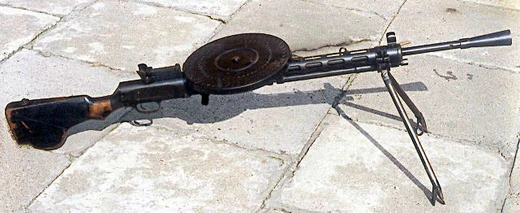
Type 73 light machine gun
North Korean light machine gun with dual feed and rifle grenade capability.

The Type 73 light machine gun was built by North Korea's First Machine Industry Bureau. It serves mainly in the Korean People's Army and, through Iranian channels, has reached various groups across the Middle East. When fitted with its top-mounted box magazine, it looks somewhat like the Bren light machine gun.
Its design draws heavily from a Soviet machine gun of the 1960s, likely the PKM, though when North Korea first produced it is not known. The weapon was spotted in the Korean Demilitarized Zone in 2002, when a UN team reported that North Korean soldiers had placed many Type 73s 100 to 400 meters north of the demarcation line, removing them each day. Because the North Korean government keeps such information secret, details are scarce. South Korea has acquired one example.
North Korean authorities seemed unhappy with the Type 73, and by 1982 they had created the Type 82, a more direct copy of the PKM. The Type 82 appears to have replaced the Type 73 in front-line units, as the older gun was seen less often after the early 1980s, though it may have moved to reserve or militia use. Many Type 73s were sent to Iran during the Iran–Iraq War, and some later went to Iranian-backed groups fighting ISIL.
Since mid-2015, belt-fed Type 73s—either North Korean or Iranian-made—have been used by Iranian-supported militias such as the Popular Mobilization Forces, as well as other factions like the Christian Babylon Brigades, which obtained them through their anti-ISIS alliance. The Sarya Ashoura also used them. By early 2016, they were in service with Syria and with Houthi rebels in Yemen. In 2017, the French Navy seized a shipment of Type 73s bound for Somalia. In November 2024, Ukrainian media reported Russian troops using the Type 73, and the following month an unknown Russian soldier complained about its weight and iron sights.
The gun is based on the Soviet PKM but includes indigenous changes: removable muzzle sleeves and a dual feed system copied from the Czechoslovak Vz.52, letting it fire from either box magazines or PKM-style belts. A special barrel attachment allows it to launch rifle grenades. It was likely intended as a squad automatic weapon, but it uses the 7.62×54mmR cartridge rather than the 7.62×39mm round of North Korea’s standard Type 58 rifle. This is unusual, as many armies now prefer squad weapons that share ammunition with their rifles.
Quick Facts
- Origin
- North Korea
- Is Ranged
- YES
- Wars
- Iran–Iraq War / Lebanese Civil War / Syrian Civil War / Iraqi Civil War (2014–2017) / Yemeni Civil War (2015–present) / Russo-Ukrainian War
- Design Date
- 1973
- Weight
- 10.6 kg
- Length
- 1190 mm
- Part Length
- 608 mm
- Cartridge
- 7.62×54mmR
- Caliber
- 7.62 mm
- Action
- Gas
- Rate
- 600–700 rpm
- Feed
- Box magazine- or belt-feed
Facts from the source article.
Lore & Background
The Type 73 is based on a 1960s-era Soviet design, most likely the PK machine gun (PKM), although the date of its first production in North Korea is currently unknown. The weapon was reportedly seen in the Korean Demilitarized Zone in 2002, when a United Nations Command Military Armistice Commission team told media outlets that North Korean soldiers had set up numerous Type 73s in positions 100 to 400 meters north of the demarcation line. The weapons were reportedly removed at the end of each day. Due to the North Korean government's policy of secrecy, information on the weapon is hard to obtain. One example has been acquired by South Korea.
North Korean officials were apparently not satisfied with the weapon, and by 1982 they had developed the Type 82 machine gun, which was more directly copied from the PKM's design. This seemed to replace the Type 73 in front-line service, as it was seen in use less since the early-1980s, though it was possibly moved to reserve or militia service. Many were supplied to Iran during the Iran–Iraq War, and some of these have in turn been supplied to Iranian-backed groups engaged in fighting the Islamic State of Iraq and the Levant (ISIL). Since mid-2015, North Korean or Iranian-built copies of belt-fed Type 73s have been seen in use by Iranian-supported militias like the Popular Mobilization Forces, as well as other factions including the Christian Babylon Brigades that acquired the weapons through their alliance against ISIS. Some were also used by the Sarya Ashoura. By early 2016, they were being used by Syria and by Houthi rebels in Yemen.
The design is heavily based on the 1960s-era Soviet PK machine gun. However, the Type 73 does have certain indigenous modifications, including removable muzzle sleeves and a dual magazine/belt feed system, patterned after the Czechoslovak Vz.52 LMG, allowing the user to fire the weapon from indigenous box magazines or ammunition belts that can be used with the PKM. One unusual feature is a special barrel attachment to enable the gun to fire rifle grenades. The weapon's intended combat role is thought to be as a squad automatic weapon. However, it uses a 7.62×54mmR cartridge, not the 7.62×39mm round used by the Type 58 assault rifle, North Korea's standard infantry rifle. This is becoming more unusual as many armies have migrated to squad automatic weapons that use the same ammunition as rifles, so all members of a unit may share ammunition and only one type needs to be supplied. A larger cartridge is a characteristic of a general-purpose machine gun, although such weapons typically are belt fed and do not use a box magazine.
Reader's Guide
The Type 73 represents a notable example of North Korean small arms development, blending Soviet PK machine gun lineage with indigenous modifications and a Czechoslovak-inspired dual feed system. Its ability to fire both box magazines and PKM-compatible belts, along with a rifle grenade attachment, made it a versatile but ultimately unsatisfactory weapon for the Korean People's Army, leading to its replacement by the more direct PKM copy, the Type 82, by 1982. Despite being largely phased out of front-line service, the Type 73 gained a second life through Iranian channels, appearing in conflicts across the Middle East from the Iran–Iraq War through the fight against ISIL, and later in Syria and Yemen. Its use by Iranian-backed militias, the Popular Mobilization Forces, and even Christian factions like the Babylon Brigades illustrates how North Korean arms have proliferated through non-state actors. The weapon's continued appearance in new conflicts—such as its reported supply to Russian forces in 2024—underscores its enduring, if niche, role in modern warfare. Criticisms from a Russian serviceman in December 2024 regarding its weight and iron sights highlight the limitations of a design that, while innovative for its time, has not aged gracefully. The Type 73's legacy is thus one of a transitional weapon, bridging Soviet and Czechoslovak concepts, that found its true impact not in its original intended role but as a tool of proxy warfare.
Did You Know?
- The Type 73 has a special barrel attachment to fire rifle grenades.
- Chrome variants of the Type 73 are awarded to North Korean soldiers who excel.
- In 2017, some Type 73s being covertly shipped to Somalia were seized by the French Navy.
More in Machine Guns, Part 2 1-24
Spotted an error? Know more?
Reader corrections go straight into our review queue. Suggest an edit · How this site is sourced