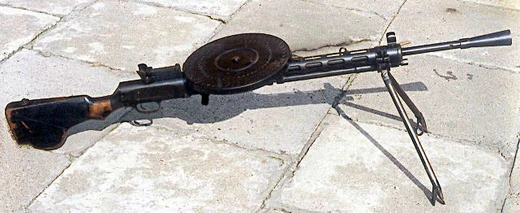
Type 11 light machine gun
First light machine gun mass-produced in Japan, used from 1922 to 1945.
The Type 11 light machine gun served as the Imperial Japanese Army’s first light machine gun, seeing action from the interwar period through World War II. Designed by Kijirō Nambu, it shared features with the Hotchkiss machine gun family. Its most distinctive trait was an unusual feed system: five-round rifle clips were dropped into a hopper that held up to six clips (30 rounds total), and each round was oiled as it entered the chamber. While the gun performed well overall, the open hopper collected dirt and grit, causing frequent jams. Adopted in 1922, it remained a standard squad weapon until 1945.
Quick Facts
- Origin
- Empire of Japan
- Is Ranged
- yes
- Service
- 1922–1945
- Designer
- Kijiro Nambu
- Design Date
- 1922
- Production Date
- 1922–1941
- Number
- 29,000
- Weight
- 10.2 kg
- Length
- 1100 mm
- Part Length
- 443 mm
- Cartridge
- 6.5×50mm Arisaka
- Action
- Gas-operated
Facts from the source article.
Lore & Background
Combat experience in the Russo-Japanese War of 1904–1905 convinced the Japanese of the utility of machine guns in providing covering fire for advancing infantry. This was reinforced by first-hand observations of European combat tactics by Japanese military attachés during the First World War, and the Army Technical Bureau was tasked with developing a lightweight machine gun easily transported by an infantry squad. The resultant Type 11 (named after the 11th year of the reign of Emperor Taishō, or 1922) was the first light machine gun mass-produced in Japan and the oldest Japanese light machine gun design to see service in the Pacific War. It was superseded by the Type 96 light machine gun in 1936.
The Type 11 was an air-cooled, gas-operated design using the same 6.5×50mm Arisaka cartridges as the Type 38 infantry rifle. Its detachable hopper could be refilled while attached and held up to six of the same five-round clips used on the Type 38 rifle. The clips were stacked flat above the receiver, secured by a spring arm, and rounds were stripped from the lowest clip one at a time, with the empty clip dropping out the bottom and the next clip automatically falling into place. The system allowed any squad member to supply ammunition and the hopper could be replenished at any time. The relatively short barrel (17.5 inches) produced excessive flash with standard ammunition, so a new load called the 6.5×50mm Arisaka genso round was introduced, identified by a circled "G" on the carton.
The inherent disadvantage of the hopper was that the open feeder box allowed dust and grit to enter, causing jams in muddy or dirty conditions due to poor dimensional tolerances, giving the weapon a bad reputation with Japanese troops. The weight of the rifle cartridges in the side-mounted hopper unbalanced the weapon when fully loaded; to compensate, the buttstock was designed to bend to the right, leading to the Chinese nickname "bent buttstock." Reloading during an assault charge proved impossible due to the clip feeding system.
Reader's Guide
The Type 11 light machine gun served as the primary Japanese light machine gun through the Manchurian Incident and the early stages of the Second Sino-Japanese War. Although superseded in production by the Type 96 in 1936, it remained in front-line service through the end of World War II. Some 29,000 were produced by 1941. Many were captured by the Chinese and used against the Japanese. The Manchukuo Imperial Army replaced its ex-Chinese ZB vz. 30s with Type 11s in 1936. Both sides used Type 11 machine guns during the Chinese Civil War, and North Korea used Type 11 and Type 91 during the Korean War. Indonesian nationalist forces used the Type 11 during the Indonesian National Revolution, and the Viet Minh used it during the First Indochina War, as did the Viet Cong during the Vietnam War. Variants included the Type 89 "flexible" (two Type 11 actions on a flexible mounting for anti-aircraft and rear-defense aerial use, chambered in 7.7x58mmSR Type 89, fed from two 45-round pan magazines, weighing about 28 kg with a rate of fire around 1,400 rpm), the Type 91 for tanks and armored vehicles (with an angled pistol grip, extended hopper holding 45 rounds, and brackets for a scope), the Te-4 (a modified Type 11 designed to replace the Type 89, using a different flexible mounting, chambered in 7.7x58mmSR Type 89, fed from 70-round pan magazines), and the Liao Type 17 (a Chinese copy manufactured at the Mukden Arsenal, about 400 produced between 1928 and 1931).
Did You Know?
- The Type 11 was named after the 11th year of the reign of Emperor Taishō, corresponding to 1922.
- Its hopper feed system held up to six five-round clips (30 rounds) and oiled each round as it fed into the chamber.
- The Chinese nickname for the Type 11 was 'bent buttstock' due to the rightward bend of the stock to balance the side-mounted hopper.
- A variant, the Type 89 'flexible', mounted two Type 11 actions together for anti-aircraft use and had a rate of fire around 1,400 rpm.
More in Machine Guns, Part 2 1-24
Spotted an error? Know more?
Reader corrections go straight into our review queue. Suggest an edit · How this site is sourced