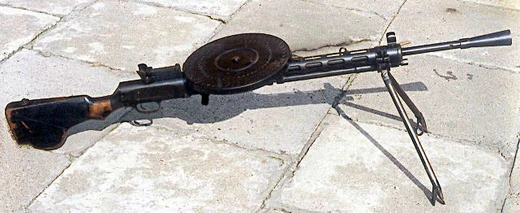
Mendoza RM2
A simplified light machine gun developed from the Model 1934.
The Mendoza RM2 is a light machine gun introduced in 1947 by Productos Mendoza, S.A. of Mexico. It was developed from the earlier Model 1934 Mendoza machine gun, which had been adopted by the Mexican Army, and was chambered for the .30-’06 Springfield cartridge. The RM2 was notable for its simplified design, which eliminated the quick-change barrel, cooling fins, and flash hider of its predecessor.
Quick Facts
- Is Ranged
- yes
- Origin
- Mexico
- Design Date
- 1928-1933
- Designer
- Rafael Mendoza
- Used By
- Mexico / United States
- Wars
- World War II
- Part Length
- 610 mm
- Cartridge
- 7×57mm Mauser / .30-06 Springfield (7.62×63mm)
- Feed
- 20- or 32-round detachable box magazine
- Action
- Gas-operated, open bolt
- Rate
- 450-650 round/min
- Velocity
- 805 m/s (2,640 ft/s)
Facts from the source article.
Lore & Background
The RM2 was the result of design work Rafael Mendoza had done during World War II to convert his Model 1934 machine gun from 7×57mm Mauser to .30-’06 Sprg. caliber for a U.S. contract that was ultimately canceled. After the war, Mendoza used that work to introduce the RM2 in 1947. The new model emphasized ease of production and differed from the Model 1934 by lacking a quick-change barrel, cooling fins, and flash hider. It used a top center magazine, which required offset sights, and a muzzle brake to control recoil.
Introduction of the RM2 coincided with the Mexican Army’s adoption of the .30-’06 Sprg. cartridge and new military arms to fire it. Productos Mendoza made approximately 50 prototype RM2 machine guns, which were subsequently tested by the Mexican Marine Corps. However, the RM2 was not adopted by the Mexican military. Because the Mexican constitution expressly forbids the export of 'instruments of war,' Mendoza was handicapped by having his designs restricted to one potential customer: Mexico.
Reader's Guide
The Mendoza RM2 represents a transitional design in the career of Rafael Mendoza, bridging his earlier military machine gun work with post-war production realities. Its development stemmed from a canceled U.S. World War II contract, which had prompted Mendoza to adapt his Model 1934 to the .30-’06 cartridge. The RM2’s simplified construction—lacking the quick-change barrel, cooling fins, and flash hider of the earlier gun—reflected an effort to reduce manufacturing costs and complexity. However, the RM2 was not adopted by the Mexican Marine Corps after testing, and only about 50 prototypes were made. The Mexican constitutional ban on exporting weapons limited Mendoza’s potential market to Mexico alone, which contributed to the RM2’s lack of production beyond the prototype stage. The RM2 was the last light machine gun design Rafael Mendoza worked on before turning to other projects, including a submachine gun and an assault rifle. Its legacy is that of a capable but unadopted design that illustrates the challenges faced by Mexican arms manufacturers in the mid-20th century.
Did You Know?
- The RM2 was developed from design work done to convert the Model 1934 from 7×57mm Mauser to .30-’06 Sprg. for a canceled U.S. World War II contract.
- Approximately 50 prototype RM2 machine guns were made and tested by the Mexican Marine Corps, but not adopted.
- The Mexican constitution forbids the export of 'instruments of war,' restricting Mendoza's designs to Mexico.
Revolutionary Origins: From Villa's Bodyguard to First Designs
Rafael Mendoza did not begin as a gunsmith in a workshop; he began as an infantryman in the chaos of 1910 Mexico. Fighting alongside the Anti-Reelectionists against Diaz's forces, he served under Pancho Villa in three engagements before earning a place in Villa's elite bodyguard unit, the Dorados de Villa. It was in this milieu of leather bandoliers and captured Federal ordnance that his first firearm design took shape: a hand-cranked, air-cooled, two-barrel belt-fed weapon in 7×57mm Mauser, demonstrated on October 15, 1911. Though never produced, the prototype survived in storage before being sold to an unknown buyer and lost. Villa subsequently tasked him with a portable cannon firing 35mm and 37mm rounds captured from Federal troops. Mendoza delivered a bolt-action, single-shot piece on a simple metal sled, operable by two men or a horse rider. By August 6, 1915, roughly 75 of these cannons were in revolutionary service. These early wartime projects, all aimed at equipping the Mexican Army, planted the seeds for a career that would span decades.
From Arsenal Machinist to Adopted Designer
After the revolution settled, a 40-year-old Mendoza moved to Mexico City in 1922 and took a machinist position at the National Arsenal, where wages were low and facilities modest. His ingenuity still shone through: in 1926 he perfected a cup-launched rifle grenade that saw military adoption. In 1928, superiors tasked him with developing an improved machine gun for the Army. His first prototype emerged in 1929, followed by further iterations and trials at Rancho del Charro in 1931. The design was formally adopted in 1934 after a personal demonstration to President Cárdenas, and the Arsenal received an order for 10,000 units in 7×57mm Mauser. The Mexican government even secured a U.S. patent in Mendoza's name for several of the gun's features. The Model 1934 served the Army reliably until the late 1950s. In 1938, Mendoza left government employment to found Productos Mendoza, S.A. de C.V. in Mexico City, a company that sustained itself by producing metal stampings, buttons, and 30-round magazines for the very machine gun he had designed.
The RM2: A Weapon Simplified for a New Era
When the United States entered World War II in 1941, its military faced acute shortages of machine guns and BARs. In 1943, Rafael and his son Héctor traveled to the U.S. to sign a contract with Maury Maverick, head of the Bureau of Government Requirements, for 5,000 Mendoza light machine guns in .30-06 Springfield and 3,000 in .50 BMG. Héctor studied drafting at the University of Detroit while Rafael scouted manufacturing arrangements across the country. The war ended in September 1945, and the U.S. government canceled nearly all pending arms contracts before a single gun was delivered. Undeterred, Rafael repurposed the conversion work from 7×57mm to .30-06 Springfield and introduced the RM2 in 1947. The new model prioritized manufacturing simplicity: it dropped the quick-change barrel, the 39 radial cooling fins, and the flash hider of its predecessor. The top-mounted magazine moved to center, necessitating offset sights and a muzzle brake for recoil control. About 50 prototypes were built and tested by the Mexican Marine Corps, but the weapon was never adopted.
Constitutional Walls and Unfinished Ambitions
The RM2's failure to enter service was less a matter of mechanical inadequacy than of structural constraint. Mexico's constitution explicitly prohibits the export of "instruments of war," meaning Productos Mendoza could sell its designs to exactly one customer: the Mexican government. This single-market limitation crippled a company that had already demonstrated the engineering capability to produce for foreign militaries. The cancellation of the U.S. wartime contracts removed the only realistic path to broader production. Meanwhile, in the late 1940s Mendoza had begun developing a submachine gun in 9mm Luger, .38 Super Auto, and .45 ACP calibers; prototypes were built and the design patented, yet it never reached full production. The company itself survived on peripheral work—metal stampings, buttons, and magazine production—rather than the firearms it was best known for. Rafael Mendoza's career arc, from Villa's bodyguard to arsenal machinist to independent manufacturer, ended not with a bang but with a quiet narrowing of opportunity, his most ambitious designs remaining curiosities in a single nation's arsenals.
More in Machine Guns, Part 2 1-24
Spotted an error? Know more?
Reader corrections go straight into our review queue. Suggest an edit · How this site is sourced