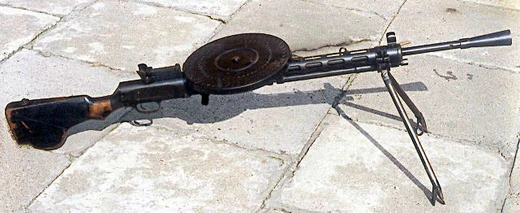
TADEN gun
British experimental belt-fed machine gun for the .280 intermediate cartridge.
The TADEN was a British experimental light and medium machine gun developed as part of a proposal to reequip the British Army with new small arms. It fired the .280 in (7 mm) intermediate cartridge and was designed alongside the bullpup EM-2 rifle. The name derives from the designer Harold Turpin ('T') at the Armament Design Establishment ('AD') and Enfield ('EN').
Quick Facts
- Origin
- United Kingdom
- Is Ranged
- YES
- Service
- 1951
- Manufacturer
- Enfield RSAF
- Weight
- 11.03 kg
- Length
- 889 mm
- Part Length
- 623 mm
- Cartridge
- .280 British
- Caliber
- .276 (7 mm)
- Action
- gas operation
- Rate
- 450 to 600 round/min
- Feed
- Non-Disintegrating Metal-Link Belt
Facts from the source article.
Lore & Background
The TADEN was developed as part of a British Army reequipment plan that also included the EM-2 rifle. The light machine gun variant was intended to replace the Bren gun, while the heavier tripod-mounted version was meant to replace the Vickers medium machine gun, referred to at the time as a Sustained Fire Machine Gun. The overall plan envisioned the EM-2 replacing both the Lee–Enfield rifle and 9 mm submachine guns.
The TADEN used the action and gas system of the Bren gun but fed from 250-round non-disintegrating metal-link belts instead of box magazines. Two basic versions were produced: a light machine gun with a bipod and a buttstock and trigger group similar to the Bren, and a medium machine gun with spade grips and a butterfly trigger like the Vickers.
The project was discontinued when the United States Army refused to consider the .280 cartridge for the new NATO standard, citing that it was less powerful than their .30-06 Springfield round. Others have suggested reluctance to adopt a round developed outside the USA also played a role. It was decided that the TADEN and EM-2 could not realistically be reworked to take the new NATO round, and alternatives were sought.
Reader's Guide
The TADEN's significance lies in its role as a British attempt to modernize infantry small arms with an intermediate cartridge and a belt-fed machine gun that could serve both light and medium roles. It was part of a comprehensive reequipment plan that included the bullpup EM-2 rifle, aiming to replace the Lee–Enfield rifle, Bren gun, Vickers machine gun, and 9 mm submachine guns with a unified family of weapons using the .280 round. The project's cancellation due to NATO standardization politics—specifically US rejection of the .280 cartridge—marked a turning point. The British Army subsequently adopted licence-built variants of the Belgian 7.62 mm FN MAG (as a general-purpose machine gun) and FN FAL (as a rifle). A belt-fed derivative of the Bren gun, known as the X11, had been considered for the GPMG role but was not selected; however, the Bren itself was retained after adaptation to use the NATO round. The TADEN thus represents a path not taken, illustrating the impact of alliance politics on weapons development.
Did You Know?
- The TADEN name combines the initials of designer Harold Turpin ('T'), the Armament Design Establishment ('AD'), and Enfield ('EN').
- Two versions were developed: a light machine gun with a bipod and a medium machine gun with a tripod, spade grips, and butterfly trigger.
- The project was discontinued after the US refused to adopt the .280 cartridge for NATO, citing it was less powerful than the .30-06 Springfield.
More in Machine Guns, Part 2 1-24
Spotted an error? Know more?
Reader corrections go straight into our review queue. Suggest an edit · How this site is sourced