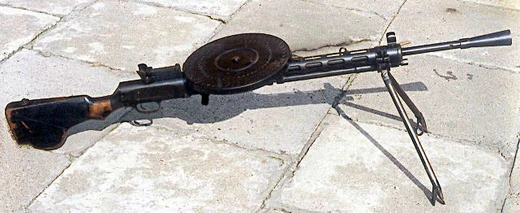
SIG KE7
Swiss-designed light machine gun exported widely but never Swiss Army issue.
The SIG KE7 is a light machine gun developed at the Swiss firm SIG in Neuhausen am Rheinfall during the 1920s. Designed by Pál Király and Gotthard End, production began in 1929. Though exported, the Swiss Army never adopted it. The weapon is recoil-operated and air-cooled, with a tilting bolt. It feeds from a curved 25-round box magazine mounted below the receiver. A folding bipod attaches to the perforated barrel jacket, and an optional rear monopod could be fitted. A distinctive feature is the bolt carrier’s unusually long travel—about 6 cm (2.4 inches)—before it begins extracting the spent case, allowing barrel pressure to drop for easier extraction. Most exports went to the Republic of China, chambered in 7.92×57mm Mauser. Between 1928 and 1939, the Chinese government bought 3,025 from Switzerland, and the Guangdong provincial government purchased 200 with 4,000 magazines in December 1928. In 1933, Liu Xiang funded Huaxing Machine Works to set up a workshop in Chongqing, which produced 6,000 copies from 1933 to 1936. Three months after the war with Japan began, the workshop was requisitioned by the Chinese government and switched to producing ZB-26 copies after 1939. The KE7 saw use in the Chinese Civil War, the Second Sino-Japanese War, and the Korean War. Some were made in other calibers for Latin America and Ethiopia. In 1930, examples were submitted for British Army trials to replace the Lewis gun, but a modified ZB vz. 26 was ultimately adopted as the Bren gun. Users included China (at least 3,225 original and 6,000 domestic copies), Ethiopia (in 7.92×57mm Mauser), Cuba (used by guerrillas during the Cuban Revolution), and various Latin American countries (in 7×57mm Mauser or 7.65×53mm Mauser). North Korea captured examples from Chinese forces during the Civil War.
Quick Facts
- Origin
- Switzerland
- Is Ranged
- yes
- Service
- 1929
- Wars
- Chinese Civil War / Second Italo-Ethiopian War / Spanish Civil War / Second Sino-Japanese War / Korean War / Cuban Revolution
- Manufacturer
- SIG
- Production Date
- 1929-1938
- Weight
- 8.2 kg
- Length
- 1,190 mm
- Part Length
- 600 mm
- Crew
- 2, firer and magazine/barrel changer
- Cartridge
- 7×57mm Mauser / 7.65×53mm Mauser / 7.92×57mm Mauser
- Action
- Recoil-operated
Facts from the source article.
Lore & Background
The KE7 light machine gun was designed by Pál Király and Gotthard End at the SIG small arms factory in Neuhausen am Rheinfall. Production commenced in 1929, with most weapons being exported to the Republic of China chambered for 7.92×57mm Mauser ammunition. The Chinese government purchased 3,025 from Switzerland between 1928 and 1939, and the provincial government of Guangdong purchased 200 KE7s with 4,000 magazines in December 1928. In 1933, Liu Xiang funded Huaxing Machine Works' acquisition of machinery for a workshop in Chongqing. From 1933 to 1936, it would produce 6,000 KE7 copies. Three months after the war with Japan began, the workshop would be requisitioned by the Chinese government and produce ZB-26 copies after 1939.
The KE7 is a recoil operated, air cooled light machine gun with tilting bolt. It is fed from a curved box magazine mounted on the underside of the weapon, which holds 25 rounds. A light folding bipod is attached to the perforated barrel jacket, and an additional rear monopod can be fitted. A notable feature of the gun is a very long travel of the bolt carrier (about 6 cm, 2.4 in) before it starts pulling the bolt back and extracting the fired case. It gives longer time for the pressure in barrel to drop for easier extraction.
The KE7 would be used during the Chinese Civil War, the Second Sino-Japanese War and the Korean War. Some KE-7 machine guns were also made in other calibres for export to Latin America and Ethiopia. In 1930, examples were provided for trials being run by the British Army to find a replacement for the Lewis gun, although a modified ZB vz. 26 was finally adopted as the Bren gun.
Reader's Guide
The SIG KE7's significance lies in its widespread use in China, where it saw action in multiple conflicts including the Chinese Civil War, the Second Sino-Japanese War, and the Korean War. Despite being designed and manufactured in Switzerland, it was never adopted by the Swiss Army, instead finding its primary market abroad. The Chinese government purchased 3,025 from Switzerland between 1928 and 1939, and an additional 200 were bought by the provincial government of Guangdong in 1928. Domestic production in China, initiated by Liu Xiang's funding of Huaxing Machine Works, yielded 6,000 copies from 1933 to 1936. After the war with Japan began, the workshop was requisitioned and later produced ZB-26 copies after 1939. The KE7 also saw use in Latin America and Ethiopia, and was evaluated by the British Army in 1930 as a potential replacement for the Lewis gun, though the Bren gun was ultimately selected. Its legacy is tied to its role in Chinese arsenals and conflicts, as well as its distinctive long bolt carrier travel designed to ease extraction.
Did You Know?
- The KE7 was designed by Pál Király and Gotthard End at the SIG factory in Neuhausen am Rheinfall.
- The bolt carrier travels about 6 cm (2.4 in) before extraction begins, allowing barrel pressure to drop.
- China produced 6,000 domestic copies of the KE7 between 1933 and 1936.
- The KE7 was evaluated by the British Army in 1930 but the Bren gun was adopted instead.
More in Machine Guns, Part 2 1-24
Spotted an error? Know more?
Reader corrections go straight into our review queue. Suggest an edit · How this site is sourced