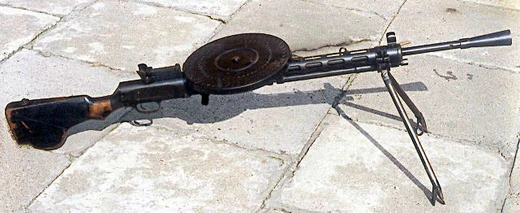
SAFAT M1926 machine gun
Italian light machine gun of the 1920s, competitor to the Breda Mod.30.
The SAFAT M1926, also called the Fiat Mod.1926 or Fiat-SAFAT mod.1926, is a light machine gun from the Kingdom of Italy, designed in the 1920s. It came from FIAT’s dedicated firearms branch, the Società Anonima Fabbrica Armi Torino (SAFAT), which was set up in 1924. FIAT itself had been a major supplier of machine guns during World War I, mostly based on Revelli designs.
In the early 1920s, the Regio Esercito wanted a new light machine gun to replace the S.I.A. mod.18. The Fiat Mod.1926 was developed after the Fiat Mod.1924 and was one of several guns tested. It was adopted in small numbers for troop trials, alongside the competing Breda 5C. The army was not fully satisfied, so it was later replaced in the competition by the Fiat Mod.1928, which went up against the Breda 5GF. The Breda Mod.30 eventually won the light machine gun contest.
Some Fiat Mod.1926 guns also saw use with the Regia Marina. They were mounted on their original tripod for landing parties on larger ships, and on an anti-aircraft tripod for smaller or older vessels. Over time, the Breda Mod.30 replaced them in these roles. During the Spanish Civil War, Italy supplied a small number of these guns to the Nationalists.
The weapon was also fitted to a few armored vehicle prototypes from the early 1930s, such as the motoblindata Guzzi, the carro armato da 9T, and a fast tank with a turret from 1935. After the Italian Armistice, German forces captured some and designated them the 6.5 mm Leichtes Maschinengewehr 097(i).
The Fiat Mod.1926 operates with a short recoil system and fires from an open bolt. It is air-cooled with a quick-change, fluted barrel that must be swapped after 300 rounds of full-auto fire. Its feeding system is similar to the Breda Mod.30: a fixed magazine on the left side (the Breda’s is on the right), loaded using 20-round brass stripper clips. A unique feature is that the stripper clip must be inserted through the ejection port after the bolt is pulled back. Like the Breda Mod.30, it has an oil pump on top of the receiver to lubricate each cartridge before chambering.
The charging handle sits below the receiver. At the rear are spade grips and a folding metal shoulder stock hinged on the left. The sight is graduated from 1 to 15 hectometers (100 to 1500 meters).
Quick Facts
- Origin
- Kingdom of Italy
- Is Ranged
- yes
- Manufacturer
- SAFAT
- Cartridge
- 6.5×52mm (6.5mm Carcano)
- Rate
- 400 rounds/min
Facts from the source article.
Lore & Background
After World War I, FIAT created a dedicated firearms subsidiary in 1924, the Società Anonima Fabbrica Armi Torino, known as SAFAT. The Regio Esercito had been seeking a new light machine gun since the early 1920s to replace the S.I.A. mod.18. The Fiat Mod.1926 was developed after the Fiat Mod.1924 and was one of several guns proposed for selection. It was adopted in relatively small numbers for practical evaluation alongside the competing Breda 5C light machine gun. Not having fully satisfied expectations, it was replaced in the competition by the Fiat Mod.1928, which competed against the Breda 5GF. The light machine gun competition was ultimately won by the Breda Mod.30.
The gun was also used by the Regia Marina, installed on its original tripod for landing parties of major units and on an anti-aircraft tripod on some minor and older vessels. These roles were progressively taken over by the Breda Mod.30. During the Spanish Civil War, a small number of Fiat Mod.1926 were supplied by Italy to the nationalists. The weapon was also mounted on several early 1930s armored vehicle prototypes, including the motoblindata Guzzi, the carro armato da 9T, and a fast tank with turret from 1935. After the Italian Armistice, guns captured by the Germans were designated 6,5 mm Leichtes Maschinengewehr 097(i).
The Fiat Mod.1926 is a short recoil operated, air-cooled gun firing from an open bolt. It features a quick-change fluted barrel that required replacement after 300 rounds of full automatic fire. Its feeding system is similar to that of the Breda Mod.30, with a fixed magazine on the left side (opposite the Breda's right-side placement) loaded using brass 20-round stripper clips. A peculiarity is that the stripper clip must be inserted through the ejection port after retracting the bolt. An oil pump on top of the receiver lubricates each cartridge before chambering. The charging handle is below the receiver. At the rear are spade grips and a metallic folding shoulder stock hinged on the left side. The light tripod has two adjustable, foldable front legs and dedicated shoulder straps for carrying the gun on the gunner's back.
Reader's Guide
The SAFAT M1926 represents a transitional phase in Italian light machine gun development during the interwar period. Produced by FIAT's newly formed firearms subsidiary SAFAT, it was one of several designs evaluated by the Regio Esercito as it sought to replace the S.I.A. mod.18. Although adopted in small numbers for troop trials, it did not fully satisfy military expectations and was superseded in the competition by the Fiat Mod.1928, which itself lost to the Breda Mod.30. The gun's limited adoption by the Regia Marina for landing parties and anti-aircraft roles on older vessels, as well as its use on early armored vehicle prototypes, indicates it served as a stopgap or testbed rather than a standard-issue weapon. Its supply to nationalist forces during the Spanish Civil War and later German capture and redesignation after the Italian Armistice show it saw some operational use beyond Italian borders. The design shares notable features with the Breda Mod.30, including a fixed side-mounted magazine loaded with stripper clips and an oil pump for cartridge lubrication, but differs in magazine placement and loading procedure. Ultimately, the SAFAT M1926's significance lies in its role as a competitor in the light machine gun selection process that culminated in the adoption of the Breda Mod.30, and as an example of Italian small arms development in the 1920s.
Did You Know?
- The Fiat Mod.1926 was also known as the SAFAT Mod.1926 or Fiat-SAFAT mod.1926.
- Its barrel had to be changed after 300 rounds of full automatic fire.
- The magazine was loaded by inserting a brass 20-round stripper clip through the ejection port after retracting the bolt.
- After the Italian Armistice, captured guns were renamed 6,5 mm Leichtes Maschinengewehr 097(i) by the Germans.
More in Machine Guns, Part 2 1-24
Spotted an error? Know more?
Reader corrections go straight into our review queue. Suggest an edit · How this site is sourced