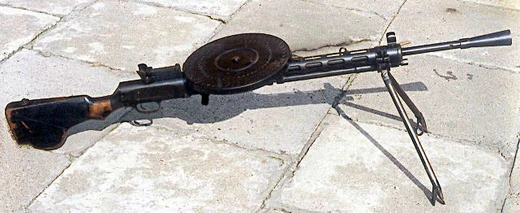
RPK
Soviet squad automatic weapon developed alongside the AKM.
The RPK is a Soviet light machine gun and squad automatic weapon chambered in 7.62×39mm. Mikhail Kalashnikov developed it in the early 1960s alongside the AKM assault rifle. Its purpose was to simplify the Soviet Army’s small arms inventory, and it took over from the 7.62×39mm RPD machine gun. Today, the RPK remains in service with the armed forces of post-Soviet countries, as well as several nations in Africa and Asia. It is also produced in Bulgaria, Hungary, Romania, and Serbia.
The RPK fires the 7.62×39mm intermediate cartridge. It uses the same pistol grip as the AKM and can accept standard AKM detachable box magazines, though it is typically used with a 40-round box magazine or a 75-round drum magazine. Its receiver is stamped from 1.5 mm sheet steel, thicker than the 1 mm sheet metal used on the standard AKM. The weapon has a thick laminated wood foregrip and a fixed laminated wood buttstock shaped like a club foot, similar to the RPD’s stock, designed for comfortable prone firing. Parts interchangeability between the RPK and AKM is moderate.
Mechanically, the RPK operates identically to the AK-47. It uses a modified AKM recoil spring assembly with a rear guide rod from the AK and a new forward flat guide rod and coil spring. Its layout resembles the Kalashnikov rifle series, but with modifications to improve effective range, accuracy, sustained fire capability, and receiver strength.
The barrel is thicker and longer than the AKM’s, allowing longer firing without permanent accuracy loss from heat. It is chrome-lined, permanently fixed to the receiver, and cannot be replaced in the field. The barrel has a new front sight base, and the gas block lacks a bayonet lug and an under-barrel cleaning rod guide. A folding bipod is mounted near the muzzle, and the front sight base includes a lug that limits the bipod’s rotation around the barrel axis. The muzzle is threaded for devices like flash hiders, compensators, and blank-firing adapters; when not in use, a thread protector covers the threads. The barrel is pinned to the receiver in a reinforced trunnion that is slightly wider than the standard AKM trunnion, with symmetrical bulges on both sides to ensure a proper fit.
The iron sights have an elevation-adjustable leaf graduated from 100 to 1,000 meters in 100-meter increments.
Quick Facts
- Service
- 1961–present
- Designer
- Mikhail Kalashnikov
- Length
- 1040 mm (stock extended)
- Action
- Gas-operated, rotating bolt; closed bolt
- Origin
- Soviet Union
- Is Ranged
- Yes
- Design Date
- 1959-61
- Manufacturer
- Vyatskiye Polyany Machine-Building Plant
- Production Date
- 1961–1978
- Weight
- 4.8 kg
- Part Length
- 590 mm
Facts from the source article.
Lore & Background
The RPK was developed in parallel with the AKM assault rifle to standardize the Soviet Army's small arms, replacing the RPD. It uses a standard AKM pistol grip and can accept AKM detachable box magazines, but is most commonly used with a 40-round box magazine or a 75-round drum magazine. The U-shaped receiver is stamped from 1.5 mm sheet steel, thicker than the 1 mm sheet used on the AKM, and features a thick laminated wood foregrip and a fixed laminated wood 'club-foot' buttstock similar to the RPD's, designed for comfortable prone firing. Interchangeability of parts between the RPK and AKM is moderate.
The operating mechanism is identical to the AK-47, with a modified AKM recoil spring assembly. The barrel is thicker and longer than the AKM's, chrome-lined, and permanently fixed to the receiver. It includes a folding bipod near the muzzle, a front sight base with a lug limiting bipod rotation, and a threaded muzzle for devices such as flash hiders, compensators, and blank-firing adapters. The iron sights are elevation adjustable from 100 to 1,000 meters, with a windage adjustment knob unique to the RPK series.
Accessories supplied include spare magazines, a cleaning rod, cleaning kit (stored in the buttstock), sling, oil bottle, and magazine pouches. The RPK was adopted by the former Soviet Union and issued mainly to motorized units, later adopted by several military agencies worldwide.
Reader's Guide
The RPK represents a significant step in standardizing Soviet squad-level firepower, merging the reliability of the Kalashnikov action with the sustained-fire capability of a light machine gun. Its design, derived directly from the AKM, allowed for simplified logistics and training within Soviet motorized units. The thicker receiver and heavier barrel improved accuracy and heat dissipation during prolonged firing, while the bipod and club-foot stock facilitated prone engagement. The RPK's influence extended beyond the Soviet Union, with licensed production in Bulgaria, Hungary, Romania, and Serbia, and adoption by numerous African and Asian nations. Its legacy is evident in the subsequent RPK-74 and RPK-16 variants, which continued the concept of a magazine-fed squad automatic weapon based on the Kalashnikov platform. The RPK remains in service decades after its introduction, a testament to its robust design and the enduring utility of the 7.62×39mm cartridge in the squad support role.
Did You Know?
- It uses a 1.5 mm sheet steel receiver, thicker than the AKM's 1 mm sheet.
- The rear sight leaf has a windage adjustment knob unique to the RPK series.
More in Machine Guns, Part 2 1-24
Spotted an error? Know more?
Reader corrections go straight into our review queue. Suggest an edit · How this site is sourced