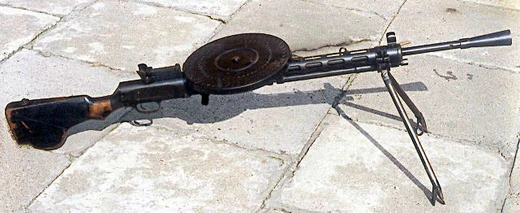
RPD machine gun
Soviet belt-fed light machine gun for the 7.62×39mm cartridge.
The RPD is a Soviet light machine gun that fires the 7.62×39mm M43 intermediate cartridge. It was designed by Vasily Degtyaryov to replace the earlier DP machine gun, which used the larger 7.62×54mmR round. The RPD is considered a forerunner of modern squad automatic weapons. Development began in 1943, with three prominent Soviet engineers—Vasily Degtyaryov, Sergei Simonov, and Alexei Sudayev—each submitting a design. After evaluation, Degtyaryov’s prototype was chosen and adopted by the Soviet armed forces as the 7.62 mm RPD model 1944. Although the RPD was ready for mass production during the final stages of World War II, it was adopted in 1948 and large scale delivery of the machine gun did not begin until 1953. During the Vietnam War, the RPD and its Chinese copy, the Type 56, were the standard light machine guns for the Viet Cong and the People’s Army of Vietnam. After the introduction of the Kalashnikov RPK and PK machine guns in the 1960s, the RPD was phased out of most front-line units in the former Warsaw Pact. However, it remains in active service in many African and Asian countries. The RPD is gas-operated with a long-stroke piston system and fires from an open bolt. Its locking mechanism, borrowed from earlier Degtyaryov designs, uses a pair of hinged flaps that fit into recesses on each side of the receiver. Angled surfaces on the bolt carrier control the flaps’ movement for locking and unlocking. The hammer is part of the rear of the bolt carrier, which continues forward after a round is chambered and the bolt locks, striking the rear of a free-floating firing pin that runs through the bolt. Locking happens when the flaps are forced outward by the hammer’s angled sides into receiver recesses; then the hammer hits the firing pin. This system is simple, rugged, and reliable. The trigger mechanism allows only fully automatic fire. The bolt has a spring-loaded casing extractor, and a fixed insert in the receiver acts as the ejector, passing between the bolt’s feed horns. Spent casings are ejected downward through openings in the bolt carrier and receiver. A manual lever-type safety blocks the bolt catch when engaged. Unlike earlier Degtyaryov designs, the return spring is inside the buttstock. The chamber and bore are chrome-lined to resist corrosion and jamming. The barrel is non-removable and has a three-position gas adjustment valve.
Quick Facts
- Origin
- Soviet Union
- Is Ranged
- Yes
- Service
- 1944–1961 (Soviet Union) / 1944–present (other nations)
- Designer
- Vasily Degtyaryov
- Design Date
- 1943–1944
- Production Date
- 1944–1960
- Weight
- 7.4 kg when empty
- Length
- 1037 mm
- Part Length
- 520 mm
- Cartridge
- 7.62×39mm / 5.56×45mm NATO (Israeli conversion)
- Action
- Gas operated long stroke piston, flapper locking and fires from the open bolt
Facts from the source article.
Lore & Background
Development of the RPD commenced in 1943. Three Soviet engineers—Vasily Degtyaryov, Sergei Simonov, and Alexei Sudayev—submitted designs. Degtyaryov's prototype was accepted as the 7.62 mm RPD model 1944. Although the RPD was ready for mass production during the final stages of World War II, it was adopted in 1948 and large scale delivery of the machine gun did not begin until 1953. During the Vietnam War, the RPD and its Chinese copy, the Type 56, served the Viet Cong and the People's Army of Vietnam as their standard light machine gun.
Reader's Guide
The RPD is significant as one of the earliest successful light machine guns chambered for an intermediate cartridge, bridging the gap between full-power rifle cartridges and later squad automatic weapons. Its adoption by the Soviet Union and widespread use by communist forces during the Vietnam War cemented its role in Cold War conflicts. The RPD's simple, rugged mechanism—recycling Degtyaryov's hinged-flap locking system—provided reliable operation, though its non-removable barrel limited sustained fire. The push-through belt feed was innovative, reducing complexity compared to pull-through designs. The RPD's legacy includes its Chinese copy, the Type 56, and its continued service in African and Asian nations long after its withdrawal from Warsaw Pact front-line units. Its design influenced later Soviet machine guns, though it was ultimately superseded by the RPK and PK series. The RPD remains a recognizable symbol of mid-20th-century infantry firepower.
Did You Know?
- The RPD uses a push-through belt feed where rounds are pushed out the front of the belt into the chamber.
- The RPD's return spring is located inside the butt, unlike Degtyaryov's earlier firearms.
- RPD belt segments are connected using a round of ammunition that holds the last link of one belt and the first link of the next.
- The RPD's drum feed system is unreliable in dirty conditions due to clogging from debris.
More in Machine Guns, Part 2 1-24
Spotted an error? Know more?
Reader corrections go straight into our review queue. Suggest an edit · How this site is sourced