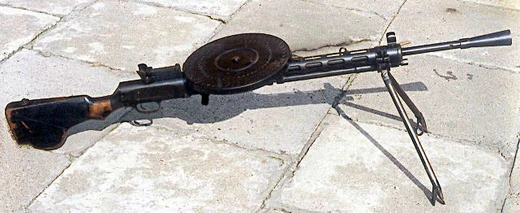
PU-21
A Soviet dual-feed light machine gun that never entered service.
The PU-21 (ПУ-21 Пулемёт с унифицированной подачей) is a 5.45×39mm machine gun developed by designers V. M. Kalashnikov and M. E. Dragunov from 1972 to 1977. It was a dual-feed light machine gun meant to replace the RPK in Soviet service, capable of using either a 45-round magazine or a 200-round belt. Its sights are calibrated out to 1,000 meters.
By the early 1960s, Soviet forces had retired the RPD, their last squad-level belt-fed machine gun in an intermediate caliber. Official doctrine from the 1960s onward assigned the RPK for squad-level suppressive fire, while PK machine guns were held at the company level for heavier support. When the Soviet military adopted the 5.45×39mm cartridge for rifles and light machine guns, it considered fielding a dual-feed light machine gun in that caliber—similar to the FN Minimi used by Western armies—to replace the RPK. This led to the PU-21 project.
Prototypes underwent thorough testing by the Soviet Army in Leningrad, but military experts found no strong reasons to replace the RPK and RPK-74 with the PU-21. They judged the design too complex compared to existing weapons and saw no improvement in combat effectiveness. Instead, the modernized PKM machine gun was adopted. The RPL-20, a later 5.45mm belt-fed machine gun, drew some inspiration from this project.
Quick Facts
- Origin
- Soviet Union
- Is Ranged
- YES
- Designer
- Yu.K. Aleksandrov / M.E. Dragunov / V.M. Kalashnikov
- Manufacturer
- TsNIITochMash
- Weight
- 5.7 kg
- Length
- 1060 mm (41.73 in)
- Part Length
- 590 mm (23.2 in)
- Cartridge
- 5.45×39mm
- Caliber
- 5.45 mm
- Action
- Gas-operated
- Rate
- 750 rpm
- Velocity
- 960 m/s (3150 ft/s)
Facts from the source article.
Lore & Background
The PU-21 was conceived during a period when the Soviet military had not fielded a squad-level, intermediate caliber, belt-fed machine gun since the retirement of the RPD in the early 1960s. Official Soviet doctrine from the 1960s onward dictated that squad-level suppressive fire would be provided by the RPK, while PK machine guns were issued at the company level. With the military's move from the 7.62×39 mm round to the 5.45×39 mm cartridge for rifles and light machine guns, it considered adopting a dual-feed light machine gun in the new caliber to replace the RPK, similar to the FN Minimi in Western armies. This resulted in the development of the PU-21.
The PU-21 can be fed from either a 45-round magazine or a 200-round belt. Its sights are graduated to a distance of 1000 m. The prototypes were thoroughly tested by the Soviet Army in Leningrad, but military experts did not see convincing arguments for replacing the RPK and RPK-74 with the PU-21 design. According to the Soviet military, the design was too complex compared to other weapons then in service, and failed to enhance combat effectiveness. The PKM machine gun, the modernised PK variant, was adopted instead.
Reader's Guide
The PU-21 represents a notable but ultimately unsuccessful attempt by the Soviet Union to introduce a squad-level belt-fed light machine gun in the new 5.45×39mm caliber. Its development paralleled Western efforts like the FN Minimi, reflecting a shared interest in combining the firepower of a belt feed with the convenience of magazine compatibility. However, the Soviet military judged the PU-21 too complex relative to the existing RPK and RPK-74, and saw no clear improvement in combat effectiveness. The decision to adopt the PKM instead reinforced the existing doctrine of company-level machine guns. The PU-21 project did not lead to production or fielding, but it influenced later designs; the RPL-20, a similarly belted 5.45 machine gun, drew some inspiration from this project. The PU-21 remains a footnote in Soviet small arms history, illustrating a path not taken in the evolution of squad automatic weapons.
Did You Know?
- The PU-21 was designed by V. M. Kalashnikov and M. E. Dragunov between 1972 and 1977.
- The Soviet military considered it too complex and not sufficiently effective to replace the RPK and RPK-74.
- The RPL-20, a later belted 5.45 machine gun, drew some inspiration from the PU-21 project.
More in Machine Guns, Part 2 1-24
Spotted an error? Know more?
Reader corrections go straight into our review queue. Suggest an edit · How this site is sourced