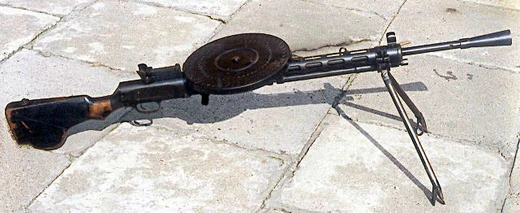
Nambu-type training light machine gun
Japanese blank-firing training light machine gun used until World War II.
The Nambu-type training light machine gun was a Japanese weapon designed solely to fire blanks for military drills. It was created by the Nambu Arms Manufacturing Company, which was restructured as Chūō Kōgyō in 1936. This weapon was the first training light machine gun of its kind in Japan and saw extensive use in training exercises through the end of World War II. It was employed alongside the Type 11 light machine gun, the Imperial Japanese Army’s first combat light machine gun. While the Type 11 was gas-operated and used in battle, the Nambu-type was a low-cost, simplified version that made setting up safe training facilities easier. Introduced near the end of the Taishō period, it remained in service throughout the Shōwa period until the war’s end.
Starting in 1935, the Youth School Order required soldiers to provide military education to middle schools, high schools, and vocational institutions. For young people who could not continue formal schooling, youth training institutes were set up in factories, companies, and local communities. This program integrated military training into civilian education. Surplus Type 30 and Type 38 rifles were used to teach basic rifle handling and drill, while training light machine guns were used for instruction on operating light machine guns. These training weapons were often obtained through martial arts equipment dealers, who acted as intermediaries.
After the war, Allied occupation forces confiscated Japanese weapons, including training machine guns. Some training weapons were mistaken for real firearms and destroyed. Because they were produced in limited numbers, surviving examples are extremely rare today. A few can be found in museums and private collections.
Following the Nambu-type, several other models of training light machine guns were produced. These include the Kanayama-type, made by the Kanayama Kujiro Company in Toyohashi, Aichi; the Izawa-type, produced by Izawa Firearms Manufacturing in Tenmabashi, Kita, Osaka; the Nissho-type; the Sugimoto-type; and the Hyorinkan-type, whose official designation is unknown. Other variants were made by various smaller workshops and manufacturers. The Izawa-type had a magazine mounted on the left side, while the Kanayama-type, styled after the Type 96, featured a top-mounted magazine to mimic the later Type 96 and Type 99 light machine guns.
Quick Facts
- Is Ranged
- yes
- Origin
- Empire of Japan
- Designer
- Kijirō Nambu
- Service
- 1920s-1945
- Used By
- Imperial Japanese Army / Middle and high school military training programs
- Cartridge
- 6.5mm blanks
- Feed
- 15, 20, 30-round detachable box magazine
- Action
- Simple blowback
Facts from the source article.
Lore & Background
The Nambu-type training light machine gun was introduced near the end of the Taishō period. It was a low-cost simplified training version of the Type 11 light machine gun, designed to simplify arranging safe facilities for training. Unlike the gas-operated Type 11 used in combat, the Nambu-type was incapable of firing live ammunition and was built from cast metal components fastened with screws. Its magazine was mounted on the left side of the mechanism, and the grip was integrated with the stock, resembling the Type 11. The barrel featured cooling fins to mimic real machine guns, and it was equipped with a bipod; some versions included a mock gas cylinder and bayonet mount. The Nambu-type had few parts and could be easily disassembled and reassembled like the Type 100 submachine gun.
Beginning in 1935, as part of the Youth School Order, soldiers provided military education to middle schools, high schools, and vocational institutions. For young people who could not continue formal education, youth training institutes were introduced in factories, companies, and local communities. In these programs, training light machine guns were employed for instruction in the handling and operation of light machine guns. These weapons were often acquired through martial arts equipment dealers, who acted as intermediaries.
After the war, Allied occupation forces confiscated Japanese weapons, including training machine guns. Some training weapons were mistaken for real firearms and destroyed. Their limited production numbers make them extremely rare today. Some surviving examples are found in museums and private collections.
Reader's Guide
The Nambu-type training light machine gun holds significance as the first Japanese training light machine gun of its kind, providing a low-cost and safe alternative to live-fire weapons for military training. Its introduction near the end of the Taishō period allowed soldiers to train with a weapon that mimicked the handling of the Type 11 light machine gun without the dangers and costs associated with live ammunition. The weapon's simple blowback mechanism and cast-metal construction made it easy to produce and maintain, and its use of wooden bullet blanks further enhanced safety. The integration of military training into civilian schooling after 1935, under the Youth School Order, expanded the demand for such training weapons, with the Nambu-type being employed in youth training institutes across factories, companies, and local communities. Its legacy is marked by rarity; after World War II, Allied occupation forces confiscated and often destroyed these weapons, mistaking them for real firearms. Today, surviving examples are extremely rare and are found primarily in museums and private collections, serving as artifacts of Japan's pre-war and wartime military training practices.
Did You Know?
- It fired wooden bullet blanks, including 6.5mm blank cartridges designed for the Type 38 rifle.
- The magazine was made of cast metal and weighed around 630 g, nearly twice as thick as real Type 99 or Type 96 magazines.
- After the war, some training weapons were mistaken for real firearms and destroyed by Allied occupation forces.
More in Machine Guns, Part 2 1-24
Spotted an error? Know more?
Reader corrections go straight into our review queue. Suggest an edit · How this site is sourced