Tetraroginae
Venomous bottom-dwelling fishes of the Indian and West Pacific oceans.

Tetraroginae, also called waspfishes or sailback scorpionfishes, are a subfamily of marine ray-finned fish within the scorpionfish family Scorpaenidae. They live in the Indian Ocean and western Pacific, usually on the seafloor at depths down to 300 meters. As their common name suggests, many are venomous, with poison glands located on their spines. These bottom-dwellers typically hide in crevices or other sheltered spots on the seabed.
The group was first recognized as a distinct taxonomic unit in 1949 by South African ichthyologist J. L. B. Smith. While the 5th edition of *Fishes of the World* treats it as a subfamily of Scorpaenidae, some authorities consider it a separate family, Tetrarogidae. A recent study placed waspfishes within an expanded stonefish clade in the family Synanceiidae, because all these fish share a lachrymal sabre—a switch-blade-like spine that can project from beneath the eye. The subfamily name comes from the genus *Tetraroge*, coined by Albert Günther in 1860, meaning "four clefts," referring to the four gill slits (compared to five in the related genus *Pentaroge*, now considered a synonym of *Gymnapistes*).
The following genera are classified under Tetraroginae: *Ablabys*, *Centropogon*, *Coccotropsis*, *Cottapistus*, *Glyptauchen*, *Gymnapistes*, *Liocranium*, *Neocentropogon*, *Neovespicula*, *Notesthes*, *Ocosia*, *Paracentropogon*, *Pseudovespicula*, *Richardsonichthys*, *Snyderina*, *Tetraroge*, and *Vespicula*. The genus *Vespicula* is not universally accepted; its type species is *Apistus trachinoides*, which some workers place in the monotypic genus *Trichosomus*, with the other two species moved to *Pseudovespicula*.
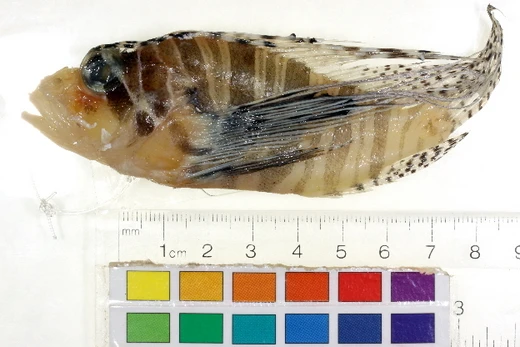
Waspfishes have compressed bodies and heads usually covered with ridges and spines. The spines on the gill cover (operculum) are divergent, and the gill membrane is free from the isthmus. A large, mobile spine below each eye can be projected outward. The venom carried on these spines is very potent. These fish are small, ranging from 2.5 to 23 centimeters (1 to 9 inches) in length.
Almost all Tetraroginae species occur in the Indian and western Pacific Oceans, except for the smoothskin scorpionfish (*Coccotropsis gymnoderma*), which is found in the southeastern Atlantic off South Africa. They are demersal fish, mostly marine, though some live in brackish water.
Quick Facts
- Taxon
- Tetraroginae
Facts from the source article.
Lore & Background
Tetraroginae was first formally recognised as a taxonomic grouping in 1949 by the South African ichthyologist J. L. B. Smith. The 5th edition of Fishes of the World treats this as a subfamily of Scorpaenidae, however other authorities treat it as a valid family, the Tetrarogidae. A recent study placed the waspfishes into an expanded stonefish clade, within the family Synanceiidae, because all of these fish have a lachrymal sabre that can project a switch-blade-like mechanism out from underneath their eye. The name of the subfamily is based on the genus name Tetraroge, which was described in 1860 by Albert Günther and its name means 'four clefts', an allusion to the four clefts in the gills in comparison to the five clefts in the gills of Pentaroge, now regarded as a synonym of Gymnapistes.
Tetraroginae waspfishes have compressed bodies with heads typically with ridges and spines. The spines on the operculum are divergent and the gill membrane is free from isthmus. There is a large mobile spine below each eye which may be projected outwards. The venom borne on the spines of these fishes is very potent. They are small fish, from 2.5–23 cm. They are predatory fishes, which feed on crustaceans and fishes.
Tetraroginae waspfishes are almost all found in the Indian and western Pacific Ocean, the exception is the smoothskin scorpionfish (Coccotropsis gymnoderma) found in the southeastern Atlantic off South Africa. They are demersal fishes, mostly marine, but some species will live in brackish water with one, the bullrout (Notesthes robusta) spending much of its life in the freshwater reaches of rivers. Tetraroge nigra, sometimes called the freshwater waspfish, may also be found in freshwater, although it is primarily brackish.
Reader's Guide
Tetraroginae waspfishes are notable for their potent venom and distinctive defensive adaptations. The subfamily includes 17 genera, with some taxonomic uncertainty: the genus Vespicula is not universally recognised, and its type species has been placed in the monotypic genus Trichosomus by some workers. These fishes are primarily found in the Indian and western Pacific Oceans, with one species occurring in the southeastern Atlantic off South Africa. They inhabit depths up to 300 metres and are bottom-dwelling, often hiding on the sea floor. Their venom is extremely potent, and wounds from their spines can be extremely painful and dangerous. Ecologically, they are predators of crustaceans and fishes. The group's evolutionary history includes a recent placement within an expanded stonefish clade (Synanceiidae) due to the shared lachrymal sabre mechanism. The subfamily's name derives from the genus Tetraroge, meaning 'four clefts', referencing gill structure. Their size range of 2.5–23 cm makes them relatively small but formidable due to their venom. Some species, like the bullrout, can live in freshwater, while others tolerate brackish conditions, showing adaptability beyond typical marine habitats.
Did You Know?
- Tetraroginae waspfishes have a large mobile spine below each eye that can be projected outwards.
- The name Tetraroge means 'four clefts', referring to the number of gill clefts.
- One species, the bullrout (Notesthes robusta), spends much of its life in freshwater rivers.
- A recent study placed waspfishes into an expanded stonefish clade due to a lachrymal sabre mechanism.
Frequently Asked Questions
What is Tetraroginae?
Tetraroginae is a subfamily of venomous, bottom-dwelling ray-finned fishes within the scorpionfish family Scorpaenidae, widely known by the common names waspfishes and sailback scorpionfishes. Individual species span a size range from roughly 2.5 cm to about 23 cm in length.
What are Tetraroginae's 'powers' or special abilities?
Many members of this group carry poison glands along their dorsal spines, delivering a painful sting to anything that grabs or steps on them. They also rely heavily on camouflage, tucking into crevices and sheltered nooks on the seabed to ambush passing prey.
Where does Tetraroginae live?
These fishes are native to the Indian Ocean and the western Pacific, where they typically rest on the seafloor at depths reaching down to 300 metres.
How was Tetraroginae first recognized as its own group?
South African ichthyologist J. L. B. Smith formally separated Tetraroginae from the broader scorpionfish assemblage and described it as a distinct taxonomic unit in 1949.
Why is Tetraroginae important to the scorpionfish family?
Its recognition helped ichthyologists carve out a clearly defined subfamily within Scorpaenidae, highlighting the venom-spine defense strategy that sets sailback scorpionfishes apart from many of their close relatives. The 1949 description remains a foundational reference point for classifying diversity in the family.
More in Lionfish and Scorpionfish 1-24
Spotted an error? Know more?
Reader corrections go straight into our review queue. Suggest an edit · How this site is sourced