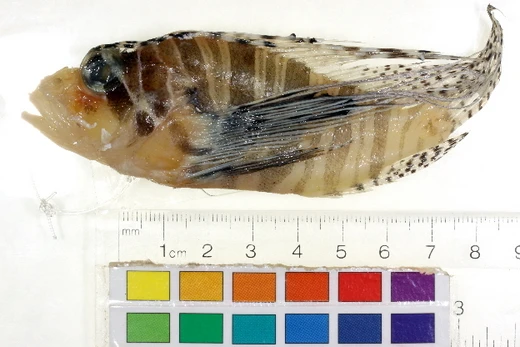
Ebosia
A genus of falcate lionfishes in the scorpionfish family.

Ebosia is a genus of marine ray-finned fish in the scorpionfish family, Scorpaenidae, commonly called falcate lionfishes. They inhabit the Indian and Pacific Oceans.
The genus was established in 1904 by American ichthyologists David Starr Jordan and Edwin Chapin Starks, with *Pterois bleekeri* as the type species. That species had originally been described in 1884 by Ludwig Heinrich Philipp Döderlein from Tokyo. Ebosia belongs to the tribe Pteroini within the subfamily Scorpaeninae. Its name comes from a Latinisation of *eboshi*, a type of helmet that resembles the bony crests seen on males of this genus.
Four species are currently recognized. A key trait of Ebosia lionfishes is that the bases of the spines on the nuchal, parietal, and coronal bones are continuous, with the parietal spine being longer and, in males, forming a slender, bony crest. Their sizes range from a maximum standard length of 8.7 cm (3.4 in) in *E. falcata* to 22 cm (8.7 in) in *E. bleekeri*.
These fish are found across the Indo-Pacific, from the eastern coast of Africa between Somalia and South Africa, through the Indian Ocean, and east to eastern Australia, north to Japan, Korea, and China. They live over sandy or muddy substrates, typically at depths less than 100 m (330 ft). Like other scorpionfishes, they are predators; *E. bleekeri* is known to feed on small fishes and crustaceans.
Quick Facts
- Taxon
- Ebosia
- Type Species
- Pterois bleekeri
- Type Species Authority
- Döderlein, 1884
Facts from the source article.
Lore & Background
Ebosia was described as a genus in 1904 by American ichthyologists David Starr Jordan and Edwin Chapin Starks, with Pterois bleekeri as the type species. The genus name is a latinisation of eboshi, a type of helmet that resembles the parietal crests shown by males in this genus. The genus is classified within the tribe Pteroini of the subfamily Scorpaeninae.
Ebosia lionfishes are characterized by having the bases of the spines on the nuchal, parietal and coronal bones continuous with the parietal spine being longer, and in males, this creates a slender, bony crest. They vary in size from a maximum published standard length of 8.7 cm in E. falcata to 22 cm in E. bleekeri.
These fishes are found in the Indo-Pacific from the eastern coast of Africa between Somalia and South Africa across the Indian Ocean and eastwards into the Pacific Ocean as far as eastern Australia, north to Japan, Korea and China. They inhabit sandy or muddy substrates at depths normally less than 100 m. Like other scorpionfishes, they are predatory; E. bleekeri is known to feed on small fishes and crustaceans.
Reader's Guide
Ebosia represents a distinct lineage within the scorpionfish family, notable for the bony crests on the heads of males that resemble a type of helmet, which inspired the genus name. The genus contains four recognized species, ranging in size from about 8.7 cm to 22 cm in standard length. These fishes are found across a broad Indo-Pacific distribution, from eastern Africa to Japan and Australia, typically on sandy or muddy bottoms at depths less than 100 meters. As predators, they feed on small fishes and crustaceans, consistent with the feeding habits of other scorpionfishes. The genus was established in 1904 by Jordan and Starks, with a type species originally described in 1884. The presence of parietal crests in males is a key distinguishing feature. The known depth range and substrate preferences indicate a benthic lifestyle in coastal waters. The genus is classified within the tribe Pteroini, linking it to other lionfishes. The maximum sizes recorded for the two named species provide a size benchmark for the genus.
Did You Know?
- Males of this genus have a slender, bony crest on the head.
- Ebosia lionfishes are found at depths normally less than 100 meters.
- E. bleekeri feeds on small fishes and crustaceans.
Taxonomy and the Helmet-Inspired Name
Ebosia occupies a specific place within the broader family of scorpionfishes, positioned in the tribe Pteroini under the subfamily Scorpaeninae. The genus was formally established in 1904 by two American ichthyologists, David Starr Jordan and Edwin Chapin Starks, who selected Pterois bleekeri as its type species. That particular fish had originally been described back in 1884 by Ludwig Heinrich Philipp Döderlein, based on a specimen collected in Tokyo. Today, four species are recognized under this genus. Perhaps the most evocative aspect of Ebosia is its very name, which derives from a latinisation of "eboshi," a traditional Japanese helmet. The connection is anatomical: male members of this genus display prominent parietal crests on their skulls that bear a visual resemblance to the ornamental ridges of such headgear. This naming choice reflects the close ties between the fish's native Indo-Pacific waters and the cultures of the region where the type species was first documented.
Morphology and the Bony Crests
What sets Ebosia apart from many of its scorpionfish relatives is the architecture of its cranial spines. In these falcate lionfishes, the bases of the spines located on the nuchal, parietal, and coronal bones form a continuous structure rather than appearing as isolated projections. Among these, the parietal spine is notably the longest, and in mature males it extends into a slender, bony crest running along the top of the head. This crest is the very feature that inspired the genus name. In terms of overall body size, the four recognized species span a moderate range. The smallest, E. falcata, reaches a maximum published standard length of roughly 8.7 centimetres, while the largest, E. bleekeri, can grow to about 22 centimetres. These dimensions place Ebosia within the smaller end of the scorpionfish family, suggesting a lifestyle adapted to navigating the intricate spaces of their preferred benthic environments rather than dominating open water.
Indo-Pacific Range and Benthic Habitat
Ebosia lionfishes are distributed across a vast stretch of the tropical and subtropical Indo-Pacific. Their range begins along the eastern African coastline, spanning from Somalia southward to South Africa, then extends across the Indian Ocean and continues eastward into the Pacific, reaching as far as the waters off eastern Australia. Toward the north, their distribution encompasses the coastal waters of Japan, Korea, and China. Despite this broad geographic spread, these fishes are consistently associated with a particular type of seafloor: sandy or muddy substrates. They are typically encountered at depths not exceeding 100 metres, placing them firmly within the shallow continental shelf zone. This preference for soft, unconsolidated bottoms aligns with the ambush-predator strategy typical of scorpionfishes, as Ebosia species can likely rest partially buried in sediment, using their spiny profiles to blend into the surrounding environment while waiting for prey to drift within striking distance.
Predatory Ecology and Feeding Behavior
As members of the scorpionfish family, Ebosia species share the fundamentally predatory lifestyle that characterizes the group. Rather than actively chasing prey across open water, these falcate lionfishes rely on a sit-and-wait strategy, using their spiny bodies and bony cranial crests as both camouflage and defense while stationed on the seafloor. The most well-documented dietary information comes from E. bleekeri, which is known to consume small fishes and crustaceans. This diet of relatively small, mobile invertebrates and juvenile fish is consistent with the modest body sizes of the genus, with the largest species reaching only about 22 centimetres in standard length. Their position in the food web is therefore that of a mid-level benthic predator, preying on organisms that inhabit the same sandy and muddy substrates where they themselves reside. The continuity of their cranial spine bases and the elaborate male crests may also play roles in intraspecific interactions, though the full behavioral ecology of all four species remains an area where further field research would be valuable.
Frequently Asked Questions
What is Ebosia?
Ebosia is a small genus of falcate lionfishes belonging to the scorpionfish family, Scorpaenidae. These marine ray-finned fish are native to the Indian and Pacific Oceans.
Who established the genus Ebosia and when?
American ichthyologists David Starr Jordan and Edwin Chapin Starks formally erected the genus in 1904, designating Pterois bleekeri as its type species. That particular species had first been described back in 1884 by Ludwig Heinrich Philipp Döderlein from a specimen collected in Tokyo.
How many species belong to Ebosia and how big do they get?
The genus contains four species, with standard lengths spanning from about 8.7 cm in E. falcata up to 22 cm in E. bleekeri.
What habitat does Ebosia prefer?
Members of this genus typically occupy sandy or muddy seafloor environments and are generally found at depths under 100 meters.
Where does the name 'Ebosia' come from?
The genus name is a Latinised form of 'eboshi,' a traditional helmet whose shape echoes the distinctive bony crests that develop on males of these fish.
More in Lionfish and Scorpionfish 1-24
Spotted an error? Know more?
Reader corrections go straight into our review queue. Suggest an edit · How this site is sourced