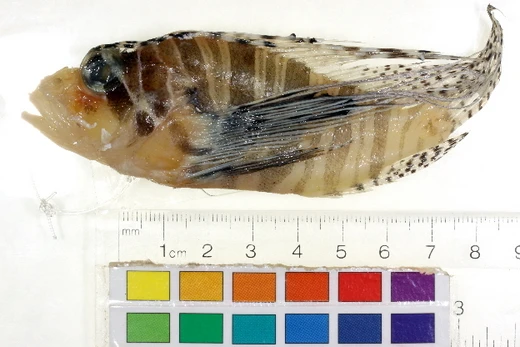
Caracanthinae
Monotypic subfamily of coral-dwelling velvetfishes in the scorpionfish family.

Caracanthinae is a monotypic subfamily of ray-finned fishes within the family Scorpaenidae, comprising only the genus Caracanthus. These fishes, known as coral crouchers or orbicular velvetfishes, are notable for their close association with coral reefs in the tropical Indo-Pacific and for their velvety skin.
Quick Facts
- Taxon
- Caracanthus
- Type Species
- Caracanthus typicus
- Type Species Authority
- Krøyer, 1845
Facts from the source article.
Lore & Background
The subfamily Caracanthinae was established as a monotypic group within Scorpaenidae, containing only the genus Caracanthus. This genus was first formally described in 1845 by Danish zoologist Henrik Nikolai Krøyer, who designated Caracanthus typicus (the Hawaiian orbicular velvetfish) as the type species. Molecular studies have suggested that Caracanthinae should probably be treated as a tribe within the subfamily Scorpaeninae, or possibly included in the tribe Scorpaenini, though this remains a point of uncertainty.
Caracanthus fishes have an oval, laterally compressed body covered in small, rough papillae, giving them a velvety texture. They possess a single notch in the dorsal fin, which contains 6 to 8 spines and 11 to 14 soft rays. The anal fin has 2 spines and 11 to 14 soft rays. Their pelvic fins are small and barely noticeable, with a single spine and 2 or 3 small soft rays. The head bears tiny scales, each with a single spine. These fishes use their small pectoral fins to wedge themselves into crevices in coral. They range in size from a maximum standard length of 2.9 cm in C. typicus to a maximum total length of 5 cm for the other three species.
The genus name Caracanthus is a compound of cara, meaning 'head', and acanthus, meaning 'thorn' or 'spine', referring to the strong spines on the infraorbital bone of C. typicus. The four recognized species are Caracanthus maculatus (spotted coral croucher), Caracanthus madagascariensis (spotted croucher), Caracanthus typicus (Hawaiian orbicular velvetfish), and Caracanthus unipinna (pygmy coral croucher).
Reader's Guide
The subfamily Caracanthinae holds significance as a distinct lineage within the scorpionfish family Scorpaenidae, representing a group of small, coral-specialized fishes. Its monotypic status—containing only the genus Caracanthus—highlights its evolutionary uniqueness. The subfamily's members are notable for their velvety skin, a trait shared with related velvetfishes, and their adaptation to living among coral branches in the Indian and Pacific Oceans. The small pectoral fins used to wedge into coral crevices illustrate a specialized ecological niche. Molecular studies have raised uncertainty about the subfamily's taxonomic rank, suggesting it may be better placed as a tribe within Scorpaeninae or even within the tribe Scorpaenini, indicating ongoing refinement of scorpionfish phylogeny. The four species, including the type species described by Krøyer in 1845, demonstrate a range of sizes up to 5 cm total length. The genus name itself, referencing head spines, underscores morphological traits that define the group. As coral reef inhabitants, these fishes contribute to the biodiversity of tropical Indo-Pacific reefs, though the article does not discuss conservation or broader ecological impact.
Did You Know?
- Caracanthinae is a monotypic subfamily, containing only the genus Caracanthus.
- The genus name Caracanthus means 'head thorn', referring to spines on the infraorbital bone.
- The maximum total length for three of the four species is 5 cm (2.0 in).
Taxonomic Identity and Classification
Caracanthinae stands as one of six recognized subfamilies within the scorpionfish family Scorpaenidae, a lineage first formally established by the French naturalist Antoine Risso in 1826. The subfamily itself was named by Gill in 1885, and it is distinguished by containing a single genus, Caracanthus, which was originally described by Krøyer back in 1845. In everyday language, its members are known as orbicular velvetfishes or coral crouchers. Taxonomically, Scorpaenidae sits within the suborder Scorpaenoidei; while older references placed it under the order Scorpaeniformes, more current authorities assign it to Perciformes. A sweeping 2018 revision reshuffled the family's internal architecture, elevating several former subfamilies to full family rank and promoting certain tribes to subfamily status, yet Caracanthinae retained its position as a subfamily. The broader family now encompasses thirty-nine genera and at least three hundred eighty-eight species, making Caracanthinae a small but distinct branch of a remarkably diverse group.
Physical Form and Defensive Armament
Members of Caracanthinae inherit the characteristic body plan of the scorpionfish family: a laterally compressed form with a head studded by ridges and sharp spines. The operculum typically bears one or two spines, usually a divergent pair, while the preoperculum carries three to five, most commonly five. Where scales are present, they belong to the ctenoid type. A single dorsal fin, often deeply incised, runs along the back and houses between eleven and seventeen spines alongside eight to seventeen soft rays. The anal fin generally presents three spines and five soft rays, and the pelvic fin carries a single spine with two to five soft rays. The large pectoral fin contains eleven to twenty-five soft rays, with some lower rays occasionally freed from the membrane. Gill membranes remain unattached to the isthmus, and certain species entirely lack a swim bladder. Most critically, venom glands are embedded in the spines of the dorsal, anal, and pelvic fins, giving these fish their reputation as among the world's most dangerous marine species.
Range, Habitat, and Ecological Niche
Scorpaenidae as a whole are predominantly marine fishes distributed across tropical and temperate waters, with the Indo-Pacific region serving as their principal stronghold. While the family's range extends into the Atlantic, the core diversity clusters in the Pacific and Indian Oceans. Caracanthinae members, like their relatives, occupy marine and brackish-water environments, favoring coral reefs but also tolerating estuaries, bays, and lagoons. The common name coral crouchers aptly captures their preferred habitat: they are creatures of structured reef environments where their compressed, spined bodies allow them to blend into the surrounding architecture. It is worth noting that these fishes should not be confused with the cabezones of the genus Scorpaenichthys, which belong to the separate but related family Cottidae. Invasive populations of certain scorpionfish relatives, notably the lionfishes of genus Pterois, have established themselves in the Caribbean and eastern Mediterranean, underscoring the family's capacity for range expansion beyond its native waters.
Reproductive Biology and Deep-Time Context
Reproduction within Scorpaenidae, and by extension among Caracanthinae members, most commonly involves internal fertilization. Species vary in their reproductive strategy: some are ovoviviparous, carrying developing young internally, while others deposit eggs in a gelatinous mass. The species Scorpaena guttata, for instance, has been reported to produce a gelatinous egg balloon measuring up to twenty centimeters across. Size variation across the family is striking; the shortraker rockfish reaches a maximum total length of one hundred and eight centimeters, whereas many other species top out at merely five centimeters. The deep-time record for scorpaenids is modest: fossil otoliths date to the mid-Eocene, but body fossils do not appear until the Oligocene or Miocene. Caracanthinae, with its single genus Caracanthus described in 1845, represents a small yet enduring thread in this long evolutionary tapestry, a lineage that has persisted through millions of years of marine change.
Frequently Asked Questions
What is Caracanthinae?
Caracanthinae is a monotypic subfamily inside the scorpionfish family (Scorpaenidae) that houses a single genus, Caracanthus. In the reef-fish community these little guys go by the nicknames coral crouchers or orbicular velvetfishes.
What makes Caracanthinae stand out among scorpionfishes?
Their skin has a distinctly velvety texture that sets them apart from most other Scorpaenidae members, earning them the 'velvetfish' moniker. They are also tightly tied to living coral, essentially treating reef structures as their home base across the tropical Indo-Pacific.
How big do Caracanthinae get?
Three of the four species in the group max out around 5 cm (2 in) in total length, while the type species Caracanthus typicus is even smaller at roughly 2.9 cm (1.1 in) standard length. They are genuinely pocket-sized reef dwellers.
Where do you find Caracanthinae in the wild?
These velvetfishes are restricted to coral reef habitats throughout the tropical Indo-Pacific. Their lifestyle is so intertwined with living coral that they are rarely encountered far from reef structures.
Why should a scorpionfish fan care about Caracanthinae?
Being a monotypic subfamily with just four species in one genus, it forms a neat, self-contained evolutionary branch that is easy to track and appreciate in full. For fans who like cataloguing Scorpaenidae lineages, it is a compact group with a clear identity and a well-defined type species.
More in Lionfish and Scorpionfish 1-24
Spotted an error? Know more?
Reader corrections go straight into our review queue. Suggest an edit · How this site is sourced