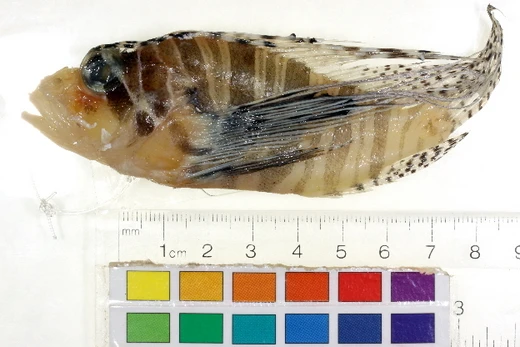
Caracanthus typicus
Endemic Hawaiian reef fish with venomous spines and velvety skin.

Caracanthus typicus, the Hawaiian orbicular velvetfish, is a marine ray-finned fish in the family Scorpaenidae. It is found only in the Hawaiian Islands.
Danish zoologist Henrik Nikolai Krøyer first formally described the species in 1845, giving the Hawaiian Islands as the type locality. When he described this fish, Krøyer also created the new genus *Caracanthus*, making *C. typicus* the type species of that genus and of the subfamily Caracanthinae. Its specific name, *typicus*, reflects its status as the genus’s type species.
The Hawaiian orbicular velvetfish has a disc-shaped, laterally compressed gray body dotted with small red spots. Its skin is covered in papillae, giving it a velvety feel. A close relative, *Caracanthus maculatus*, has smaller, more numerous spots that are dark red to dark brown. This species reaches a maximum length of 4 cm (1.6 in).
Endemic to the Hawaiian Islands in the east-central Pacific, it lives on reefs as a bottom-dwelling fish, usually among the branches of cauliflower coral (*Pocillopora meandrina*). When disturbed, it retreats deeper into the coral. Its fins contain venomous spines.
Because it is tied to coral reefs—especially cauliflower coral—and is found only in Hawaii, the species has a very limited distribution, close to the threshold for a Vulnerable listing by the IUCN. Local declines in coral cover from overfishing, climate change, pollution, and invasive species have caused a continuing drop in habitat quality. Given these threats, the species is estimated to occur at only 2 to 6 locations, and the IUCN lists it as Near Threatened.
Quick Facts
- Taxon
- Caracanthus typicus
Facts from the source article.
Lore & Background
Caracanthus typicus was first formally described in 1845 by Danish zoologist Henrik Nikolai Krøyer, who also established the monotypic genus Caracanthus for this species. The specific name typicus indicates its status as the type species of its genus and of the subfamily Caracanthinae. The type locality is the Hawaiian Islands.
This species has a laterally compressed, disc-shaped, gray body covered with small red spots, and its skin is covered with papillae that produce a velvety texture. It can reach a length of 4 cm (1.6 in). The closely related Caracanthus maculatus has smaller and more numerous spots that are dark red to dark brown.
Caracanthus typicus is a benthic species that inhabits reefs in the Hawaiian Islands, usually living among the branches of cauliflower coral (Pocillopora meandrina). If disturbed, it moves deeper into the coral. It has venomous spines in its fins.
Reader's Guide
Caracanthus typicus is significant as an endemic species of the Hawaiian Islands, restricted to coral reef habitats, particularly those dominated by cauliflower coral. Its limited distribution, based on the area of coral reef in Hawaii, is near the threshold for the IUCN to classify it as Vulnerable. Localised declines in coral cover due to overfishing, climate change, pollution, and invasive species have led to a continuing decline in habitat quality. The species is estimated to occur at between 2 and 6 locations, and the IUCN lists it as Near Threatened. As the type species of the genus Caracanthus and the subfamily Caracanthinae, it holds taxonomic importance within the family Scorpaenidae. Its venomous spines and velvety skin are distinctive biological features, and its association with cauliflower coral underscores its ecological specialization. The primary threat to this species is habitat degradation, making its conservation dependent on the health of Hawaiian coral reefs.
Did You Know?
- Its skin is covered with papillae that give it a velvety texture.
- The IUCN lists this species as Near Threatened due to habitat degradation.
Frequently Asked Questions
What is Caracanthus typicus?
Caracanthus typicus, commonly called the Hawaiian orbicular velvetfish, is a small marine ray-finned fish in the scorpionfish family Scorpaenidae. It is recognized for its disc-shaped, laterally compressed body, velvety skin, and venomous spines.
Who described Caracanthus typicus and when?
Danish zoologist Henrik Nikolai Krøyer formally named the species in 1845, designating the Hawaiian Islands as the type locality. In that same work he erected the genus Caracanthus, making C. typicus its type species and the anchor of the subfamily Caracanthinae.
How big does Caracanthus typicus get?
The Hawaiian orbicular velvetfish is a tiny reef dweller, topping out at roughly 4 cm (about 1.6 inches) in total length. Its compact, disc-like build keeps it among the smaller members of Scorpaenidae.
Where can you find Caracanthus typicus?
This species is endemic to the Hawaiian Islands and occurs nowhere else on Earth. It is a resident of Hawaiian reef habitats, making its entire global range confined to a single archipelago.
What is the conservation status of Caracanthus typicus?
The IUCN currently classifies Caracanthus typicus as Near Threatened. Because the species is restricted to a single island chain, any localized habitat degradation or environmental shift poses a disproportionate risk to its survival.
More in Lionfish and Scorpionfish 1-24
Spotted an error? Know more?
Reader corrections go straight into our review queue. Suggest an edit · How this site is sourced