Lionfish
Venomous Indo-Pacific reef fish with invasive Atlantic populations.

Lionfish are venomous, ray-finned fish belonging to the genus *Pterois*. They naturally inhabit coral reefs in the Indo-Pacific. These fish are known for their bold warning colors—red or black bands—and showy dorsal fins tipped with venomous spines, which they use mainly to deter predators. Two species, *Pterois volitans* and *Pterois miles*, have recently become significant invaders in the western Atlantic, the Caribbean Sea, and the Mediterranean Sea.
Quick Facts
- Taxon
- Pterois
- Type Species
- Scorpaena volitans
- Type Species Authority
- Bloch, 1787
Facts from the source article.
Lore & Background
The genus Pterois was described in 1817 by German naturalist Lorenz Oken. In 1856, French naturalist Eugène Anselme Sébastien Léon Desmarest designated Scorpaena volitans as the type species. The related genus Pteropterus was inconsistently treated until 2023, when it was validated after Pterois was found not to be monophyletic. The genus name Pterois is based on Georges Cuvier's 1816 French name 'Les Pterois', meaning 'fins', alluding to the high dorsal and long pectoral fins.
According to the National Oceanic and Atmospheric Administration, lionfish have distinctive brown or maroon and white stripes, fleshy tentacles above the eyes and below the mouth, fan-like pectoral fins, and long separated dorsal spines. Juveniles have a unique tentacle above the eye sockets that varies between species, suggested to attract prey and play a role in sexual selection. Five species are currently recognized, though molecular studies indicate P. lunulata is a junior synonym of P. russelii, and P. volitans may be a hybrid between P. miles and P. russelii sensu lato.
Pterois species live 5 to 15 years, with complex courtship and mating behaviors. Females release mucus-filled egg clusters containing up to 15,000 eggs, laying up to 2 million eggs per year. All species are aposematic, advertising their venomous defense with bold stripes and projecting spines. They prey mostly on small fish, invertebrates, and mollusks, using specialized swim bladder muscles and jets of water to confuse prey before swallowing it head-first.
Reader's Guide
Lionfish are notable for their venomous fin rays, which cause hazardous effects in humans including pain, nausea, vomiting, fever, headache, numbness, paresthesia, diarrhea, sweating, temporary paralysis, respiratory insufficiency, heart failure, and convulsions, and can be fatal, especially in very young children, the elderly, or those allergic. The venom is rarely fatal to healthy adults but can cause extreme discomfort for days. Allergic victims may experience anaphylaxis requiring immediate medical treatment. Lionfish are edible if prepared correctly.
Their invasive significance is substantial: P. volitans and P. miles have established themselves as significant invasive species off the East Coast of the United States and in the Caribbean, with about 93% of the Western Atlantic invasive population being P. volitans. The introduction likely occurred off Florida by the early to mid-1980s, possibly from aquarium releases or the 1992 Hurricane Andrew. By 2001, NOAA documented sightings from Florida to Delaware. Moray eels, bluespotted cornetfish, barracuda, large groupers, and sharks prey on lionfish. Park officials in Honduras have attempted to train sharks to feed on them. In Texas and Florida, divers are encouraged to capture lionfish for sport and food. Parasites are infrequent but include isopods and leeches.
Did You Know?
- Lionfish can lay up to about 2 million eggs per year.
- The genus name Pterois means 'fins' in reference to its high dorsal and long pectoral fins.
- About 93% of the invasive lionfish population in the Western Atlantic is Pterois volitans.
Taxonomy and the Long Road to a Name
The spotfin lionfish carries an extraordinary number of common names—banded lionfish, broadbarred firefish, raggedfinned scorpionfish, roughscaled lionfish, among others—yet its scientific identity shifted more recently than many might expect. In 1787, German physician and naturalist Marcus Elieser Bloch formally described the species as Scorpaena antennata, designating Ambon Island in Indonesia as the type locality. For over two centuries it remained within that genus, but a 2023 taxonomic revision moved it into the revalidated genus Pteropterus, reflecting a deeper understanding of its relationships within the scorpionfish family, Scorpaenidae. The specific epithet antennata is a direct reference to the pair of elongated tentacles that arch above each eye, features that have long set this fish apart from its close relatives. As a marine ray-finned species, it occupies a distinctive niche among the lionfishes, and its reclassification underscores how ongoing research continues to refine even the most familiar entries in the marine catalog.
A Portrait in Spines and Stripes
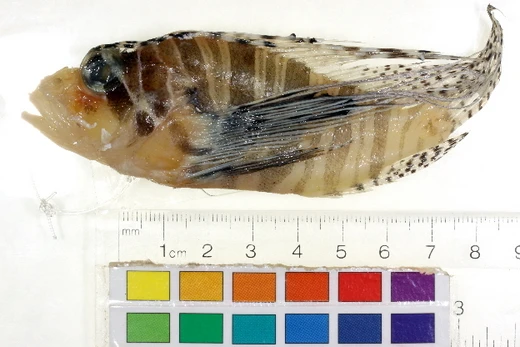
At a maximum of just twenty centimetres, the spotfin lionfish is a compact yet densely armed creature. Its body is laterally compressed and notably deep, giving it a broad, almost disc-like silhouette. The dorsal fin carries thirteen spines alongside eleven or twelve soft rays, while the anal fin bears three spines and six soft rays. Seventeen simple rays fan out from the pectoral fin. The head is a landscape of spines—coronal spines and numerous smaller ones dot the skull—and two long, banded tentacles extend above each eye, the very feature that inspired the species name. The mouth is lined with many tiny teeth arranged in clusters along both jaws, with a small additional patch on the front of the roof of the mouth. Colouration is a warm reddish-brown overlaid with numerous darker vertical bars that thin and angle sharply on the tail peduncle. The head displays three dark brown bars, one of which cuts diagonally through the eye and terminates in a prominent spot on the lower operculum. Scattered dark spots pepper the dorsal, anal, and caudal fins, and in larger adults, bluish-black blotches appear near the pectoral fin bases.
A Vast Tropical Playground
The spotfin lionfish roams one of the broadest tropical ranges of any reef fish. Its distribution stretches from the Gulf of Aden in the Red Sea southward to the waters off South Africa, eastward all the way to French Polynesia, and northward to the southern reaches of Japan. In the southern hemisphere, it is recorded as far south as Australia and the Kermadec Islands off New Zealand. Within Australian coastal waters, its range begins at Fremantle in Western Australia and sweeps north and east along the tropical northern coastline, extending at least as far south as Sydney in New South Wales. It also occupies Ashmore Reef in the Timor Sea, the Coral Sea reef systems, the waters around Lord Howe Island, the Cocos (Keeling) Islands, and Christmas Island. Vertically, this species inhabits both lagoon and seaward reefs at depths ranging from just two metres to as deep as eighty-six metres. This extraordinary breadth of distribution, spanning the entire Indo-West Pacific from warm shallow lagoons to deeper seaward slopes, makes it one of the most geographically widespread members of the lionfish group.
Nocturnal Hunter, Solitary Keeper, and Aquarium Star
By day, the spotfin lionfish retreats into crevices and caves, pressing its body inward so that its venomous spines point backward. Once darkness falls, it emerges as a slow-moving predator, approaching crustaceans, small fish, and even juvenile conspecifics with gentle undulations of its fins. Despite this active hunting, adults are fundamentally solitary, each individual defending a home range against other broad-barred lionfishes and other species in the lionfish group. Exceptions arise during juvenile aggregations and the breeding season, when the species spawns on a monthly cycle. A female can release up to fifteen thousand eggs in a mucus-encased mass, which the male fertilises externally; hatching is thought to occur roughly thirty-six hours later. In the wild, sharks and the cornet fish Fistularia commersonii are known predators. For humans, the fish's small size and dangerous spines render it uninteresting to commercial fisheries, though it is occasionally taken in subsistence catches and remains a common and popular sight in the aquarium trade.
Frequently Asked Questions
What is a lionfish?
Lionfish are venomous, ray-finned fish in the genus Pterois, native to coral reef environments throughout the Indo-Pacific. They are instantly recognizable by their bold red-and-black banding and the large, fan-like dorsal fins bristling with spines.
Are lionfish dangerous to humans?
Lionfish bear venomous spines along their dorsal, pelvic, and anal fins, but they deploy this venom chiefly as a defensive deterrent against predators rather than as an offensive weapon. A sting is painful, yet the fish is not generally regarded as a lethal threat to people.
Why are lionfish a problem in the Atlantic and Mediterranean?
Two species, Pterois volitans and Pterois miles, have become significant ecological invaders in the western Atlantic, the Caribbean Sea, and the Mediterranean. Their arrival in these non-native waters has upset local reef food webs that evolved without them.
How many species of lionfish are there?
The genus Pterois, established by Lorenz Oken in 1817, currently includes five recognized species. The type species of the genus is Scorpaena volitans, originally described by Bloch in 1787.
What are the key anatomical features of a lionfish?
A lionfish carries thirteen dorsal spines supported by ten or eleven soft dorsal rays, plus three anal spines. Its most dramatic feature is the wide, showy spread of venomous dorsal spines framed by translucent fin membranes, which it displays to warn off would-be predators.
More in Lionfish and Scorpionfish 1-24
Spotted an error? Know more?
Reader corrections go straight into our review queue. Suggest an edit · How this site is sourced