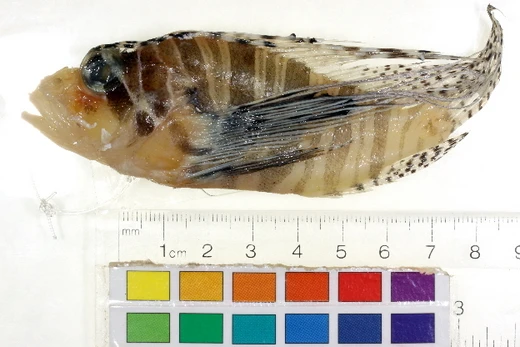
Plectrogenium
Venomous stinger flatheads found in deep Indian and Pacific waters.

Plectrogenium is a genus of marine ray-finned fish, commonly called stinger flatheads, belonging to the family Plectrogeniidae. These fish inhabit the Indian and Pacific Oceans.
The genus was first established in 1905 by American ichthyologist Charles Henry Gilbert as a monotypic group, based on the single species *Plectrogenium nanum* from Hawaii. The name *Plectrogenium* combines the Greek words *plectro* ("spur") and *genys* ("cheek" or "chin"), referring to the rows of strong spines along the sides of the head.
Currently recognized species include: *P. barsukovi*, *P. capricornis*, *P. kamoharai*, *P. kanayamai*, *P. longipinnis*, *P. megalops*, *P. nanum*, *P. occidentalise*, *P. rubricauda*, and *P. serratum*.
These fish have a laterally compressed body and a head covered with spines and ridges. Venom glands are present on the spines of the dorsal, anal, and pelvic fins. The dorsal fin usually has 12 spines and 7½ soft rays, and is split into two fins, with two spines in the front part of the second dorsal fin. Pectoral fins have 22 to 25 rays, and the body is covered with 30 to 35 vertical rows of ctenoid scales. The suborbital ridge bears flattened spines similar to those of the Platycephalidae family. The mouth is positioned on the underside. They are small fish, reaching standard lengths of less than 10 cm (3.9 in).
Plectrogenium is found from Madagascar to Hawaii in the Indian and Pacific Oceans. These are bathydemersal fish, living at depths greater than 250 m (820 ft).
Quick Facts
- Taxon
- Plectrogenium
- Type Species
- Plectrogenium nanum
- Type Species Authority
- Gilbert, 1905
Facts from the source article.
Lore & Background
The genus Plectrogenium was originally named as a monotypic genus in 1905 by the American ichthyologist Charles Henry Gilbert, who described what was then considered its only species, Plectrogenium nanum, from Hawaii. The genus name is a compound of plectro, meaning 'spur', and genys, meaning 'cheek' or 'chin', alluding to the lines of robust spines along the sides of the head.
Plectrogenium is characterized by having a laterally compressed body with a number of spines and ridges on the head. There are venom glands on the spines in the dorsal, anal and pelvic fins. The dorsal fin typically has 12 spines and 71/2 soft rays, and is split into 2 fins with 2 spines in the anterior part of the second dorsal fin. They have between 22 and 25 rays in the pectoral fins and 30-35 vertical rows of ctenoid scales on the body. Flattened spines on the suborbital ridge resemble those of the Platycephalidae. The mouth is positioned ventrally. They are small fishes with standard lengths of less than 10 cm.
Currently recognized species include Plectrogenium barsukovi, P. capricornis, P. kamoharai, P. kanayamai, P. longipinnis, P. megalops, P. nanum, P. occidentalise, P. rubricauda, and P. serratum. They are bathydemersal fishes found at depths greater than 250 m, ranging from Madagascar to Hawaii.
Reader's Guide
Plectrogenium holds significance as a genus of venomous, deep-dwelling fishes within the family Plectrogeniidae. Its taxonomy began with a single species described from Hawaii in 1905 by Charles Henry Gilbert, and has since expanded to ten recognized species. The genus name reflects its distinctive head spines, which are a key characteristic. These fishes are notable for their venom glands located on the spines of the dorsal, anal, and pelvic fins, a feature that underscores their defensive adaptations. Their laterally compressed body, ctenoid scales, and suborbital spines resembling those of the Platycephalidae further distinguish them. Found in the Indian and Pacific Oceans at depths exceeding 250 meters, they are bathydemersal and small, rarely exceeding 10 cm in length. The legacy of Plectrogenium lies in its representation of a specialized lineage of venomous scorpionfish relatives, with ongoing species discoveries (many described in 2021) highlighting continued taxonomic interest. Their deep-water habitat and venomous spines contribute to their ecological role, though specific behaviors remain unaddressed in the source.
Did You Know?
- Plectrogenium was originally described as a monotypic genus in 1905 by Charles Henry Gilbert.
- The genus name combines plectro ('spur') and genys ('cheek' or 'chin'), referring to head spines.
- Plectrogenium species are found at depths greater than 250 meters, from Madagascar to Hawaii.
Frequently Asked Questions
What is Plectrogenium?
Plectrogenium is a genus of venomous ray-finned fish commonly known as stinger flatheads, placed in the family Plectrogeniidae. They are distinguished by prominent rows of strong spines running along the lateral edges of their heads.
What does the name Plectrogenium mean?
The genus name is a Greek compound of *plectro* (spur) and *genys* (cheek or chin), a direct reference to the conspicuous spiny ridges that line the sides of the head.
How many species are recognized in Plectrogenium?
The genus currently contains ten described species, all of which are deep-water dwellers in the Indian and Pacific Oceans.
Where do Plectrogenium fish live?
Stinger flatheads of this genus are found in deep-sea habitats spanning the Indian and Pacific Oceans; the original type species was collected off the coast of Hawaii.
Who described the genus Plectrogenium and when?
American ichthyologist Charles Henry Gilbert erected the genus in 1905 as a monotypic group based on a single Hawaiian specimen, *Plectrogenium nanum*, which remains the type species.
More in Lionfish and Scorpionfish 1-24
Spotted an error? Know more?
Reader corrections go straight into our review queue. Suggest an edit · How this site is sourced