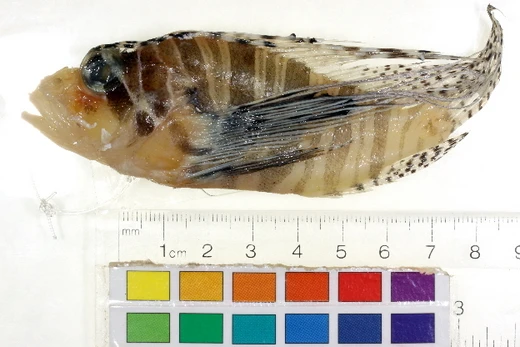
Scorpaenidae
A family of venomous marine fishes with sharp, mucus-coated spines.

Scorpaenidae, commonly called scorpionfish, is a family of fish that live mostly in saltwater and contain some of the most venomous species on Earth. Their name comes from their method of defense: they possess sharp spines coated in a venomous mucus, similar to a sting. These fish are found widely across tropical and temperate seas, particularly in the Indo-Pacific region. They are not the same as cabezones (genus *Scorpaenichthys*), which belong to a different but related family, Cottidae.
The family Scorpaenidae was first described in 1826 by French naturalist Antoine Risso. In the fifth edition of *Fishes of the World*, it was placed in the suborder Scorpaenoidei of the order Scorpaeniformes, but more recent authorities put it in the suborder Scorpaenoidei of the order Perciformes. A major revision in 2018 reclassified several groups: former subfamilies like Synanceiidae and Plectrogeniidae are now separate families, while former tribes like Pteroinae are now treated as subfamilies.
The family is divided into six subfamilies, containing 39 genera and at least 388 species. These subfamilies are Scorpaeninae (scorpionfishes and lionfishes), Caracanthinae (orbicular velvetfishes or coral crouchers), Pteroinae (turkeyfishes and lionfishes), Setarchinae (deep-sea bristly scorpionfishes), Sebastolobinae (thornyheads), and Sebastinae (rockfishes). Fossil otoliths of scorpaenids date back to the mid-Eocene, though body fossils appear only from the Oligocene or Miocene.
Scorpionfish have a compressed body, and their heads usually feature ridges and spines. The operculum has one or two spines (typically two that diverge), and the preoperculum has three to five spines (usually five). The suborbital stay is normally firmly attached to the preoperculum, though in some species it is not. If scales are present, they are usually ctenoid. They typically have a single dorsal fin, often notched, with 11 to 17 spines and 8 to 17 soft rays. The anal fin usually has one to three spines (typically three) and three to nine soft rays (usually five). The pelvic fin has one spine and two to five soft rays (again, typically five), while the large pectoral fin has 11 to 25 soft rays, sometimes with a few lower rays free of the membrane. The gill membranes are not attached to the isthmus. Some species lack a swim bladder.
Quick Facts
- Taxon
- Scorpaenidae
- Type Species
- Scorpaena porcus
- Type Species Authority
- Linnaeus, 1758
Facts from the source article.
Lore & Background
Scorpaenidae was described as a family in 1826 by the French naturalist Antoine Risso. The family was included in the suborder Scorpaenoidei of the order Scorpaeniformes in the fifth edition of Fishes of the World, but more recent authorities place it in the suborder Scorpaenoidei of the order Perciformes. Following a major revision in 2018, several groups previously treated as subfamilies, such as Synanceiidae and Plectrogeniidae, are now treated as their own families, while several tribes, such as Pteroinae, are now treated as subfamilies.
The Scorpaenidae have a compressed body with the head typically having ridges and spines. One or two spines are on the operculum, with two normally being divergent, and three to five on the preoperculum. The dorsal fin contains between 11 and 17 spines and 8 and 17 soft rays, while the anal fin usually has between one and three spines and three to nine soft rays. Venom glands are in the spines of the dorsal, anal, and pelvic fins in some species. Most species use internal fertilisation, and some are ovoviviparous while others lay eggs in a gelatinous mass; Scorpaena guttata reportedly creates a gelatinous 'egg balloon' as large as 20 cm across.
Reader's Guide
Scorpaenidae are notable for their venomous spines, which deliver a sting coated with venomous mucus, making them among the world's most venomous fishes. The family is widespread in tropical and temperate seas, especially in the Indo-Pacific, and includes invasive species such as lionfishes of the genus Pterois, which have become established in the Caribbean and eastern Mediterranean Sea. The family's taxonomy has been revised, with the 2018 revision elevating some former subfamilies to family status and reclassifying tribes as subfamilies. Fossil otoliths of scorpaenids are known from as early as the mid-Eocene, though body fossils appear only during the Oligocene or Miocene. The family includes both the largest species, the shortraker rockfish reaching 108 cm, and many species with maximum lengths of only 5 cm. Their habitats range from reefs to estuaries, bays, and lagoons, and they are found in marine and brackish waters.
Did You Know?
- The family includes many of the world's most venomous species, with venom glands in the spines of the dorsal, anal, and pelvic fins.
- The largest species is the shortraker rockfish (Sebastes borealis), reaching a maximum total length of 108 cm.
Venom and Defensive Armament
Scorpionfish have earned their reputation as among the most venomous marine creatures through a specialized multi-point defensive system. Rather than relying on a single stinger, these fishes deploy sharp spines along their dorsal, anal, and pelvic fins, each coated with venomous mucus produced by associated venom glands. This layered arsenal means that a careless hand or foot stepping on a camouflaged specimen can receive several simultaneous envenomations. The spines are not merely passive structures; they are integrated into the fish's overall skeletal architecture, with the head itself bearing ridges and additional spiny projections. The operculum typically carries one or two divergent spines, while the preoperculum bears three to five, usually five. This arrangement of venomous and non-venomous spines across the head and fins creates a formidable barrier that deters predators and, unfortunately, injures divers and fishers who encounter these ambush predators in their natural reef habitats.
Taxonomic History and Major Revisions
The formal recognition of Scorpaenidae as a distinct family traces back to 1826, when French naturalist Antoine Risso first described the group. For much of the twentieth century, the family sat within the suborder Scorpaenoidei under the order Scorpaeniformes, as reflected in the fifth edition of Fishes of the World. However, taxonomic thinking shifted, and more recent authorities reclassified the family into the suborder Scorpaenoidei within the broader order Perciformes. A particularly consequential revision arrived in 2018, reshaping the family's internal architecture. Groups that had long been treated as subfamilies—Synanceiidae and Plectrogeniidae among them—were elevated to full family status, while certain tribes previously nested inside Scorpaenidae, such as Pteroinae, were promoted to subfamily rank. The current framework recognizes six subfamilies encompassing 39 genera and at least 388 species, a diversity spanning from the familiar lionfishes and rockfishes to the lesser-known velvetfishes and thornyheads.
Morphology and Reproductive Strategies
Scorpaenidae members share a broadly compressed body plan, with heads that are often heavily ridged and spined. Scales, when present, are typically ctenoid. The single dorsal fin is frequently incised and carries between 11 and 17 spines alongside 8 to 17 soft rays, while the anal fin usually presents one to three spines—most commonly three—and three to nine soft rays. The large pectoral fin ranges from 11 to 25 soft rays, with some species showing lower rays that extend free of the fin membrane. Notably, the gill membranes do not attach to the isthmus, and some species lack a swim bladder entirely. Reproductively, most scorpaenids rely on internal fertilization. Some are ovoviviparous, while others deposit eggs in gelatinous masses; the species Scorpaena guttata has been reported to produce an egg balloon measuring up to 20 centimeters across. Size variation within the family is striking: the shortraker rockfish, Sebastes borealis, reaches a maximum total length of 108 centimeters, whereas many species top out at just 5 centimeters.
Geographic Range and Invasive Impact
Scorpaenidae are predominantly a Pacific and Indian Ocean family, with their greatest diversity concentrated in the Indo-Pacific region, though several species also inhabit the Atlantic. Their habitat preferences span marine and brackish waters, with a strong association with coral reefs, yet they are equally at home in estuaries, bays, and lagoons. Fossil evidence, in the form of otoliths, pushes the family's history back to the mid-Eocene, while body fossils only appear during the Oligocene or Miocene epochs. Beyond their native ranges, certain scorpaenids have become ecologically disruptive. The lionfishes of the genus Pterois, members of the subfamily Pteroinae, have established themselves as invasive non-native species in the Caribbean and the eastern Mediterranean Sea, where they prey upon local reef fish. This invasive success underscores how a family long adapted to the warm, biodiverse waters of the Indo-Pacific can, when translocated, destabilize ecosystems far from its evolutionary home.
Frequently Asked Questions
What exactly is Scorpaenidae?
Scorpaenidae is a family of venomous saltwater fish spanning 39 genera and at least 388 species. Members are best known for their sharp, mucus-coated defensive spines and their wide distribution across the world's oceans.
How do scorpionfish and lionfish defend themselves?
They carry 11 to 17 dorsal-fin spines that are coated in a venomous mucus, delivering a painful sting to anything that brushes against them. This stinging mechanism is the trait behind the common name 'scorpionfish'.
Where do Scorpaenidae live?
These fish inhabit tropical and temperate marine environments around the globe, with the Indo-Pacific region hosting especially high diversity. They are strictly saltwater species and are not found in freshwater systems.
How big can a scorpionfish get?
The family covers a remarkable size range, from species that max out at just 5 cm to the shortraker rockfish (Sebastes borealis), which can reach 108 cm in total length.
Who first described the family Scorpaenidae?
French naturalist Antoine Risso formally described the family in 1826, establishing the taxonomic group that now encompasses nearly 400 species across 39 genera.
More in Lionfish and Scorpionfish 1-24
Spotted an error? Know more?
Reader corrections go straight into our review queue. Suggest an edit · How this site is sourced