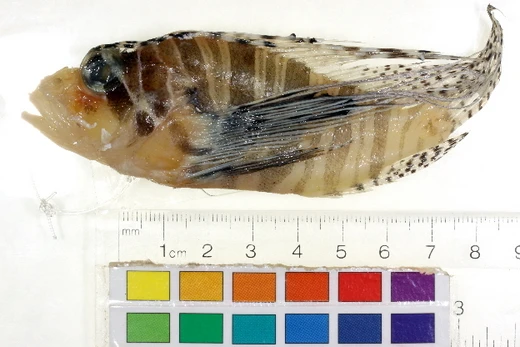
Sebastinae
Marine fish subfamily with venomous spines and ovoviviparous reproduction.

Sebastinae is a subfamily within the family Scorpaenidae, which itself belongs to the order Scorpaeniformes. These marine fish go by several common names, such as rockfishes, rock perches, ocean perches, sea perches, and rockcods. However, despite being called rockcods, they are not closely related to true cods (genus *Gadus*) or to the rock cod *Lotella rhacina*.
The grouping now known as Sebastinae (or Sebastidae) was first formally described in 1873 by German naturalist Johann Jakob Kaup. Whether it should be considered its own family or a subfamily of Scorpaenidae is debated. FishBase treats it as a distinct family, but the Integrated Taxonomic Information System and the 5th Edition of *Fishes of the World* place it as a subfamily within Scorpaenidae. Eschmeyer's *Catalog of Fishes* also classifies it as a subfamily, but it further separates the Sebastolobinae (once considered a tribe within Sebastinae) into its own subfamily.
The subfamily contains these genera: *Helicolenus*, *Hozukius*, *Sebastes*, and *Sebastiscus*.
Members of Sebastinae have a compressed body, and their heads typically feature ridges and spines. Their gill membranes are not attached to the isthmus. Venom glands are present in the spines of the dorsal, anal, and pelvic fins. The largest species is the shortraker rockfish (*Sebastes borealis*), which can reach 108 cm (43 in) in total length, while the smallest is *Sebastes koreanus*, maxing out at 13.7 cm (5.4 in).
These rockfishes live in the Pacific, Indian, and Atlantic Oceans. The largest genus, *Sebastes*, contains over 100 species and is mostly found in the North Pacific; these fish are ovoviviparous. They inhabit both marine and brackish waters.
Quick Facts
- Taxon
- Sebastinae
Facts from the source article.
Lore & Background
Sebastinae was first formally recognised as a grouping in 1873 by the German naturalist Johann Jakob Kaup. Some authorities recognise this family as distinct from Scorpaenidae. FishBase does, but the United States Federal government's Integrated Taxonomic Information System and the 5th Edition of Fishes of the World do not, classifying it as a subfamily of Scorpaenidae. Eschmeyer's Catalog of Fishes classifies it as a subfamily of Scorpaenidae, but also classifies the Sebastolobinae as a different subfamily.
Sebastinae species have a compressed body with the head typically having ridges and spines. The gill membranes are not attached to the isthmus. There is a venom gland in the spines of the dorsal, anal and pelvic fins. The largest species is the shortraker rockfish (Sebastes borealis) which attains a maximum total length of 108 cm, while the smallest species is Sebastes koreanus which reaches a maximum total length of 13.7 cm.
Sebastinae rockfishes are found in the Pacific, Indian and Atlantic Oceans with most species in the largest genus, the ovoviviparous Sebastes with over 100 species, in the North Pacific. They can be found in marine and brackish waters.
Reader's Guide
Sebastinae holds significance as a diverse subfamily of marine fish, notable for its venomous fin spines and the taxonomic debate surrounding its classification. The group includes the genus Sebastes, which contains over 100 species, most found in the North Pacific, and is ovoviviparous. The subfamily's common names—rockfishes, rock perches, ocean perches, sea perches, and rockcods—reflect its widespread recognition, though the article clarifies it is not closely related to true cods. The largest species, the shortraker rockfish, reaches 108 cm, while the smallest, Sebastes koreanus, reaches only 13.7 cm. The taxonomic uncertainty persists: some authorities treat Sebastinae as a distinct family (Sebastidae), while others, including the Integrated Taxonomic Information System and Fishes of the World, place it within Scorpaenidae. This ongoing dispute highlights the complexity of fish classification. The subfamily's distribution across the Pacific, Indian, and Atlantic Oceans, and its presence in both marine and brackish waters, underscores its ecological adaptability. The venom glands in its dorsal, anal, and pelvic fins serve as a defensive adaptation, contributing to its survival in diverse habitats.
Did You Know?
- The largest species is the shortraker rockfish (Sebastes borealis), reaching 108 cm total length.
- The smallest species is Sebastes koreanus, reaching only 13.7 cm total length.
- Most species in the genus Sebastes are ovoviviparous and found in the North Pacific.
Taxonomic Identity & Genera
Sebastinae, commonly referred to as rockfishes, was established as a subfamily by Kaup in 1873. It sits within the family Scorpaenidae, which was first described as a family by the French naturalist Antoine Risso back in 1826. The subfamily encompasses four genera: Helicolenus (Goode and Bean, 1896), Hozukius (Matsubara, 1934), Sebastes (Cuvier, 1829), and Sebastiscus (Jordan and Starks, 1904). Taxonomically, Scorpaenidae has experienced notable reclassification over the years. In the fifth edition of Fishes of the World, the family was placed in the suborder Scorpaenoidei under the order Scorpaeniformes, but more recent authorities have shifted it to the suborder Scorpaenoidei within Perciformes. A major 2018 revision further reshuffled the family's internal structure, elevating several former subfamilies to full family status and promoting certain tribes to subfamily rank. Sebastinae, however, retained its standing as a subfamily through all of these changes.
Morphological Profile
Members of the Scorpaenidae family, including the rockfishes of Sebastinae, display a distinctly compressed body plan with heads that typically bear prominent ridges and spines. The operculum carries one or two spines, usually divergent, while the preoperculum hosts three to five, most commonly five. Scales, when present, are ctenoid in type. A single dorsal fin, often incised along its edge, spans 11 to 17 spines paired with 8 to 17 soft rays. The anal fin typically presents three spines alongside three to nine soft rays, and the pelvic fin bears a single spine with two to five soft rays. Pectoral fins are notably large, containing 11 to 25 soft rays, with some lower rays occasionally free of the fin membrane. Gill membranes remain unattached to the isthmus. In certain species, venom glands are associated with the spines of the dorsal, anal, and pelvic fins. Reproductive strategies vary: most employ internal fertilization, with some being ovoviviparous while others deposit eggs in gelatinous masses.
Range & Habitat
The Scorpaenidae, of which Sebastinae forms a part, are predominantly distributed across the Pacific and Indian Oceans, with a smaller representation in the Atlantic. Their preferred environments span marine and brackish-water settings. While reefs constitute their most typical habitat, rockfishes and their close relatives are also encountered in estuaries, bays, and lagoons, demonstrating a degree of ecological flexibility beyond strict reef association. The family's geographic reach extends across both tropical and temperate seas, with a particularly dense concentration in the Indo-Pacific region. It is worth noting that certain members of the broader family, such as the lionfishes of the genus Pterois, have become invasive non-native species in regions like the Caribbean and the eastern Mediterranean Sea, though this phenomenon is not specifically attributed to Sebastinae. The family's presence in diverse water types and coastal configurations underscores the adaptability of scorpaenid fishes to varied marine environments.
Size Spectrum & Deep Time
The size range within Scorpaenidae is striking. At the upper extreme, the shortraker rockfish (Sebastes borealis), a member of the genus Sebastes within Sebastinae, reaches a maximum total length of 108 centimetres (approximately 43 inches), making it the largest species in the entire family. At the opposite end, numerous scorpaenid species cap out at mere 5 centimetres (about 2 inches) in total length. This extraordinary variation means that rockfishes share their family with both substantial forms and diminutive specialists. The deep-time record of scorpaenids is equally remarkable: fossil otoliths of the family date back to the mid-Eocene epoch, providing evidence of their ancient lineage. However, body fossils do not appear in the geological record until the Oligocene or Miocene, leaving a gap of millions of years between the earliest hard-part evidence and the first preserved skeletal remains. This fossil trajectory suggests a long evolutionary history for the group that includes today's rockfishes.
Frequently Asked Questions
What exactly is Sebastinae?
Sebastinae is a subfamily of marine fish nested inside the family Scorpaenidae (order Scorpaeniformes). Anglers and enthusiasts usually know them by their common names—rockfishes, rock perches, ocean perches, sea perches, or rockcods—even though they share no close kinship with true cods (genus Gadus) or the rock cod Lotella rhacina.
Who first formally described Sebastinae and when?
German naturalist Johann Jakob Kaup gave the group its first formal taxonomic recognition back in 1873. That single 19th-century description is still the reference point for every modern discussion of the group's boundaries.
Is Sebastinae a family or just a subfamily?
This is one of the most hotly debated points in the community: some taxonomists elevate it to a full family (Sebastidae), while others keep it as a subfamily within Scorpaenidae. FishBase and other major databases still list it as a subfamily, so the question remains genuinely unresolved.
What's the size range across Sebastinae species?
The group spans a remarkable spread, from the tiny Sebastes koreanus, which tops out around 13.7 cm (5.4 in), all the way up to the shortraker rockfish (Sebastes borealis), which can reach 108 cm (43 in) in total length. That means the largest species is roughly eight times the size of the smallest.
What are the key biological traits that set Sebastinae apart?
Every member of the subfamily carries venomous spines, making them dangerous to handle and a cautionary note for divers. They also reproduce ovoviviparously, meaning females carry developing embryos internally and give birth to free-swimming young rather than releasing eggs into the water.
More in Lionfish and Scorpionfish 1-24
Spotted an error? Know more?
Reader corrections go straight into our review queue. Suggest an edit · How this site is sourced