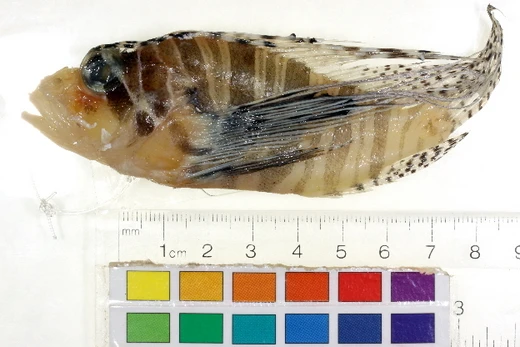
Brachypterois
A genus of scorpionfishes with short dorsal spines and venom glands.

Brachypterois is a genus of marine ray-finned fish in the scorpionfish family, Scorpaenidae. These fish are found in the Indian Ocean and the western Pacific Ocean. The genus was first established in 1938 by American zoologist Henry Weed Fowler, who described *Brachypterois serrulifer* from the Philippines as its sole species at that time.
The genus name combines the prefix *brachy*, meaning "short," with the genus name *Pterois*, referring to the shorter dorsal fin spines of these fish compared to those in *Pterois*. Initially considered monotypic, with *Sebastes serrulatus* (described by John Richardson in 1846) treated as a senior synonym of Fowler's *B. serrulifer*, a 2013 review of many specimens across the genus's wide range concluded that three valid species exist and that Fowler's *B. serrulifer* is distinct from Richardson's *B. serrulata*.
Three species are currently recognized: *Brachypterois curvispina* (Australian sawcheek scorpionfish), *Brachypterois serrulata* (sawcheek scorpionfish), and *Brachypterois serrulifer* (sawmaxilla scorpionfish).
These fish typically have 13 dorsal fin spines (occasionally 12 or 14), three anal fin spines, and 5–8 branched rays in the caudal fin with three procurrent rays on each side. The maxilla is covered in scales, and there are clear ridges on the jaw. The intraorbital space is flat and scaled. The spines of the dorsal, anal, and pelvic fins have distinct notches containing venom glands. There are no teeth on the palatine bone. The orbit and suborbital ridge are distinctly closed, and there are five spines on the preoperculum. They are relatively small, with maximum total lengths ranging from 12.6 cm (5.0 in) in *B. curvispina* to 15.5 cm (6.1 in) in *B. serrulifer*.
The most widespread species, *B. serrulifer*, occurs from East Africa to the Philippines. *B. curvispina* is endemic to northeastern Australia, while *B. serrulata* is found in the western Pacific from the Gulf of Thailand to southern Japan.
Quick Facts
- Taxon
- Brachypterois
- Type Species
- Brachypterois serrulifer
- Type Species Authority
- Fowler, 1938
Facts from the source article.
Lore & Background
The genus name Brachypterois combines the prefix 'brachy', meaning 'short', with the genus name Pterois, referring to the shorter dorsal fin spines of these fishes compared to Pterois species. The genus was originally considered monotypic, with Sebastes serrulatus (described by John Richardson in 1846) regarded as a senior synonym of Fowler's B. serrulifer. However, a review published in 2013 examined many specimens from across the genus's wide distribution and concluded that three valid species exist, and that Fowler's B. serrulifer is a separate species from Richardson's B. serrulata.
Brachypterois species are characterized by having typically 13 dorsal fin spines (infrequently 12 or 14), 3 anal fin spines, 5–8 branched rays in the caudal fin, and 3 procurrent rays on each side. The maxilla is clothed in scales, there are clear ridges on the jaw, and the intraorbital space is flat and scaled. The dorsal, anal, and pelvic fin spines have clear notches containing venom glands. There are no palatine teeth, the orbit and suborbital ridge are distinctly closed, and there are 5 spines on the preoperculum. These are relatively small scorpionfishes, with maximum total lengths ranging from 12.6 cm in B. curvispina to 15.5 cm in B. serrulifer.
Reader's Guide
The significance of Brachypterois lies in its taxonomic history and the resolution of species boundaries within the genus. Initially described as monotypic by Henry Weed Fowler in 1938, the genus was long considered to contain only one species, with Richardson's earlier Sebastes serrulatus treated as a senior synonym. The 2013 review of the genus, which examined many specimens from across its wide distribution, overturned this view by recognizing three valid species: B. curvispina, B. serrulata, and B. serrulifer. This revision clarified that Fowler's B. serrulifer is distinct from Richardson's B. serrulata. The genus is classified within the tribe Pteroini of the subfamily Scorpaeninae, and its name reflects a morphological distinction from related Pterois species—namely, shorter dorsal fin spines. The presence of venom glands in notches on the dorsal, anal, and pelvic fin spines is a notable characteristic shared with other scorpionfishes. The distribution of the genus spans the Indo-Pacific region, with B. serrulifer being the most widespread, found from East Africa to the Philippines; B. curvispina endemic to northeastern Australia; and B. serrulata occurring in the western Pacific from the Gulf of Thailand to southern Japan.
Did You Know?
- The genus name Brachypterois means 'short Pterois', referring to its shorter dorsal fin spines.
- Brachypterois was first described in 1938 by American zoologist Henry Weed Fowler.
- A 2013 review recognized three valid species in the genus, resolving a long-standing synonymy.
- The dorsal, anal, and pelvic fin spines of Brachypterois have notches containing venom glands.
Taxonomic History and the Meaning of the Name
The story of how this small scorpionfish earned its scientific name stretches back to 1846, when the Scottish naval surgeon and Arctic explorer John Richardson formally described the species under the name Sebastes serrulatus, citing waters off Dong Kang in Pigtung, southern Taiwan, as the type locality. For well over a century, taxonomists treated Richardson's name as a senior synonym of B. serrulifer, a species originally described by Fowler. That assumption persisted until a comprehensive 2013 review of the genus Brachypterois, in which researchers examined numerous specimens collected across the genus's broad geographic range. That study concluded the genus actually contains three valid species and that Fowler's B. serrulifer is a distinct taxon separate from Richardson's original description. The specific epithet serrulata derives from a diminutive form of the Latin word serra, meaning saw. Richardson chose this name to highlight the low, slender, serrated crests running along the head, a feature that sets this species apart from the more robust rows of spines characteristic of other rockfishes once grouped within the genus Sebastes.
Fin Structure and Skeletal Details
Brachypterois serrulata is a compact fish, reaching a maximum total length of just fifteen centimetres. Its fin architecture is relatively modest: the dorsal fin carries thirteen spines alongside ten or eleven soft rays, while the anal fin holds three spines paired with five or six soft rays. The pectoral fin typically bears between fourteen and sixteen rays, with fifteen being the most common count. Several skeletal details help distinguish this species from its close relatives. The posterior lacrimal spine points straight backward rather than curving upward at its tip. On the outer angular ridge, the spines at the corner are no larger than their neighbours and point downward rather than projecting prominently. The middle lateral ridge on the maxilla frequently lacks spines entirely, though larger adults exceeding eight centimetres in standard length may develop one to three small spines in that position. These subtle morphological traits, taken together, form the basis for separating B. serrulata from the similar B. serrulifer and for recognising the three valid species now acknowledged within the genus.
Colouration and Markings
The colour scheme of B. serrulata is warm and muted. The head and body range from pinkish to reddish brown, fading paler along the lower flanks. A single ill-defined black blotch, slightly smaller than the eye's diameter, sits on the operculum. Five bands in dark red to black cross the head: the first sweeps from the front of the eye across the snout to the lower jaw tip; the second runs from the lower front of the eye onto the lacrimal bone and both jaws; the third extends from beneath the eye to the upper rear corner of the maxilla; the fourth stretches from the lower rear of the eye to the rear operculum; and the fifth links the rear eye margin to the operculum, partly merging with the black blotch. Five faint vertical dark bands mark the body, the fourth y-shaped and the last on the caudal peduncle. The fins share the body's pinkish-brown base, overlaid with dotted dark red lines and diagonal bands. The caudal fin membrane is translucent with a dark red marginal band and sixty to one hundred and ten tiny dark red spots on the rays. The eye is bright yellow with a dark blue iris.
Geographic Range and Habitat Preference
Brachypterois serrulata is native to the northwestern Pacific Ocean, with its range spanning from the Gulf of Thailand in the south to southern Japan in the north. This distribution includes the South China Sea and the waters surrounding Taiwan. Its preferred environment consists of muddy, sheltered settings, particularly deep or very enclosed estuaries. The small maximum total length of fifteen centimetres is consistent with a fish that moves through the confined, sediment-rich waters of these estuarine systems. The broad geographic span from the Gulf of Thailand to southern Japan represents a considerable latitudinal range within the northwestern Pacific. The type locality, off Dong Kang in Pigtung, southern Taiwan, falls within the central portion of this range. The consistent association with muddy substrates and the enclosed conditions of sheltered estuaries defines the primary habitat of this species, a quiet, sediment-laden niche that suits a small, camouflaged scorpionfish.
Frequently Asked Questions
What is Brachypterois?
It is a genus of venomous, ray-finned scorpionfishes in the family Scorpaenidae. These fish are set apart from the more famous Pterois by their noticeably shorter dorsal fin spines and associated venom glands.
Who first described Brachypterois and when?
American zoologist Henry Weed Fowler established the genus back in 1938. He named it after describing Brachypterois serrulifer, a specimen collected from the Philippines.
What does the name Brachypterois actually mean?
It's a Latinized mash-up of the Greek prefix brachy (short) and the genus name Pterois. The name is essentially a shorthand for 'the short-spined Pterois,' pointing to the reduced dorsal spine length compared to that genus.
How many valid species are in Brachypterois today?
Three species are currently recognized as valid within the genus. It was originally treated as monotypic with just B. serrulifer, but subsequent taxonomic work expanded the group.
Where do Brachypterois species live in the wild?
They are native to tropical reef habitats spanning the Indian Ocean and the western Pacific Ocean. The type species was originally collected in Philippine waters, anchoring the genus's Pacific distribution.
More in Lionfish and Scorpionfish 1-24
Spotted an error? Know more?
Reader corrections go straight into our review queue. Suggest an edit · How this site is sourced