Parapterois
Venomous lionfish relatives from the Indian Ocean and West Pacific.

Parapterois is a genus of venomous, ray-finned marine fish in the scorpionfish family Scorpaenidae. They are found in the Indian Ocean and nearby waters. One species, *Parapterois heterura*, sometimes appears in the aquarium trade.
The genus was established in 1876 by Dutch physician and ichthyologist Pieter Bleeker. He designated *Pterois heterurus*—a species he had described from Ambon Island in 1856—as the type species. The name *Parapterois* combines the Greek *para* ("near") with *Pterois*, the genus where Bleeker originally placed *P. heterura*. This genus belongs to the tribe Pteroini within the subfamily Scorpaeninae.
Two species are currently recognized. A third, *Parapterois nigripinnis* from the southwestern Indian Ocean, is considered valid by the Catalog of Fishes but treated as a synonym of *P. heterura* by FishBase.
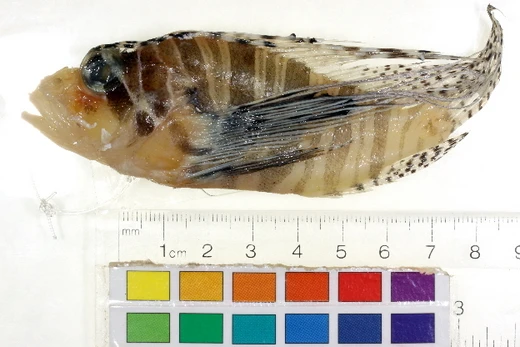
These fish have red-and-white bodies and expanded pectoral fins. Most adults reach about 11 centimeters (4 inches) in length. *Parapterois* differs from *Pterois* in several ways: it has more pectoral fin rays (18–21 versus 12–17), and these rays may be branched, whereas they are never branched in *Pterois*. It also has two anal fin spines instead of three. A more obvious trait is the truncated caudal fin with elongated upper and lower rays, while *Pterois* has a rounded tail.
*Parapterois* species are native to the Indian Ocean and the western Pacific Ocean. Though other lionfish are popular, *Parapterois* are rarely sold in the aquarium trade. *P. heterura* is occasionally available from online marine fish retailers, but it remains uncommon.
- Genus author
- Pieter Bleeker
- Year described
- 1876
- Type species
- Pterois heterurus
- Type species origin
- Ambon Island
- Number of species
- 2
- Maximum length
- about 11 cm (4 in)
- Pectoral fin ray count
- 18–21
Lore & Background
Parapterois was described as a genus in 1876 by the Dutch physician, herpetologist and ichthyologist Pieter Bleeker. Bleeker designated Pterois heterurus, which he had described from Ambon Island in 1856, as the type species of the new genus. This genus is classified within the tribe Pteroini of the subfamily Scorpaeninae within the family Scorpaenidae. The genus name is a compound of para meaning 'near' and Pterois, the genus Bleeker originally placed P. heterura in.
There are currently two recognized species in this genus. A third species, Parapterois nigripinnis of the southwestern Indian Ocean, is recognised as valid by the Catalog of Fishes but FishBase treats it as a synonym of P. heterura.
Parapterois bodies are red and white, and their pectoral fins are expanded. These fish are venomous. However, most specimens are much smaller; larger adults of both species are about 11 centimetres (4 in) in length. A number of differences set this genus apart from Pterois: Parapterois have more (18–21) pectoral fin rays than Pterois (12–17), and these rays may be branched, while they are never branched in Pterois. Parapterois have two anal fin spines, while Pterois have three. Also, the caudal fin of these fish are truncated with longer upper and lower caudal fin rays, while the caudal fin in Pterois is rounded.
Reader's Guide
Parapterois species are native to the Indian Ocean and the West Pacific Ocean. Despite the popularity of other lionfish, Parapterois species are only rarely found in the aquarium trade. P. heterura can be found on certain online marine aquarium fish stores, but is not common. The genus is notable for its venomous spines and its distinct anatomical differences from the related genus Pterois, including a higher number of pectoral fin rays, branched rays, two anal fin spines, and a truncated caudal fin with elongated upper and lower rays. The taxonomic uncertainty regarding Parapterois nigripinnis—recognized by the Catalog of Fishes but treated as a synonym by FishBase—highlights ongoing debate in ichthyology. The genus was established by Pieter Bleeker, a prominent Dutch naturalist, based on a species he originally described from Ambon Island. Its limited presence in the aquarium trade contrasts with the popularity of other lionfish, making it a rare find for enthusiasts.
Did You Know?
- The type species, Pterois heterurus, was originally described from Ambon Island in 1856.
- Parapterois have 18–21 pectoral fin rays, while the related genus Pterois has 12–17.
Taxonomy & the Question of Identity
Parapterois heterura entered the scientific record in 1856 when the Dutch physician and ichthyologist Pieter Bleeker formally described it under the name Pterois heterurus, designating Ambon Island as the type locality. Two decades later, in 1876, Bleeker established the genus Parapterois, and this species became its type. The name heterura translates to "different tail," a reference to the notably long, flared caudal fin whose upper ray bears a filamentous extension. The taxonomic picture grew more complicated in 1904, when Scottish-born South African ichthyologist John Dow Fisher Gilchrist described a fish from the mouth of the Ohlanga River in KwaZulu-Natal as Pterois nigripinnis. To this day, some authorities maintain that this southwestern Indian Ocean population deserves recognition as a distinct species, Parapterois nigripinnis, while others lump it with P. heterura. The debate underscores how geographic separation can blur the boundaries between what we call a single species and two.
Anatomy & the Puzzle of Near-Identical Cousins
The blackfoot firefish reaches a maximum total length of roughly 38 centimeters, though most adults measure closer to 11 centimeters. Its dorsal fin carries thirteen spines, each tipped with a long filament, followed by nine soft rays; the anal fin holds two spines and seven or eight soft rays. The outer rays of the caudal fin also extend into delicate filaments, giving the tail a lacy, irregular silhouette. Morphologically, P. heterura is strikingly close to its relative P. macrura. The two share nearly identical counts of fin spines, fin rays, and gill rakers, and their overall body proportions are almost the same. The key distinguishing feature is a small patch of scales nestled in a pit between the posterior nostrils, present in P. heterura but absent in P. macrura. In adult specimens, the upper margin of the eye sits below the base of the first dorsal spine in P. heterura, whereas it sits above in P. macrura. Juveniles of both species, however, can show the eye margin below, making young fish genuinely hard to tell apart.
Nocturnal Hunter and Master of Disguise
Parapterois heterura is a largely sedentary, nocturnal creature that spends daylight hours partially buried in the sandy or muddy substrate, rendering it nearly invisible to passing observers. This habit of sinking into the seafloor makes the fish exceptionally difficult to spot during the day. When disturbed, it flashes its vividly colored pectoral fins in a sudden display. While this dramatic reveal can startle a predator into hesitation, research on related lionfishes suggests the fins serve a more active purpose: they are used to corral and corner small prey during hunts. The fish's diet consists of small fish and bottom-dwelling invertebrates, which it ambushes from its buried position. Despite its low-key lifestyle, P. heterura has found a secondary life in the aquarium trade, where its striking pectoral fin colors and unusual filamentous tail rays make it a point of visual interest. Its modest adult size, typically around 11 centimeters, and its natural preference for soft sandy or muddy bottoms make it a species that suits a particular niche in the hobbyist world.
Two Oceans, One Species
The distribution of Parapterois heterura is notably fragmented, appearing to comprise two geographically isolated populations. One range hugs the southeastern African coast, particularly the waters off Natal in South Africa. The other spans the central Indo-Pacific, stretching from Japanese coastal waters through Indonesia, New Guinea, and into Australian seas. Within each of these broad regions, the fish favors sheltered coastal bays where the seafloor is composed of fine sand or soft mud—conditions that suit its burrowing lifestyle. Vertically, it occupies a wide depth band from about 40 meters down to 300 meters, a range that places much of its habitat well below the surface. The fact that the same species name applies to fish on opposite sides of the Indian Ocean, separated by vast stretches of open water, raises questions about how these populations remain connected, if at all. The ongoing taxonomic debate over whether the African form, P. nigripinnis, is truly conspecific with the Indo-Pacific populations adds further uncertainty to our understanding of this fish's biogeography.
Frequently Asked Questions
What is Parapterois?
Parapterois is a small genus of venomous, ray-finned marine fish in the scorpionfish family Scorpaenidae. It contains two species and is sometimes nicknamed a "near-lionfish" because of its close kinship with the genus Pterois.
Who established the genus Parapterois and when?
Dutch physician and ichthyologist Pieter Bleeker formally erected the genus in 1876. He designated Pterois heterurus—a species he had originally described from Ambon Island in 1856—as the type species.
How large do Parapterois species grow?
Members of this genus are quite small, topping out at roughly 11 centimetres (about 4 inches) in total length. They are noticeably smaller than many of their better-known lionfish relatives.
Where can you find Parapterois in the wild?
These fish inhabit the Indian Ocean and adjacent West Pacific waters. One species, Parapterois heterura, occasionally appears in the marine aquarium trade.
How is Parapterois related to Pterois (lionfish)?
The name itself—Greek para ("near") plus Pterois—signals that Bleeker regarded it as a close but distinct relative of the lionfish genus. Both sit within the tribe Pteroini of the scorpionfish family and share venomous dorsal spines with a broadly similar body plan.
More in Lionfish and Scorpionfish 1-24
Spotted an error? Know more?
Reader corrections go straight into our review queue. Suggest an edit · How this site is sourced