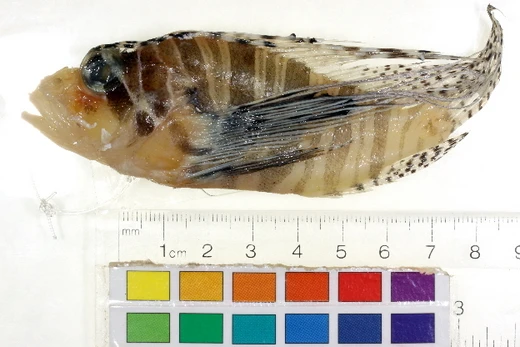
Brachypterois serrulata
A small scorpionfish with saw-like head crests and vivid fin markings.

Brachypterois serrulata, called the sawcheek scorpionfish or pygmy lionfish, is a scorpionfish species found in the northwestern Pacific Ocean.
Scottish naval surgeon, Arctic explorer, and naturalist John Richardson first formally described this species in 1846, naming it *Sebastes serrulatus*. The type locality is off Dong Kang in Picgtung, southern Taiwan. For a long time, this name was widely considered a senior synonym of Fowler's *B. serrulifer*. However, a 2013 review of the genus, which examined many *Brachypterois* specimens from across its broad range, concluded that three valid species exist within the genus and that Fowler's *B. serrulifer* is a separate species from Richardson's *B. serrulata*. The specific name *serrulata* is a diminutive of the Latin *serra*, meaning "saw," and refers to the low, slender, serrated crests on the head, rather than the rows of spines seen in other rockfishes of the genus *Sebastes*, where Richardson originally placed it.
This fish has 13 spines and 10 or 11 soft rays in its dorsal fin, while the anal fin has 3 spines and 5 or 6 soft rays. The pectoral fin has 14 to 16 fin rays, most often 15. The posterior lacrimal spine usually points backward without curving upward at its tip. The spines at the corner of the outer angular ridge are not well developed, are about the same size as the other spines on the ridge, and point downward. Often there are no spines on the middle lateral ridge of the maxilla, though larger adults with a standard length over 8 cm (3.1 in) may have 1 to 3 spines. The maximum total length is 15 cm (5.9 in).
The head and body range from pinkish to reddish brown, paler on the lower body, with an ill-defined black blotch slightly smaller than the eye's diameter on the operculum. The head has five dark red to black bands: the first runs from the front edge of the eye over the snout to the tip of the lower jaw; the second extends from the lower front edge of the eye onto the lacrimal bone and both jaws; the third runs from just under the eye to the upper rear corner of the maxilla; the fourth from the lower rear margin of the eye to the rear part of the operculum; and the fifth from the rear margin of the eye to the operculum, where it partly continues into the blotch. The body has five indistinct vertical dark bands, with the fourth spine being Y-shaped and the last on the caudal peduncle.
Quick Facts
- Taxon
- Brachypterois serrulata
Facts from the source article.
Lore & Background
Brachypterois serrulata was first formally described in 1846 as Sebastes serrulatus by the Scottish naval surgeon, Arctic explorer and naturalist John Richardson, with the type locality given as off Dong Kang in Picgtung in southern Taiwan. The specific name serrulata is a diminutive of the Latin serra meaning 'saw', referring to the low, slender and serrated crests on the head, rather than the rows of spines seen in other rockfishes of the genus Sebastes. This taxon was widely considered a senior synonym of Fowler's B. serrulifer, but a 2013 review of the genus examining many specimens concluded that three valid species exist and that B. serrulifer is a separate species from B. serrulata.
The species has 13 spines and 10 or 11 soft rays in its dorsal fin, and 3 spines and 5 or 6 soft rays in the anal fin. The pectoral fin has between 14 and 16 rays, with 15 being the most common. The posterior lacrimal spine is normally directed backwards without curving upward. The spines on the corner of the outer angular ridge are not well developed and are of similar size to other spines on the ridge, pointing downwards. Often there are no spines on the middle lateral ridge on the maxilla, though larger adults over 8 cm standard length may have 1 to 3 spines. The head and body color varies from pinkish to reddish brown, paler on the lower body, with an ill-defined black blotch on the operculum smaller than the eye's orbit. The head has five dark red to black bands, and the body has five indistinct vertical dark bands. The fins are similarly colored, with distinct blotches and lines of dots. The eye is bright yellow with a dark blue iris.
Reader's Guide
Brachypterois serrulata is significant as a species whose taxonomic history illustrates the challenges of distinguishing closely related scorpionfishes. For a long time it was considered the same as Brachypterois serrulifer, but a 2013 review of the genus, examining many specimens from across its wide distribution, determined that three valid species exist and that B. serrulifer is separate. This revision underscores the importance of detailed morphological study in resolving species boundaries. The species is also notable for its distinctive appearance: the saw-like crests on the head, referenced in its scientific name, and the complex pattern of dark bands and spots on the head, body, and fins, including a bright yellow eye with a dark blue iris. Its maximum total length of 15 cm makes it a relatively small member of the scorpionfish family. Ecologically, it inhabits muddy, sheltered habitats in deep or very sheltered estuaries in the northwestern Pacific Ocean, from the Gulf of Thailand to southern Japan, including the South China Sea and Taiwan. Its presence in such environments highlights the diversity of scorpionfishes in coastal and estuarine systems.
Did You Know?
- It was first described in 1846 as Sebastes serrulatus by John Richardson, with the type locality off Dong Kang in southern Taiwan.
- A 2013 review of the genus Brachypterois concluded that B. serrulata and B. serrulifer are separate species.
- The eye of Brachypterois serrulata is bright yellow with a dark blue iris.
Taxonomic Journey and Species Recognition
Brachypterois serrulata was first formally described in 1846 by John Richardson, a Scottish naval surgeon, Arctic explorer, and naturalist. He named it Sebastes serrulatus, placing it among the rockfishes, and designated its type locality as waters off Dong Kang in Pigtung, southern Taiwan. The specific epithet serrulata is a diminutive form of the Latin word serra, meaning saw, a nod to the low, slender, serrated crests adorning the head rather than the prominent rows of spines typical of other Sebastes species. For much of the following century, this taxon was widely regarded as a senior synonym of Fowler's B. serrulifer, effectively lumping the two together. That assumption was finally challenged in a 2013 comprehensive review of the genus Brachypterois. Researchers examined numerous specimens collected across the genus's broad geographic range and concluded that three valid species exist within the group. Crucially, they confirmed that Richardson's original B. serrulata and Fowler's B. serrulifer are indeed distinct species, restoring proper taxonomic separation to a pair that had been conflated for over a hundred and fifty years.
Striking Coloration and Head Markings
The sawcheek scorpionfish presents a vivid and intricate color palette. Its head and body display an overall hue ranging from pinkish to reddish brown, with the lower body appearing paler. A defining feature is an ill-defined black blotch on the operculum, slightly smaller than the diameter of the eye. The head bears five distinct bands colored dark red to black, each following a specific anatomical path: the first sweeps from the front margin of the eye over the snout to the tip of the lower jaw; the second extends from the lower front edge of the eye across the lacrimal bone and both jaws; the third runs from beneath the eye to the upper rear corner of the maxilla; the fourth stretches from the lower rear margin of the eye to the rear operculum; and the fifth connects the rear eye margin to the operculum, partially merging with the dark blotch. Five indistinct vertical dark bands also mark the body, with the fourth spine being Y-shaped and the last band sitting on the caudal peduncle. Perhaps most striking is the eye itself, which glows bright yellow set against a dark blue iris.
Fin Architecture and Structural Details
The fin structure of Brachypterois serrulata follows a precise and measurable pattern. The dorsal fin carries 13 spines alongside 10 or 11 soft rays, while the anal fin contains 3 spines and 5 or 6 soft rays. Pectoral fin rays number between 14 and 16, with the most common count being 15. Several subtle structural details help distinguish this species from its congeners. The posterior lacrimal spine typically points straight backward without curving upward toward its tip. Along the outer angular ridge, the spines at the corner are not well developed and remain similar in size to neighboring spines, all pointing downward. On the middle lateral ridge of the maxilla, spines are frequently absent, though larger adults exceeding 8 cm in standard length may occasionally bear between one and three. The species reaches a maximum total length of 15 cm. Fin coloration mirrors the body's pinkish to reddish brown tones, with a large dark red to black blotch on the spiny dorsal portion, 4 or 5 dotted dark red lines on the soft-rayed section, and 6 to 8 similar dotted lines on the anal fin.
Range and Estuarine Habitat
Brachypterois serrulata inhabits the northwestern Pacific Ocean, with its range stretching from the Gulf of Thailand northward to southern Japan. This distribution encompasses the South China Sea and the waters surrounding Taiwan, the region where Richardson first documented the species off Dong Kang in Pigtung during the mid-nineteenth century. The sawcheek scorpionfish is strongly associated with muddy, sheltered substrates, occurring specifically in deep or very sheltered estuaries. This habitat preference places it in calm, sediment-rich inshore waters. The species' modest maximum size of 15 cm and its overall pinkish to reddish brown coloration, marked with dark bands and an ill-defined opercular blotch, present a subdued palette consistent with the muted tones of muddy estuarine beds. The translucent caudal fin membrane, edged with a dark red band and scattered with 60 to 110 small dark red spots, adds a subtle yet distinctive element to an otherwise restrained appearance. Together, these traits characterize a small fish at home in the quiet, turbid conditions of sheltered estuarine habitats across a broad swath of the western Pacific.
Frequently Asked Questions
What is Brachypterois serrulata?
It's a small scorpionfish species commonly known as the sawcheek scorpionfish or pygmy lionfish, native to the northwestern Pacific. Its most eye-catching feature is the row of saw-toothed crests along its head, which gives the common name its 'sawcheek' nickname.
Who first described Brachypterois serrulata and when?
Scottish naval surgeon and Arctic explorer John Richardson formally named the species in 1846, originally publishing it under the binomial Sebastes serrulatus. The type locality he recorded was waters off the southern coast of Taiwan.
Where does Brachypterois serrulata live?
This species is restricted to the northwestern Pacific Ocean, with its original type locality off southern Taiwan. It occupies the broader geographic range shared by other Brachypterois species in that part of the Pacific.
What does Brachypterois serrulata look like?
It's a compact scorpionfish with distinctive serrated head crests and boldly patterned, vividly colored fins. These markings and the saw-like head structures are what set it visually apart from its close relatives in the genus.
What are Brachypterois serrulata's fin counts?
The species bears thirteen dorsal spines backed by ten or eleven soft dorsal rays, plus three anal spines. These counts are among the key diagnostic traits ichthyologists use to separate it from similar Brachypterois species.
More in Lionfish and Scorpionfish 1-24
Spotted an error? Know more?
Reader corrections go straight into our review queue. Suggest an edit · How this site is sourced