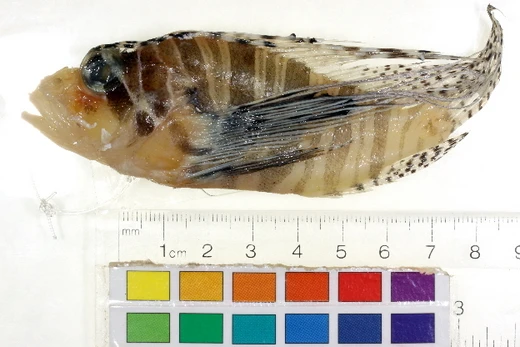
Setarchinae
Deep-sea bristly scorpionfishes of tropical and subtropical waters worldwide.

Setarchinae, commonly known as the deep-sea bristly scorpionfishes, are a small group of ray-finned fish that live in the deep ocean. They belong to the family Scorpaenidae. These marine fish are small, reaching a maximum length of 25 cm, and inhabit tropical and subtropical waters around the globe. The taxon was first described by Japanese ichthyologist Kiyomatsu Matsubara in 1943. In the 5th Edition of *Fishes of the World*, it is treated as a subfamily of Scorpaenidae within the order Scorpaeniformes. Other sources, such as FishBase, consider it a full family within the suborder Scorpaenoidei, part of the Perciformes. The name Setarchinae comes from the genus *Setarches*, named by English zoologist James Yate Johnson in 1862. Johnson did not explain the name, but it may derive from *saeta*, meaning "bristle."
Four genera are classified under Setarchinae, containing a total of 11 species: *Ectreposebastes*, *Lioscorpius*, *Lythrichthys*, and *Setarches*. *Lythrichthys* was previously regarded as a synonym of *Setarches* but has been treated as a valid genus by Catalog of Fishes with *Setarches* being considered to be a monotypic genus containing solely *S. guentheri*. The only known fossil member of the subfamily is †*Raususetarches* from the Late Miocene of Japan. These fish are distinguished from related species by a highly modified lateral line, reduced ossification, and a limited ability to move the head (supination). The lateral line lacks scales and forms a single trough; body scales are small and cycloid. Adults have no suborbital spines. They possess a small, sharp nasal spine, and the parietal bone is low, ending at the rear with a spine or spinule. Many spines are absent in large specimens; smaller individuals may have spines around the eye, but in larger fish only the postocular spine is well-defined. The dorsal fin has 12–13 spines (usually 12) and 9–11 soft rays, with the last ray divided near its base. The anal fin has 2–3 spines and 4–6 soft rays, the last ray also divided. Setarchinae are found in the Atlantic, Indian, and Pacific Oceans. They are offshore fish living at depths between 180 and 830 m. Examination of stomach contents from two species suggests they feed in the water column.
Quick Facts
- Taxon
- Setarchinae
Facts from the source article.
Lore & Background
The subfamily Setarchinae was first described as a taxon by Japanese ichthyologist Kiyomatsu Matsubara in 1943. The grouping is treated as a subfamily of Scorpaenidae within Scorpaeniformes by the 5th Edition of Fishes of the World, but other authorities such as FishBase regard it as a family within Scorpaenoidei of Perciformes. The name likely derives from saeta meaning 'bristle', though the original describer James Yate Johnson did not explain the etymology. Setarchinae species are differentiated by a highly modified lateral line lacking scales and consisting of a single trough, reduced ossification, and reduced head mobility (supination). Their body scales are small and cycloid. Adults lack suborbital spines, but possess a small, sharp nasal spine and a low parietal bone ending in a spine or spinule. In large specimens many spines are absent; smaller individuals have some spines around the eye, but only the postocular spine remains well defined in larger fish. The four genera are Ectreposebastes, Lioscorpius, Lythrichthys, and Setarches. Lythrichthys was previously considered a synonym of Setarches but is now treated as valid, with Setarches regarded as monotypic containing only S. guentheri. The only known fossil member is †Raususetarches from the Late Miocene of Japan.
Reader's Guide
Setarchinae represents a small but morphologically distinctive group of deep-sea fishes. Their significance lies in their unique adaptations to deep-water environments, including a highly modified lateral line and reduced skeletal ossification. The taxonomic uncertainty surrounding the group—whether it is a subfamily of Scorpaenidae or a separate family Setarchidae—reflects ongoing debates in fish systematics. The subfamily's fossil record is limited to a single Late Miocene species from Japan, indicating a long evolutionary history. Their offshore habitat at depths of 180 to 830 m and feeding in the water column, as suggested by stomach content studies, highlight their role in mesopelagic ecosystems. The four genera and 11 species collectively illustrate the diversity within this small lineage, with Setarches now considered monotypic after reclassification of Lythrichthys. The group's discovery and naming by Matsubara in 1943, and the earlier description of the type genus Setarches by Johnson in 1862, connect them to the history of ichthyology. Their small size (up to 25 cm) and global distribution in tropical and subtropical waters make them a consistent but inconspicuous component of deep-sea fish communities.
Frequently Asked Questions
What is Setarchinae?
Setarchinae refers to a small assemblage of deep-sea bristly scorpionfishes classified within the family Scorpaenidae. These ray-finned marine fish are native to tropical and subtropical oceans worldwide.
How big do Setarchinae get?
Members of this group stay quite small, topping out at around 25 centimeters in length. Their dorsal fin usually carries 12 to 13 spines paired with 9 to 11 soft rays.
Where do Setarchinae live?
These fish are deep-sea dwellers, occupying depths between approximately 180 and 830 meters below the surface. Their range spans tropical and subtropical waters across the globe.
How many species are in Setarchinae?
The group comprises 11 species distributed among 4 genera. It was originally described by Japanese ichthyologist Kiyomatsu Matsubara back in 1943.
Is Setarchinae a subfamily or a full family?
Taxonomic treatment depends on the reference: Fishes of the World (5th Edition) classifies it as a subfamily of Scorpaenidae, whereas FishBase and similar databases recognize it as a standalone family under the suborder Scorpaenoidei.
More in Lionfish and Scorpionfish 1-24
Spotted an error? Know more?
Reader corrections go straight into our review queue. Suggest an edit · How this site is sourced