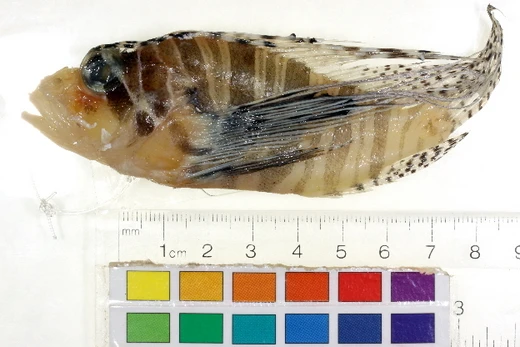
Pterois paucispinula
A lionfish species found in the Western Pacific Ocean.

Pterois paucispinula is a marine ray-finned fish in the scorpionfish and lionfish family, Scorpaenidae, native to the Western Pacific Ocean. It was formally described as a new species in 2015, having previously been considered the eastern population of the frillfin lionfish (*Pterois mombasae*). In 2023, it was moved to the revalidated genus *Pteropterus*.
The fish has 13 spines and 10 (rarely 11) soft rays in its dorsal fin, plus 3 spines and 6 soft rays in the anal fin. Its pectoral fins usually have 18 rays, though the count ranges from 17 to 19. The body is pinkish creamy-white or white, with a wide, white-edged reddish-black to black band through the eye and a large black blotch on the lower operculum. Three bands run across the nape, and the flanks bear many wide reddish-brown to light brown bands separated by thin narrow bands that extend onto the dorsal and anal fins. A relatively large black blotch with a small white spot sits over the pectoral-fin base. The spiny part of the dorsal fin has 2–6 reddish-brown to blackish bands, while the soft-rayed dorsal, anal, and caudal fins are covered with many small black spots. The pectoral fin has 14–28 large reddish-black to black blotches. Maximum standard length is 14.4 cm (5.7 in).
Compared to *P. mombasae*, *P. paucispinula* has a less deep body, a narrower head, and slightly more scale rows below the lateral line. It typically has 18 pectoral-fin rays (versus 19 in western *P. mombasae* populations) and longer dorsal fin spines. However, a Sri Lankan population of *P. mombasae* shares these traits, which are considered geographic variation. A consistent difference is that *P. mombasae* has ctenoid scales on the pectoral-fin base, below the lateral line, and on the side of the caudal peduncle at all ages, whereas *P. paucispinula* usually has only cycloid scales (or at most a few ctenoid scales) in those areas.
The species ranges from Indonesia west to the Wallis and Futuna Islands, north to southern Japan, and south to northern Australia. In Australian waters, it occurs from the Northwest Shelf of Western Australia to the Timor Sea off northwest Melville Island in the Northern Territory. It lives at depths of 1–440 m (3 ft 3 in–1,443 ft 7 in), typically over soft-bottom or muddy substrates mixed with rubble, where dense sessile invertebrates—especially sponges—grow.
Quick Facts
- Taxon
- Pteropterus paucispinula
Facts from the source article.
Lore & Background
Pterois paucispinula was first formally described in 2015 by Japanese ichthyologists Mizuki Matsunuma and Hiroyuki Motomura, with the type locality given as Kashiwa-jima Island in Kōchi Prefecture, southern Japan. It had previously been regarded as the eastern population of the frillfin lionfish (Pterois mombasae). In 2023, it was reclassified as a species of the revalidated genus Pteropterus. The specific name paucispinula is a compound of paucus, meaning 'few', and spinula, meaning 'small thorn', referring to the reduced number of small spines on the ctenoid scales compared to P. mombasae.
In terms of description, P. paucispinula has 13 spines and 10, rarely 11, soft rays in its dorsal fin, and 3 spines and 6 soft rays in its anal fin. The pectoral fins have between 17 and 19 rays, most commonly 18. The overall color is pinkish creamy-white or white, with a wide white-edged reddish-black to black band through the eye and a large black blotch on the lower operculum. The flanks have many wide reddish-brown to light brown bands with thin narrow bands between them. A relatively large black blotch with a small white spot is present over the base of the pectoral fin. The spiny part of the dorsal fin has 2–6 reddish-brown to blackish bands, while the soft-rayed part of the dorsal fin, anal fin, and caudal fin have numerous small black spots. The pectoral fin has 14 to 28 large reddish-black to black blotches.
P. paucispinula differs from P. mombasae by having a body that is not as deep, a narrower head, and slightly more scale rows below the lateral line. It typically has 18 pectoral-fin rays, whereas western populations of P. mombasae typically have 19. It also has comparatively longer spines in the dorsal fin. However, a Sri Lankan population of P. mombasae is more similar to P. paucispinula in these respects, and these differences are considered geographical variations within P. mombasae. A consistently differing feature is that both young and adult P. mombasae have ctenoid scales on the base of the pectoral fin, the part of the body below the lateral line, and on the side of the caudal peduncle, whereas P. paucispinula typically has only cycloid or at most a few ctenoid scales in these areas.
Reader's Guide
Pterois paucispinula is notable for its relatively recent formal description in 2015, which clarified its distinction from the frillfin lionfish (Pterois mombasae), with which it had previously been grouped. Its reclassification into the revalidated genus Pteropterus in 2023 reflects ongoing taxonomic refinement within the scorpionfish and lionfish family. The species is found across a wide geographic range in the Western Pacific, from Indonesia to Wallis and Futuna Islands, and from southern Japan to northern Australia, inhabiting depths from 1 to 440 meters. It typically occurs in areas of soft-bottom or muddy substrates mixed with rubble, where there is dense growth of sessile invertebrates, particularly sponges. The species is normally encountered in small groups or as a solitary fish. Its distinguishing features, such as the reduced number of small spines on its scales (reflected in its scientific name) and differences in fin ray counts and scale types compared to P. mombasae, are key to its identification. The maximum published standard length is 14.4 cm.
Did You Know?
- Its specific name paucispinula means 'few small thorns', referring to the reduced number of small spines on its scales compared to P. mombasae.
- This species is found at depths between 1 and 440 meters, typically on soft-bottom or muddy substrates with dense sponge growth.
- It differs from P. mombasae by having a less deep body, narrower head, and typically 18 pectoral-fin rays instead of 19.
More in Lionfish and Scorpionfish 1-24
Spotted an error? Know more?
Reader corrections go straight into our review queue. Suggest an edit · How this site is sourced