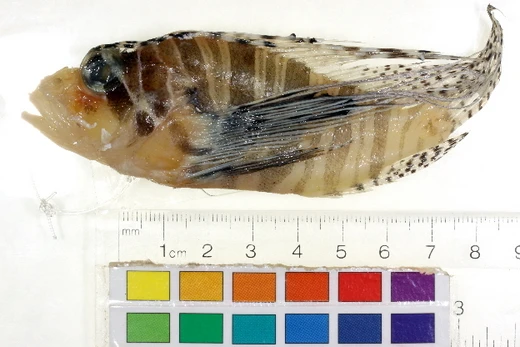
Pterois mombasae
A lionfish of the Indian Ocean with distinctive barred coloration.

The African lionfish, also known as the deepwater firefish or frillfin turkeyfish, is a marine ray-finned fish in the scorpionfish and lionfish family, Scorpaenidae. It inhabits the tropical Indian Ocean, usually on soft-bottomed seafloors, often where invertebrates like sponges grow. It reaches a typical length of 20 centimeters and has moderate commercial value.
This species was first formally described in 1957 by South African ichthyologist J. L. B. Smith, who placed it in the genus *Pteropterus* and gave it the scientific name *Pteropterus mombasae*. The type specimen came from a reef off Mombasa, Kenya. Smith noted that it closely resembled *Pterois sphex* from Hawaii. In 2014, a new species, *Pterois paucispinula*, was described from the Western Pacific; the authors noted that *P. mombasae* is limited to the Indian Ocean and that the new species had previously been mistaken for it. In 2023, *P. mombasae* was reclassified back into the revalidated genus *Pteropterus*. Its specific name refers to the type locality.
The fish ranges across the Indian Ocean, from the eastern coast of Africa between Kenya and South Africa, to Madagascar, the Maldives, India, and east to the Andaman Sea. It is rarely found on rocky bottoms of deep offshore reefs, preferring soft-bottom or muddy substrates with thick ridges of rubble among rich growths of invertebrates, especially sponges.
*Pteropterus mombasae* has 13 spines and 10 soft rays in its dorsal fin, and 3 spines with 6 or 7 soft rays in its anal fin. Its body is oblong and laterally compressed, with either very small or absent supraocular tentacles. The 18 to 19 rays in the pectoral fin are unbranched. The body is marked with many brown to brownish-red bars of varying widths; the bars on the caudal peduncle are thin and wavy. A brownish-red spot smaller than the pupil sits on the lower operculum. The soft-rayed part of the dorsal fin, along with the anal and caudal fins, is translucent and dotted with small brownish-red spots on the rays. The pelvic fin is blackish. The maximum recorded length is 31 centimeters, though a standard length of 20 centimeters is more typical.
Quick Facts
- Taxon
- Pteropterus mombasae
Facts from the source article.
Lore & Background
Pterois mombasae was first formally described in 1957 by South African ichthyologist J. L. B. Smith as Pteropterus mombasae, with the type locality given as a reef off Mombasa, Kenya. Smith noted that it seemed to most resemble Pterois sphex from Hawaii. In 2014, a new species, Pterois paucispinula, was described from the Western Pacific Ocean, and the authors stated that P. mombasae was restricted to the Indian Ocean, with the new species having been previously overlooked. In 2023, it was reclassified as a species of the revalidated genus Pteropterus. The specific name refers to the type locality.
The species is found in the Indian Ocean from the eastern African coast between Kenya and South Africa, Madagascar, the Maldives, India, and east as far as the Andaman Sea. It is a rare inhabitant of rocky bottoms on deep offshore reefs and is usually found on soft-bottom or muddy substrates with thick ridges of rubble amongst rich growths of invertebrates, particularly sponges.
Pterois mombasae has an oblong, laterally compressed body and either no supraocular tentacles or very small ones. The body has many brown to brownish red bars of differing widths, with thin and wavy bars on the caudal peduncle. There is a brownish red spot, smaller in diameter than the pupil, on the lower operculum. The soft-rayed part of the dorsal fin, as well as the anal and caudal fins, is translucent with small brownish red spots on the rays, while the pelvic fin is blackish.
Reader's Guide
Pterois mombasae holds significance as a distinct Indian Ocean lionfish species, clarified by taxonomic revisions that separated it from a similar Western Pacific species. Its description by J. L. B. Smith in 1957 and subsequent reclassification into the revalidated genus Pteropterus in 2023 highlight ongoing refinements in scorpionfish systematics. The species is notable for its moderate commercial value and its preference for soft-bottom habitats with rich invertebrate growth, particularly sponges, which distinguishes it from many reef-associated lionfishes. Its maximum size of 20 cm (with a published maximum of 31 cm) and distinctive coloration—brownish red bars, a spot on the operculum, and blackish pelvic fins—aid in identification. The species' rarity on deep offshore reefs and its distribution from East Africa to the Andaman Sea underscore its ecological niche in the tropical Indian Ocean. The 2014 recognition that P. mombasae is restricted to the Indian Ocean resolved previous confusion with the Western Pacific Pterois paucispinula, emphasizing the importance of careful taxonomic work in understanding biodiversity.
Did You Know?
- It is typically found on soft-bottom or muddy substrates with rich growths of invertebrates, especially sponges.
- The specific name 'mombasae' refers to the type locality off Mombasa, Kenya.
More in Lionfish and Scorpionfish 1-24
Spotted an error? Know more?
Reader corrections go straight into our review queue. Suggest an edit · How this site is sourced