Pterois miles
Venomous Indo-Pacific lionfish invasive in the Mediterranean and Caribbean.

Pterois miles, also called the devil firefish or common lionfish, belongs to the group of ray-finned fishes. Its native range covers the western Indo-Pacific. People often mix it up with its close cousin, the red lionfish (Pterois volitans). What makes this fish stand out are its venomous spines and the fact that it has become an invasive species in the Mediterranean Sea, along the east coast of the United States, and in the Caribbean Sea.
The name comes from Greek *pteron*, meaning "wing," and Latin *miles*, meaning "soldier." British naturalist John Whitchurch Bennett first described it in 1828 as *Scorpaena miles*, using a specimen from the south coast of Sri Lanka. Bennett never explained why he chose *miles*, but the red color may have reminded him of the red tunics worn by British soldiers in the 1800s. A molecular study looked at this species, the red lionfish, the luna lionfish, and Russell's lionfish. It found that common lionfish in the western Indian Ocean formed one lineage, while the luna lionfish and Russell's lionfish formed a second lineage—suggesting those two are actually the same species. The red lionfish made up a third lineage, but it appeared to have genetic contributions from the other two, hinting that it arose from hybrids between *P. miles* and *P. russelii* (in the broad sense).
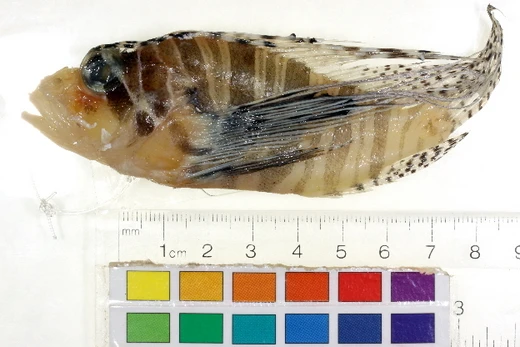
In terms of size, the common lionfish can reach up to 35 cm (14 inches) long. Its dorsal fin has 13 long, strong spines and 9 to 11 soft rays; the anal fin has three long spines and six or seven soft rays. The dorsal fin looks feathery, and the pectoral fins are wing-like, with separate, broad, smooth rays. Color ranges from reddish to tan or grey, with many thin, dark vertical bars on the head and body. Its head is less angular than that of *P. volitans*.
Behavior-wise, this fish is mostly active at night and hides in crevices during the day. It eats fish and small crustaceans. Because of its venomous spines, it has few predators, though larger lionfish will eat smaller ones. Moray eels have shown resistance to the spines, and reports indicate lionfish are part of their diet. The bluespotted cornetfish (*Fistularia commersonii*) also feeds on it, as do groupers in the Bahamas.
*P. miles* is native to the Indian Ocean, from the Red Sea to South Africa and Indonesia.
Quick Facts
- Taxon
- Pterois miles
Facts from the source article.
Lore & Background
Pterois miles was first formally described as Scorpaena miles in 1828 by British naturalist John Whitchurch Bennett, with the type locality given as the south coast of Sri Lanka. The scientific name derives from Greek pteron, meaning 'wing', and Latin miles, meaning 'soldier'. Bennett did not explain the specific name, but it may refer to the red color reminding him of the red tunics worn by British soldiers in the 19th century. A molecular study of this species, the red lionfish, the luna lionfish, and Russell's lionfish found that common lionfishes in the western Indian Ocean formed one lineage, while a second lineage consisted of both the luna lionfish and Russell's lionfish, suggesting these two taxa are conspecific. The red lionfish formed a third lineage with genetic contributions from the other two, suggesting it arose from hybrids between P. miles and P. russelii sensu lato.
Reader's Guide
Pterois miles is significant both as a native predator in the Indian Ocean and as a highly successful invasive species. It was first recorded in 1991 in the Mediterranean Sea off Israel, having entered via the Suez Canal, and is now common in the eastern Basin, with recent observations in the Sicily channel. It is also present off the east coast of the United States and in the Caribbean Sea, where it is regarded as invasive. The species is mainly nocturnal, hiding in crevices during the day, and feeds on fish and small crustaceans. Its venomous spines provide defense against most predators, though larger lionfish prey on smaller ones. Moray eels have shown resistance to the spines and are known predators in its native Red Sea habitat; bluespotted cornetfish and groupers in the Bahamas also feed on it. The fin spines are highly venomous and have caused death in some reported cases, though stings are rarely fatal to humans. Symptoms can include extreme pain, vomiting, convulsion, minor paralysis, and breathing difficulties, and immediate emergency medical attention is strongly recommended.
Did You Know?
- Pterois miles was first described as Scorpaena miles in 1828 by John Whitchurch Bennett.
- The specific name miles is Latin for 'soldier', possibly referencing the red tunics of 19th-century British soldiers.
- A molecular study suggests the red lionfish (Pterois volitans) arose from hybrids between P. miles and P. russelii sensu lato.
- Moray eels have shown resistance to the venomous spines of P. miles and are natural predators in the Red Sea.
More in Lionfish and Scorpionfish 1-24
Spotted an error? Know more?
Reader corrections go straight into our review queue. Suggest an edit · How this site is sourced