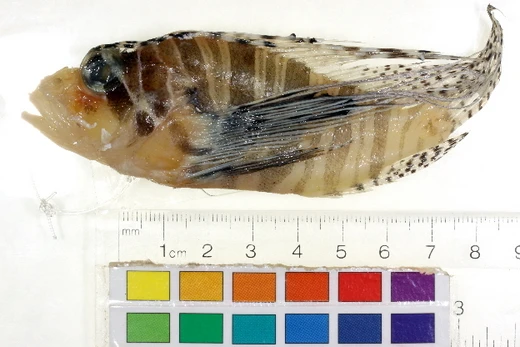
Pterois cincta
Red Sea endemic lionfish with long fin rays and white-edged bands.

The Red Sea lionfish, also called the Red Sea clearfin lionfish, is a marine ray-finned fish in the scorpionfish and lionfish family Scorpaenidae. It lives only in the Red Sea.
German naturalist and explorer Eduard Rüppell first formally described this species in 1838, giving the type location as Jeddah, Saudi Arabia. Some experts once considered it the same as *P. radiatus*, but it is now accepted as a distinct species. In 2023, it was moved to the revalidated genus *Pteropterus*.
The species name *cinctus* means "belted," referring to the thin, milky white horizontal stripes on its body.
This fish appears to be found only in the Red Sea, ranging from the Bab-el-Mandeb straits in the south up to the Gulf of Aqaba in the north. It lives over sandy bottoms near coral reefs, at depths between 5 and 15 meters.
The dorsal fin has 12 spines and 10 to 12 soft rays (usually 11), while the anal fin has 3 spines and 6 or 7 soft rays. The pectoral fin typically has 16 rays, though sometimes 15, 17, or 18. The soft rays of the dorsal fin are fairly long, averaging about 35% of the fish's standard length, and the anal fin's soft rays are even longer, averaging about 40%. The pectoral fin rays are also long—the ninth ray is nearly as long as or longer than the standard length—and the pelvic fin rays average 70% of the standard length. The tentacles above the eyes lack side branches. The maximum total length is 15.9 cm.
The head and body are brownish-red with whitish lips. A wide reddish-brown band with thin white edges runs from the tentacle above the eye, diagonally through the eye to the rear edge of the preoperculum. Two more white-edged rusty bands saddle the nape. Five similar bands appear on the flanks, with white forking at the top and bottom; the second and third bands are the widest, broader than the eye's diameter. A horizontal white-edged rusty band sits on the caudal peduncle. The fins match the body's reddish-brown color, though the soft-rayed dorsal and anal fins show this color only on the rays, with translucent membranes. Whitish markings appear on both the pectoral and pelvic fins.
It is most closely related to the more widespread *P. radiatus*, which it closely resembles. The main differences are its longer fin rays and slightly different markings. Together, these two species are easily told apart from other lionfish.
Quick Facts
- Taxon
- Pteropterus cinctus
Facts from the source article.
Lore & Background
The species was first formally described in 1838 by German naturalist and explorer Eduard Rüppell, with the type locality given as Jeddah in Saudi Arabia. It was once regarded by some authorities as a junior synonym of Pterois radiatus but is now considered a valid species. In 2023, it was reclassified into the revalidated genus Pteropterus.
The specific name cinctus means 'belted', referring to the thin milky white horizontal striping of the fish. The background color of the head and body is brownish-red with whitish lips, and it has a series of white-edged rusty bands on the nape, flanks, and caudal peduncle. The fins are similarly colored, with translucent membranes on the soft-rayed dorsal and anal fins.
Pterois cincta appears to be endemic to the Red Sea, found from the straits at Bab-el-Mandeb north to the Gulf of Aqaba. It inhabits sandy bottoms in or near coral reefs at depths of 5 to 15 meters. It is most closely related to the more broadly distributed P. radiatus, differing mainly in having longer fin rays and slightly different markings.
Reader's Guide
Pterois cincta is significant as a Red Sea endemic lionfish species, distinguished from its close relative Pterois radiatus by its longer fin rays and subtle differences in markings. Its reclassification into the genus Pteropterus in 2023 reflects ongoing taxonomic refinement within the Scorpaenidae family. The species is known from the Red Sea, ranging from Bab-el-Mandeb to the Gulf of Aqaba, and is typically found over sandy bottoms near coral reefs at depths of 5 to 15 meters. Its maximum recorded total length is 15.9 cm. The fish's distinctive appearance includes a brownish-red body with white-edged rusty bands, long pectoral and pelvic fin rays, and translucent membranes on the dorsal and anal fins. The specific epithet cinctus ('belted') alludes to its thin white horizontal stripes. The species was first described by Eduard Rüppell in 1838 from Jeddah, Saudi Arabia, and was once considered a synonym of P. radiatus before being recognized as valid.
Did You Know?
- Its specific name cinctus means 'belted', referring to its thin milky white horizontal stripes.
- This species is endemic to the Red Sea, found from Bab-el-Mandeb to the Gulf of Aqaba.
- It has 12 spines and typically 11 soft rays in its dorsal fin.
More in Lionfish and Scorpionfish 1-24
Spotted an error? Know more?
Reader corrections go straight into our review queue. Suggest an edit · How this site is sourced