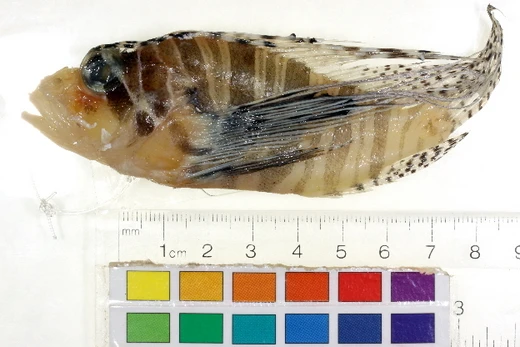
Pterois brevipectoralis
A short-finned lionfish from the Western Indian Ocean.

Pterois brevipectoralis is a marine ray-finned fish in the scorpionfish and lionfish family Scorpaenidae. It lives in the Western Indian Ocean at depths of 70 to 80 meters (230 to 260 feet). Its short pectoral fins set it apart from similar species. Russian zoologist Sergey Anatolyevich Mandritsa first described this species in 2002 as *Pteropterus brevipectoralis*, based on a specimen from the Saya de Malha Bank in the Indian Ocean. In 2023, it was moved back into the revalidated genus *Pteropterus*. The name *brevipectoralis* means "short pectoral," referring to its shorter pectoral fins compared to *P. sphex*. The dorsal fin has 13 spines and 10 soft rays, while the anal fin has 3 spines and 6 soft rays. The pectoral fin has 16 rays (sometimes 15), which are short and do not reach past the rear base of the dorsal fin. The longest dorsal spine is longer than the body’s depth; the body is moderately compressed and oblong. The head and body are white, darkening to pink on the back. The jaws and the skin flap on the tip of the lacrimal spine are pinkish. A reddish band runs through the eye to the upper rear corner of the preoperculum. There is a reddish saddle-like mark on the nape, and many slender reddish bands on the body. The median fin membranes are translucent, with each dorsal spine having two or three reddish bands. The soft-rayed parts of the dorsal, anal, and caudal fins have black dots. The pectoral fin is dark red, with large black blotches on the membrane and a thin blackish band along its edge. This little-known species has been recorded around the Mascarene Islands and the Saya de Malha Bank in the Western Indian Ocean, at depths between 70 and 80 meters.
Quick Facts
- Taxon
- Pteropterus brevipectoralis
Facts from the source article.
Lore & Background
Pterois brevipectoralis was first formally described as Pteropterus brevipectoralis in 2002 by the Russian zoologist Sergey Anatolyevich Mandritsa with the type locality given as the Saya de Malha Ban. In 2023, it was reclassified as a species of the revalidated genus Pteropterus. The specific name brevipectoralis means 'short pectoral', alluding to the shorter pectoral fins than those of the similar P. sphex. The species has 13 spines and 10 soft rays in its dorsal fin, with 3 spines and 6 soft rays in the anal fin. There are 16, occasionally 15, fin rays in the pectoral fin, which are short and do not extend beyond the rear of the base of the dorsal fin. The longest dorsal fin spine is longer than the moderately compressed, oblong-shaped body's depth. The background colour of the head and body is white, darkening to a pinkish shade on the back. The jaws are pinkish, as is the flap of skin on the tip of the lacrimal spine. A reddish band runs through the eye to the upper rear angle of the preoperculum. There is a reddish saddle-like mark on the nape and many slender reddish bands on the body. The membranes of the median fins are translucent, with each dorsal fin spine having 2 or 3 reddish bands. The soft-rayed part of the dorsal fin, the anal fin, and the caudal fin are marked with black dots.
Reader's Guide
Pterois brevipectoralis is a little known species within the family Scorpaenidae, first described in 2002 from the Saya de Malha Bank. Its reclassification in 2023 to the genus Pteropterus reflects ongoing taxonomic refinement among lionfishes. The species is distinguished by its short pectoral fins, which do not extend beyond the rear of the dorsal fin base, a trait referenced in its specific name. Its coloration includes a white body with pinkish shading, reddish bands, and black dots on the median fins, with a dark red pectoral fin bearing black blotches. Found only in the Western Indian Ocean at depths of 70 to 80 m, it has been recorded from the Mascarene Islands and the Saya de Malha Bank. As a little known species, its significance lies in contributing to the diversity of the Scorpaenidae and highlighting the need for further study of deep-reef fish in the region. Its description by Sergey Anatolyevich Mandritsa adds to the taxonomic knowledge of Indian Ocean lionfishes.
More in Lionfish and Scorpionfish 1-24
Spotted an error? Know more?
Reader corrections go straight into our review queue. Suggest an edit · How this site is sourced