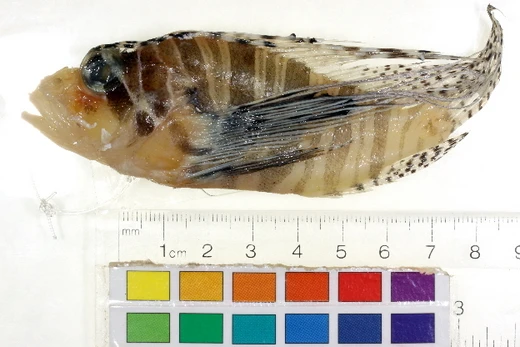
Pterois antennata
A venomous, nocturnal reef fish with long supraorbital tentacles.

The spotfin lionfish, also known as the banded lionfish, broadbarred lionfish, broadbarred firefish, raggedfinned firefish, raggedfinned scorpionfish, or roughscaled lionfish, is a marine ray-finned fish in the family Scorpaenidae, which includes scorpionfishes and lionfishes. Its range covers the tropical Indian Ocean and the western Pacific Ocean.
German physician and naturalist Marcus Elieser Bloch first formally described this species in 1787 as *Scorpaena antennata*, with the type location being Ambon Island in Indonesia. In 2023, it was reclassified into the revalidated genus *Pteropterus*. The specific name *antennata* means "with antennae," referring to the tentacles above the eyes.
The body is laterally compressed and fairly deep. The dorsal fin has 13 spines and 11 or 12 soft rays, while the anal fin has 3 spines and 6 soft rays. A long tentacle sits above each eye, and the head has coronal spines and many other spines. The pectoral fin has 17 simple fin rays. The mouth contains many very small teeth arranged in clusters on both jaws, with a small patch on the front of the roof of the mouth. Maximum total length is 20 cm (7.9 in). The overall color is reddish-brown with numerous darker vertical bars, which are thin and angled on the caudal peduncle. Dark spots are scattered on the anal, dorsal, and caudal fins. The head has three dark brown bars, including a diagonal bar through the eye ending in a large spot on the lower operculum. The long tentacles over the eyes are banded, and larger adults have bluish-black blotches near the bases of the pectoral fins.
This species has a wide Indo-West Pacific distribution, from the Gulf of Aden south to South Africa, east to French Polynesia, north to southern Japan, and south to Australia and the Kermadec Islands of New Zealand. In Australian waters, it ranges from Fremantle in Western Australia north and east around the tropical northern coast to at least as far south as Sydney in New South Wales. It also occurs at Ashmore Reef in the Timor Sea, the reefs of the Coral Sea, the region around Lord Howe Island, Cocos (Keeling) Islands, and Christmas Island. It inhabits depths between 2 and 86 m (6 ft 7 in and 282 ft 2 in) in lagoon and seaward reefs.
Quick Facts
- Taxon
- Pteropterus antennatus
Facts from the source article.
Lore & Background
Pterois antennata was first formally described in 1787 as Scorpaena antennata by German physician and naturalist Marcus Elieser Bloch, with the type locality given as Ambon Island in Indonesia. In 2023, it was reclassified as a species of the revalidated genus Pteropterus. The specific name antennata means 'with antennae', an allusion to the supraorbital tentacles.
The species has a laterally compressed rather deep body, with 13 spines and 11 or 12 soft rays in the dorsal fin and 3 spines and 6 soft rays in its anal fin. A long tentacle is present above each eye, and coronal spines and many head spines are present. The overall colour is reddish-brown marked with numerous darker slender to wide vertical bars, thin and angled on the caudal peduncle. The head is marked with three dark brown bars, one of which is a diagonal bar running through the eye ending in a large spot on the lower operculum. The long tentacles over each eye are banded, and in larger adults there are bluish-black blotches close to the pectoral fin bases.
Pterois antennata is a nocturnal hunter, most active just after nightfall, and spends the day hiding in crevices and caves facing inwards with its venomous spines pointing backwards. It preys mainly on crustaceans and small fishes, including juveniles of its own species. They are normally solitary and protect a home range from other broad-barred lionfishes and other lionfish species, though they form aggregations as juveniles and for breeding. Females can lay up to 15,000 eggs in a mass covered in mucus, which the males' sperm can penetrate to fertilise. The eggs are thought to hatch after 36 hours. Predators include sharks and the cornet fish Fistularia commersonii.
Reader's Guide
Pterois antennata is a species of marine ray-finned fish belonging to the family Scorpaenidae, found in the tropical Indian and Western Pacific Oceans. It was first formally described in 1787 as Scorpaena antennata by Marcus Elieser Bloch, with the type locality at Ambon Island, Indonesia, and was reclassified into the revalidated genus Pteropterus in 2023. The species attains a maximum total length of 20 cm and is characterized by 13 dorsal spines, long supraorbital tentacles, and a reddish-brown body with dark vertical bars. It inhabits lagoon and seaward reefs at depths between 2 and 86 m, with a wide Indo-West Pacific distribution from the Gulf of Aden and South Africa to French Polynesia, southern Japan, Australia, and the Kermadec Islands of New Zealand. The species is a nocturnal hunter, preying on crustaceans and small fishes, and is normally solitary, though it forms aggregations as juveniles and for breeding. It spawns monthly, with females laying up to 15,000 eggs. Pterois antennata is caught in some subsistence fisheries but is of little interest to commercial fisheries due to its small size and venomous spines; however, it is common in the aquarium trade. Its predators include sharks and the cornet fish Fistularia commersonii.
Did You Know?
- Females can lay up to 15,000 eggs in a mucus-covered mass, which hatch after about 36 hours.
- It is found at depths between 2 and 86 m in lagoon and seaward reefs across the Indo-West Pacific.
More in Lionfish and Scorpionfish 1-24
Spotted an error? Know more?
Reader corrections go straight into our review queue. Suggest an edit · How this site is sourced