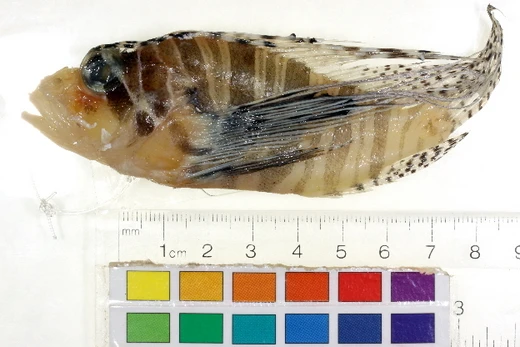
Parapterois macrura
A scorpionfish from the western Indian Ocean with a filamentous tail.

Parapterois macrura is a marine ray-finned fish in the scorpionfish family, Scorpaenidae, native to the western Indian Ocean.
English naturalist Alfred William Alcock first described this species in 1896 under the name *Pterois macrura*, based on a specimen from the Malabar Coast near Calicut. Its species name, *macrura*, means "large tail," referring to the long, filamentous extension on the upper caudal fin ray that can be as long as the fish's body from the eye backward.
This fish typically reaches about 11 centimeters (4.3 inches) in length. It closely resembles its relative *Parapterois heterura*, differing mainly in a few head proportions and in the presence or absence of scales in a pit between the posterior nostrils: *P. macrura* lacks these scales, while *P. heterura* usually has them (except in a possible separate species found off West India, South Africa, and Mozambique). In adults, the upper margin of the eye sits above the base of the first dorsal fin spine in *P. macrura*, whereas in *P. heterura* it sits below—though this trait is not consistent in juveniles.
*Parapterois macrura* occurs in the northwestern Indian Ocean, specifically the Arabian Sea, with records from the coasts of Somalia, Oman, Pakistan, and southwestern India. It lives at depths between 64 and 130 meters (210 to 427 feet), likely favoring habitats similar to those of *P. heterura*: sheltered coastal bays to deeper waters with fine sand or silt bottoms.
Quick Facts
- Taxon
- Parapterois macrura
Facts from the source article.
Lore & Background
Parapterois macrura was first formally described as Pterois macrura in 1896 by the English naturalist Alfred William Alcock, with the type locality given as the Malabar Coast off Calicut. The specific name macrura means 'large tail', an allusion to the filamentous extension of the upper caudal fin ray, which is as long as the body from the eye back.
This species generally grows to a length of 11 centimetres (4.3 in). It differs from its congener P. heterura in that P. macrura lacks scales in a pit between the posterior nostrils, while P. heterura has them (except for a population of P. heterura found off West India, South Africa, and Mozambique, which may be a different species). The two species do not differ much in fin spine, fin ray, gill raker counts, and most body proportions; their differences lie in a small difference in head proportions. In adults, the upper margin of the eye of P. heterura is below the base of the first dorsal fin spine, while it is above in P. macrura (this trait is not consistent in juveniles, in which the eye margin may be below in both species).
Parapterois macrura is found in the northwestern Indian Ocean in the Arabian Sea, recorded from the coast of Somalia, Oman, Pakistan and southwestern India. It occurs at depths between 64 and 130 m (210 and 427 ft), and its habitat preference is thought to be similar to that of P. heterura: sheltered coastal bays to deeper waters where there are fine sand or silt substrates.
Reader's Guide
Parapterois macrura is a species of scorpionfish known from the western Indian Ocean, first described in 1896 by Alfred William Alcock. Its notable feature is the filamentous extension of the upper caudal fin ray, which gives it the specific name macrura, meaning 'large tail'. The species reaches a length of 11 cm and is found at depths between 64 and 130 m in the Arabian Sea, with records from Somalia, Oman, Pakistan, and southwestern India. Its habitat is thought to be similar to that of P. heterura, favoring sheltered coastal bays to deeper waters with fine sand or silt substrates. The article notes taxonomic uncertainty regarding a population of P. heterura off West India, South Africa, and Mozambique, which may be a different species. The species is distinguished from P. heterura by the absence of scales in a pit between the posterior nostrils and by the position of the eye margin relative to the first dorsal fin spine in adults. These details contribute to the understanding of scorpionfish diversity in the Indian Ocean.
Did You Know?
- Parapterois macrura was originally described as Pterois macrura by Alfred William Alcock in 1896.
- Its specific name macrura means 'large tail', referring to a filamentous extension of the upper caudal fin ray as long as the body from the eye back.
- It differs from P. heterura in lacking scales in a pit between the posterior nostrils.
More in Lionfish and Scorpionfish 1-24
Spotted an error? Know more?
Reader corrections go straight into our review queue. Suggest an edit · How this site is sourced