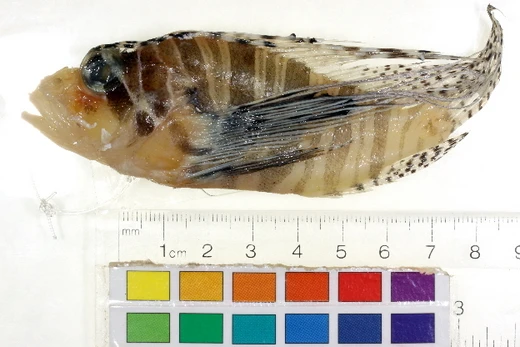
Parapterois heterura
A sedentary scorpionfish that flashes fins to startle predators.

Parapterois heterura, also called the blackfoot firefish, blue-fin lionfish, or gurnard lionfish, is a marine ray-finned fish in the scorpionfish family Scorpaenidae. It has a patchy distribution, found along the southeastern coast of Africa, off Japan, and in Indonesia, typically in sheltered coastal bays with soft bottoms like fine sand or mud, at depths between 40 and 300 meters. This fish is sedentary and may bury itself in the substrate. When disturbed, it flashes its brightly colored pectoral fins to startle predators, and it may also use these fins to corner prey—a behavior seen in other lionfish. It is sometimes kept in aquariums.
The species was first described in 1856 by Pieter Bleeker as *Pterois heterurus*, with the type locality given as Ambon Island. It is the type species of the genus *Parapterois*, which Bleeker described in 1876. Some authorities consider a southwestern Indian Ocean population, described as *Pterois nigripinnis* by John Dow Fisher Gilchrist in 1904 from the mouth of the Ohlanga River in South Africa, to be a valid species, *Parapterois nigripinnis*. The specific name *heterura* means "different tail," referring to the long, flared tail with a filamentous extension on the upper ray.
This fish reaches a maximum total length of 38 cm, though most specimens are much smaller, with adults often around 11 cm. Its dorsal fin has thirteen spines with long filaments on their tips and nine soft rays; the anal fin has two spines and seven to eight soft rays. The outer rays of the caudal fin also have filamentous extensions. *Parapterois heterura* closely resembles *Parapterois macrura*, but differs in having scales in a pit between the posterior nostrils (except for a population off West India, South Africa, and Mozambique, which may be a different species). The two species show little difference in fin spine, fin ray, or gill raker counts, and most body proportions are similar, with only small differences in head proportions. In adults, the upper margin of the eye of *P. heterura* lies below the base of the first dorsal fin spine, while in *P. macrura* it is above (though this trait is not consistent in juveniles).
The fish appears to have two separate ranges: one along the coast of Natal in southeastern Africa, and another in the central Indo-Pacific, covering Japan, Indonesia, New Guinea, and Australia.
Quick Facts
- Taxon
- Parapterois heterura
Facts from the source article.
Lore & Background
Parapterois heterura was first formally described as Pterois heterurus in 1856 by the Dutch physician, herpetologist and ichthyologist Pieter Bleeker, with the type locality given as Ambon Island. It is the type species of the genus Parapterois, which Bleeker described in 1876. Some authorities consider that the population in the southwestern Indian Ocean, described as Pterois nigripinnis by John Dow Fisher Gilchrist in 1904 from the mouth of the Ohlanga River in KwaZulu-Natal, is a valid species Parapterois nigripinnis. The specific name heterura means 'different tail,' an allusion to the long, flared tail with the upper ray having a filamentous extension.
Parapterois heterura grows to a maximum length of 38 cm, though most specimens are much smaller, with adults often about 11 cm in length. The dorsal fin has thirteen spines with long filaments on their tips and nine soft rays; the anal fins have two spines and seven to eight soft rays; the outer rays of the caudal fin also have filamentous extensions. It is very similar in appearance to Parapterois macrura, differing in that P. heterura has scales in a pit between the posterior nostrils while P. macrura does not (except for a population off West India, South Africa, and Mozambique, which may be a different species). In adults, the upper margin of the eye of P. heterura is below the base of the first dorsal fin spine, while it is above in P. macrura (this trait is not consistent in juveniles).
The fish has two separate ranges: one on the coast of Natal in southeastern Africa and the other in the central Indo-Pacific covering Japan, Indonesia, New Guinea and Australia. It is usually found in sheltered coastal bays with a soft bottom, such as fine sand or mud, at depths from 40 to 300 metres. It is a sedentary fish and may even bury itself within the substrate. Parapterois heterura is largely nocturnal and may partially bury itself in the substrate during the day, making it difficult to spot. The brightly colored pectoral fins are flared if the fish is disturbed and may startle predators, but their main purpose seems to be to help corner prey when hunting. This fish feeds on small fish and bottom-dwelling invertebrates. It can be found in the aquarium trade.
Reader's Guide
Parapterois heterura holds significance as a distinctive member of the Scorpaenidae family, noted for its wide but disjunct distribution across the southeastern coast of Africa and the central Indo-Pacific, including Japan, Indonesia, New Guinea, and Australia. Its behavior of flashing brightly colored pectoral fins to startle predators and corner prey, a trait demonstrated in other lionfish, underscores its adaptive strategies in sheltered coastal bays with soft bottoms. The species is also notable for its taxonomic history: first described by Pieter Bleeker in 1856 as Pterois heterurus, it serves as the type species of the genus Parapterois. However, taxonomic uncertainty persists, as some authorities consider the southwestern Indian Ocean population, described as Pterois nigripinnis by John Dow Fisher Gilchrist in 1904, to be a valid separate species, Parapterois nigripinnis. Additionally, a population off West India, South Africa, and Mozambique may represent a different species. Its presence in the aquarium trade highlights its appeal to enthusiasts, though its nocturnal, burying habits and specific depth range (40 to 300 metres) influence its care. The species' morphological similarity to Parapterois macrura, with subtle differences in head proportions and eye position, further contributes to its scientific interest.
Did You Know?
- Parapterois heterura was first described as Pterois heterurus by Pieter Bleeker in 1856 from Ambon Island.
- This species can partially bury itself in the substrate during the day to avoid detection.
More in Lionfish and Scorpionfish 1-24
Spotted an error? Know more?
Reader corrections go straight into our review queue. Suggest an edit · How this site is sourced