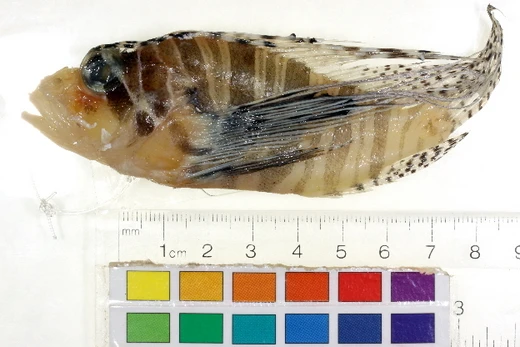
Nemapterois biocellatus
A small, venomous lionfish with two eye-like spots on its dorsal fin.

Nemapterois biocellatus, commonly known as the Fu Manchu lionfish, twospot turkeyfish, twinspot lionfish, twoeyed lionfish, or ocellated lionfish, is a species of marine ray-finned fish belonging to the family Scorpaenidae, which includes scorpionfishes and lionfishes. It is notable for being the only species in the monotypic genus Nemapterois, and for its distinctive two (sometimes three) large black eye-like spots on the soft-rayed part of its dorsal fin.
Quick Facts
- Taxon
- Nemapterois biocellatus
Facts from the source article.
Lore & Background
First formally described as Nemapterois biocellatus in 1938 by American zoologist Henry Weed Fowler, with the type locality given as off Jolo Light on Jolo Island in the Sulu Sea in the Philippines. Before 2023, it was considered a species of Dendrochirus, but is now understood to be not particularly closely related to Dendrochirus species. The genus name Nemapterois is a compound of nema, meaning 'thread,' and Pterois, the genus of 'typical' lionfishes; the specific name biocellatus means 'two spots,' alluding to the two eye-like spots (ocelli) on the soft-rayed part of the dorsal fin.
The species has 13 spines and 9 soft rays in its dorsal fin, with the middle spines shorter than the depth of the body and deep incisions in the fin membranes. The large, wing-like pectoral fins have 20 or 21 fin rays, with upper rays fully connected by membranes and lower rays simple with tips extending beyond the membrane. The tentacles on the lacrimal bone are long, more than two times the diameter of the eye. Overall color is reddish-brown, with two or three large black ocelli on the soft-rayed part of the dorsal fin, three pink to yellowish bars on the flanks, and banded pectoral fins. It attains a maximum total length of 13 cm.
In the wild, the species eats small fish as well as shrimp. It shelters in caves and on ledges during the day, emerging at night to feed. Its fin spines are venomous. Unusual feeding behavior has been observed: as it approaches prey, it snaps its dorsal fin spines and shakes its head from side-to-side, possibly to distract or attract prey. The fleshy tentacles on the upper jaw may also be used to attract prey. These fish stalk prey by moving stealthily along the substrate or around reef structures, hopping on pelvic fins or sinuously waving the caudal fin, then making a rapid lunge when about half its body length from the quarry.
Reader's Guide
Nemapterois biocellatus appears occasionally in the aquarium trade, where it is considered moderately difficult to keep and not for beginners. Its distinctive appearance, including the long tentacles on the upper jaw that give it the common name 'Fu Manchu lionfish,' and its unusual feeding behavior—snapping dorsal fin spines and shaking its head while stalking prey—make it a notable species among lionfishes. The species is widespread throughout the tropical waters of the Indo-West Pacific region, found at depths of 1 to 40 meters in areas with rich coral growth on reefs in clear water. Its distribution extends from the western Mascarene Islands, the Maldives, and Sri Lanka eastward to the Mariana and Tuamotu Islands, north to southern Japan, and south to New Caledonia and Tonga; in Australian waters it occurs at Scott Reef, Ashmore and Hibernia reefs, and Christmas Island. As the only species in the monotypic genus Nemapterois, and having been reclassified from Dendrochirus in 2023, it holds taxonomic significance. The venomous fin spines and the two (or three) ocelli on the dorsal fin are key identifying features.
Did You Know?
- The specific name biocellatus means 'two spots,' referring to the two eye-like spots on the dorsal fin.
- It was first formally described in 1938 by American zoologist Henry Weed Fowler from a specimen collected off Jolo Island in the Philippines.
- Before 2023, it was classified in the genus Dendrochirus but is now placed in the monotypic genus Nemapterois.
- The fleshy tentacles on its upper jaw give it the common name 'Fu Manchu lionfish' in the aquarium trade.
More in Lionfish and Scorpionfish 1-24
Spotted an error? Know more?
Reader corrections go straight into our review queue. Suggest an edit · How this site is sourced