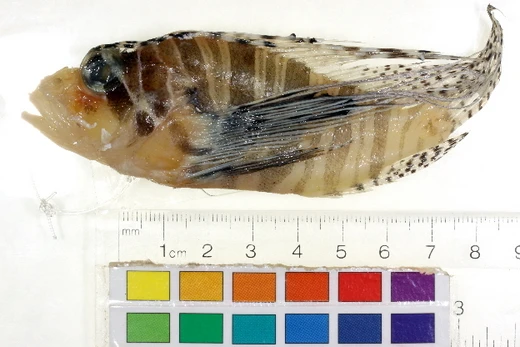
Lythrichthys
A genus of red deepwater scorpionfishes native to the Pacific Ocean.

Lythrichthys, commonly known as the red deepwater scorpionfishes, are a group of marine ray-finned fish within the subfamily Setarchinae (the deep-sea bristly scorpionfishes) and the family Scorpaenidae. Their range is the Pacific Ocean.
The genus was originally established in 1904 by American ichthyologists David Starr Jordan and Edwin Chapin Starks, who designated *Lythrichthys eulabes* as the sole species, with a type locality off Ose Point in Suruga Bay, Japan. Later, *L. eulabes* was moved into the genus *Setarches*, making *Lythrichthys* a synonym. In 2021, however, Wada, Kai & Motomura revived *Lythrichthys*, transferring *L. cypho* (previously considered a synonym of *Setarches longimanus*) and *L. longimanus* into it, and describing two new species. This left only the channelled rockfish (*Setarches guentheri*) in *Setarches*. As of January 2022, Catalog of Fishes accepts this revision. The genus name combines *lythrum* (meaning "gore," in reference to the red body of living *L. eulabes*) with *ichthys* (Greek for "fish").
Five species are currently recognized: *Lythrichthys cypho* (dwarf red deepwater scorpionfish), *L. dentatus* (gap-toothed red deepwater scorpionfish), *L. eulabes* (Jordan's red deepwater scorpionfish), *L. grahami* (Graham's red deepwater scorpionfish), and *L. longimanus* (red deepwater scorpionfish).
These fish typically have three spines and five soft rays in the anal fin, though the soft-ray count can range from four to six. They possess 7–12 predorsal scales. Body depth at the pelvic-fin origin is 29.1%–38.6% of standard length, and the interorbital width at the eye’s vertical midline is 8.1%–12.9% of standard length. The snout and the dorsal and ventral surfaces of the head lack scales. At least 75% of the premaxilla’s lateral surface is covered by a well-developed lip. The first lacrimal spine is well developed and roughly equal in length to the second and third spines. There are five preopercular spines; the second is much smaller than the first and third, which are also much longer than the fourth and fifth (the latter two are subequal). The tip of the first lacrimal spine just extends over the upper lip. Scales on the thorax and abdomen are clearly embedded in the skin. A well-developed swim bladder is present.
Quick Facts
- Taxon
- Lythrichthys
- Type Species
- Lythrichthys eulabes
- Type Species Authority
- Jordan & Starks, 1904
Facts from the source article.
Lore & Background
Lythrichthys was first described as a genus in 1904 by American ichthyologists David Starr Jordan and Edwin Chapin Starks, who designated Lythrichthys eulabes as the type species, with a type locality off Ose Point in Suruga Bay, Japan. Later, L. eulabes was placed in the genus Setarches, and Lythrichthys became a synonym of that taxon. However, in 2021, Wada, Kai & Motomura resurrected the genus, added L. cypho (previously treated as a synonym of Setarches longimanus), as well as L. longimanus, and described two new species. As of January 2022, this change has been accepted by Catalog of Fishes. The genus name is a compound of lythrum, meaning 'gore', alluding to the red color of the body of living L. eulabes, and ichthys, Greek for 'fish'.
Lythrichthys deepwater red scorpionfishes are characterized by typically having 3 spines and 5 soft rays in the anal fin, though there may be as few as 4 or as many as 6 anal soft rays. They have 7–12 predorsal scales. The body depth at the origin of the pelvic fin is 29.1% to 38.6% of the standard length, and the interorbital area has a width at the vertical midline of the eye of 8.1% to 12.9% of the standard length. The snout, dorsal and ventral surface of the head have no scales. At least 75% of the lateral surface of the premaxilla is covered by a well-developed lip. The first lacrimal spine is well developed and roughly the same length as the second and third spines. There are 5 preopercular spines, with the second being much less well developed than the first and third, which are also much longer than the fourth and fifth spines (which are subequal in length). The tip of the first lacrimal spine just extends over the upper lip. The scales on the thorax and abdomen are clearly embedded in the skin. They have a well-developed swim bladder.
Lythrichthys deepwater red scorpionfishes are found in the Indo-West Pacific as far north as Japan and south to Australia and west as far as Fiji.
Reader's Guide
The resurrection of Lythrichthys as a valid genus in 2021 by Wada, Kai & Motomura resolved a long-standing taxonomic confusion, restoring the name originally proposed by Jordan and Starks in 1904. This change left the channelled rockfish (Setarches guentheri) as the only species in the now monotypic Setarches. The genus currently comprises five species, including two newly described in 2021: Lythrichthys dentatus and Lythrichthys grahami. The genus name, derived from Greek words meaning 'gore' and 'fish', reflects the distinctive red coloration of living specimens. The species are native to the Indo-West Pacific, ranging from Japan to Australia and as far west as Fiji. Their morphological characteristics, such as the number of anal fin spines and soft rays, predorsal scales, and the structure of the lacrimal and preopercular spines, help distinguish them from related scorpionfishes. The presence of a well-developed swim bladder is notable for a deepwater genus. The acceptance of this taxonomic revision by Catalog of Fishes as of January 2022 indicates that the genus is now widely recognized in ichthyology.
Did You Know?
- The genus name combines lythrum, meaning 'gore', and ichthys, Greek for 'fish', referring to the red color of L. eulabes.
- Lythrichthys species have a well-developed swim bladder.
- The genus was resurrected in 2021 by Wada, Kai & Motomura, who added two new species.
More in Lionfish and Scorpionfish 1-24
Spotted an error? Know more?
Reader corrections go straight into our review queue. Suggest an edit · How this site is sourced