Luna lionfish
A venomous lionfish with disputed taxonomy, found in the western Pacific.

The luna lionfish (Pterois lunulata), also called the dragon's beard fish or Japanese lionfish, is a marine ray-finned fish in the family Scorpaenidae, which includes scorpionfishes and lionfishes. It lives in the western Pacific Ocean. Its classification is debated: genetic studies and some physical traits suggest it might be the same species as Pterois russelii.
This species was first formally described in 1843 by naturalists Coenraad Jacob Temminck and Hermann Schlegel, based on a specimen from Nagasaki Bay, Japan. Its scientific name, *lunulata*, means "moon-shaped," likely referring to the crescent-shaped black spots on its pectoral fins.
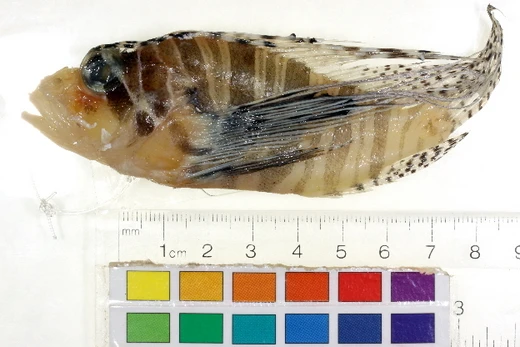
The luna lionfish closely resembles *P. russelii*, with few consistent physical or genetic differences between them. They are told apart mainly by scale counts: this species has 7–10 scales above the lateral line (versus 9–12 in *P. russelii*) and 60–80 scale rows from behind the gills to the tail base (versus 70–95). It also has white spots on the inner pectoral fin and slight differences in the average length of that fin. It may simply be a color variant of *P. russelii*. The body has bands with scales that have pale centers, creating a lattice pattern; the pectoral-fin rays show V-shaped markings, and large adults have spotted soft-rayed parts of the dorsal, anal, and caudal fins. The maximum total length is 35 cm (14 in), though 25 cm (9.8 in) is more typical.
Found in the western Pacific from southern Japan and Korea south to Australia and New Caledonia, this fish lives over rocky substrates in subtropical waters. It typically inhabits open areas with isolated reef outcrops or soft-bottom substrates at moderate depths of 132 to 172 meters (433 to 564 feet).
Like other lionfishes, the luna lionfish is a predator, feeding on small fish and crustaceans. Its fin spines carry venom.
Quick Facts
- Taxon
- Pterois lunulata
Facts from the source article.
Lore & Background
The luna lionfish was first formally described in 1843 by the naturalists Coenraad Jacob Temminck and Hermann Schlegel, with the type locality given as Nagasaki Bay in Japan. The specific name lunulata means 'moon shaped', thought to be a reference to the crescent shaped black spots on the pectoral fins. Molecular studies, and some morphological data too, have indicated that this species and P. russelii are the same species, P. russelii, and it may be that P. lunulata is a morph of P. russelli.
The luna lionfish is very similar to P. russelli, with almost no known consistent morphological and genetic features separating the two taxa. They are separated by some differences in the number of body scales above the lateral line (7–10 in this species, 9–12 in P. russelli) and in the number of scale rows running along the body from behind the gills to the base of the tail (60–80 in this species, 70–95 in P. russelli). The luna lionfish also has white spots on the inner pectoral fin and some differences in the average length of that fin. There are scales with pale centres which create a lattice-like pattern on the bands on the body, the pectoral-fin rays have V-shaped markings, and the soft-rayed parts of the dorsal, anal and caudal fins are spotted in large adults.
The luna lionfish is found in the Western Pacific Ocean from southern Japan and Korea in the north south to Australia and New Caledonia. They occur over rocky substrates in subtropical waters and are typically found in open areas where there are isolated outcrops of reef or over soft-bottom substrates at moderate depths of 132 to 172 m. Like other lionfishes, it is predatory and feeds on small fishes and crustaceans. The spines in the fins are venom bearing.
Reader's Guide
The luna lionfish is notable primarily for its taxonomic uncertainty, as molecular and morphological evidence suggests it may be conspecific with Pterois russelii. This ambiguity highlights the challenges in distinguishing closely related lionfish species. The species was first described in 1843 from Nagasaki Bay, Japan, and its name refers to moon-shaped spots on its pectoral fins. It is a venomous predator of small fishes and crustaceans, inhabiting subtropical waters over rocky or soft-bottom substrates at moderate depths. Its distribution spans from southern Japan and Korea to Australia and New Caledonia. The luna lionfish reaches a maximum total length of 35 cm, though 25 cm is more typical. Its significance lies in its role as a representative of the Scorpaenidae family and as a subject of ongoing taxonomic debate, which affects conservation and management efforts. The species is distinguished from P. russelli by subtle scale counts and fin markings, but these differences may reflect variation within a single species rather than separate taxa. This entry preserves the uncertainty reported in the source, noting that the luna lionfish may be a morph of P. russelli.
Did You Know?
- The luna lionfish was first formally described in 1843 by Temminck and Schlegel from Nagasaki Bay, Japan.
- Its specific name lunulata means 'moon shaped', referring to crescent-shaped black spots on the pectoral fins.
- Molecular and some morphological data suggest it may be the same species as Pterois russelii.
- The spines in its fins are venom bearing.
More in Lionfish and Scorpionfish 1-24
Spotted an error? Know more?
Reader corrections go straight into our review queue. Suggest an edit · How this site is sourced