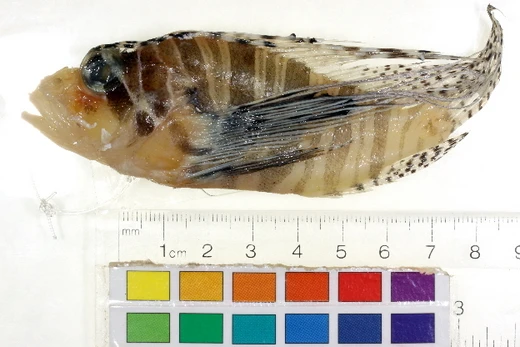
Lioscorpius
A genus of deep-sea scorpionfishes with slender bodies.

Lioscorpius is a genus of marine ray-finned fish within the subfamily Setarchinae, which are deep-sea bristly scorpionfishes, part of the family Scorpaenidae. These fish are found in the western Pacific Ocean.
The genus was first described in 1880 by the German-born British ichthyologist Albert Günther, based on a single species, *L. longiceps*, collected from the Kai Islands in the Banda Sea, Indonesia. The name *Lioscorpius* combines *lio*, meaning "smooth" (referring to the head having few ridges or spines), and *scorpius*, meaning "scorpion," indicating its classification as a scorpionfish.
Two species are currently recognized: *Lioscorpius longiceps* (slender scorpionfish) and *Lioscorpius trifasciatus* (tripleband scorpionfish).
Members of this genus have a preorbital bone with a very small first spine and a long projection covering its articulating surface. The last two to three spines in the dorsal fin are small and often embedded in the skin. They possess a well-developed swimbladder with a large gas gland. Compared to related genera in Setarchinae, they have more slender bodies—body depth is about a quarter of standard length—and a narrow space between the eyes. The two species are distinguished by anal fin structure: *L. longiceps* has two spines and six soft rays, while *L. trifasciatus* has three spines and five soft rays.
*Lioscorpius* species range from Japan south to Australia, including Vanuatu, New Caledonia, and Fiji. *L. longiceps* is bathydemersal, while *L. trifasciatus* is benthopelagic, and both are found at depths between 180 and 410 meters (590 to 1,350 feet).
Quick Facts
- Taxon
- Lioscorpius
- Type Species
- Lioscorpius longiceps
- Type Species Authority
- Günther, 1880
Facts from the source article.
Lore & Background
The genus Lioscorpius was formally described in 1880 by German-born British ichthyologist Albert Günther, who described its only species at the time, L. longiceps, from the Kai Islands in the Banda Sea, Indonesia. The genus name combines 'lio' meaning 'smooth'—referring to Günther's description of the head as 'with scarcely any ridges or spines'—and 'scorpius' meaning 'scorpion', indicating it is a scorpionfish.
Lioscorpius scorpionfishes have a preorbital bone with a very small first spine, and a long projection above the preorbital covers its articulating surface. The rearmost 2–3 spines in the dorsal fin are small and often embedded in the skin. They possess a well-developed swimbladder and a large gas gland. Their bodies are more slender than related genera within Setarchinae, with a depth around a quarter of the standard length, and they have a thin space between the eyes.
The two recognized species are L. longiceps (slender scorpionfish) and L. trifasciatus (tripleband scorpionfish). They are distinguished by anal fin counts: L. longiceps has 2 spines and 6 soft rays, while L. trifasciatus has 3 spines and 5 soft rays. L. longiceps is described as bathydemersal, and L. trifasciatus as benthopelagic.
Reader's Guide
Lioscorpius represents a small genus within the deep-sea bristly scorpionfishes, notable for its smooth-headed morphology and slender body shape that sets it apart from related genera in Setarchinae. The genus was established in 1880 based on a single specimen from the Kai Islands, and a second species was added in 2005, reflecting ongoing taxonomic refinement. Its members occupy bathydemersal and benthopelagic habitats in the western Pacific at depths between 180 and 410 meters, indicating adaptation to continental slope environments. The presence of a well-developed swimbladder and large gas gland suggests buoyancy control in deep water. The genus's distinguishing features—such as the small first preorbital spine, embedded posterior dorsal spines, and anal fin ray counts—are key for species identification. As part of the Scorpaenidae family, Lioscorpius contributes to the diversity of venomous marine fishes, though the article does not discuss venom. Its restricted distribution from Japan to Australia, including island groups like Vanuatu and Fiji, highlights its role in western Pacific deep-sea ecosystems.
Did You Know?
- The genus name Lioscorpius combines 'lio' meaning 'smooth' and 'scorpius' meaning 'scorpion'.
- The two species are distinguished by anal fin spine and soft ray counts.
More in Lionfish and Scorpionfish 1-24
Spotted an error? Know more?
Reader corrections go straight into our review queue. Suggest an edit · How this site is sourced