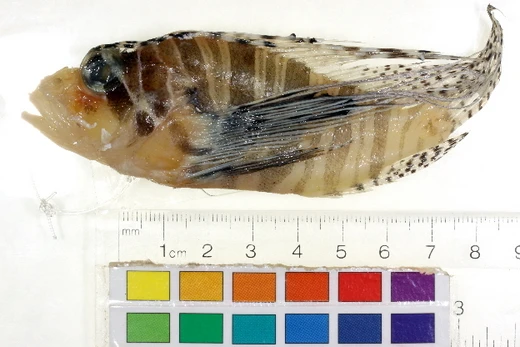
Ectreposebastes
Deep-sea scorpionfish genus with venomous spines and a soft body.

Ectreposebastes is a genus of marine ray-finned fish in the deep-sea bristly scorpionfish subfamily Setarchinae, which is part of the family Scorpaenidae. These fish are found in the Atlantic, Indian, and Pacific Oceans. The genus was first described in 1899 by American ichthyologist Samuel Garman as a monotypic group, based on the sole species *E. imus* from the Galápagos Islands. The name *Ectreposebastes* combines *ectrepos*, meaning "reversed" (Garman did not explain this choice), with *Sebastes*. The reversal may refer to the fish’s body being deepest under the soft-rayed part of the dorsal fin, unlike the species Garman compared it to, *Sebastes diploproa*, where the greatest depth is under the spiny part. Two species are currently recognized: *Ectreposebastes imus* (midwater scorpionfish) and *Ectreposebastes niger* (pelagic scorpionfish). The body of *Ectreposebastes* is relatively deep, soft, and flabby. The head is large, with a weakly ossified, translucent cranium that has a large volume. There is no postocular pit, and any head spines are weak. A longitudinal suborbital ridge bears a very small first spine, followed by two much larger ones. The eyes are medium-sized. The jaws contain many small conical teeth, and teeth are also present on the sides of the roof of the mouth. The preopercular margin has five spines, with the second being the longest. The single dorsal fin has a deep notch at the rear of its spiny section, which contains 12 robust, venomous spines; behind the notch are 9 or 10 soft rays. The anal fin has 3 spines and 6 soft rays, the last of which is divided. The lateral line is complete, forming a continuous trough covered by thin, membrane-like scales. The scales are very small, smooth, and arranged in ill-defined rows. The swim bladder is either rudimentary or absent. One species, *E. imus*, has an almost pantropical distribution, occurring in the eastern Pacific, Atlantic, and Indian Oceans. The other, *E. niger*, is restricted to the southwestern Pacific Ocean. These are bathypelagic fish, found at depths from 150 to 2,000 meters. *Ectreposebastes* are thought to feed in the water column, primarily on crustaceans such as amphipods and shrimp of the genus *Sergestes*. At least the anal fin spines bear venom.
Quick Facts
- Taxon
- Ectreposebastes
- Type Species
- Ectreposebastes imus
- Type Species Authority
- Garman, 1899
Facts from the source article.
Lore & Background
The genus Ectreposebastes was first described as monotypic in 1899 by American ichthyologist Samuel German, who described its then-only species E. imus from the Galápagos Islands. The genus name is a compound of ectrepos, meaning 'reversed' (though German did not explain this), and Sebastes. It may refer to the greater depth of the body with the back arching higher under the soft-rayed part of the dorsal fin, whereas in the species German cited for comparison, the greatest body depth occurs under the spiny part of the dorsal fin. Ectreposebastes has a relatively deep body that is rather soft and flabby. The head is quite large with a weakly ossified cranium, the bone of which is translucent and has a large volume. There is no postocular pit, and any head spines are weak. A longitudinal suborbital ridge has a single very small first spine but the next two are much bigger.
Reader's Guide
Ectreposebastes represents a genus of deep-sea scorpionfishes that are notable for their adaptation to bathypelagic life. The genus was established in 1899 by Samuel German based on a single specimen from the Galápagos Islands, and its name reflects a morphological reversal compared to related species. The genus is distinguished by a soft, flabby body, a weakly ossified and translucent cranium, and venomous spines in the dorsal and anal fins. These features, along with a rudimentary or absent swim bladder, are adaptations to life in the deep water column. The genus includes two species: the widespread E. imus and the southwestern Pacific E. niger. Their diet consists mainly of crustaceans such as amphipods and shrimp of the genus Sergestes, and they are thought to feed in the water column. The venomous spines serve as a defense mechanism. The genus is part of the subfamily Setarchinae, the deep-sea bristly scorpionfishes, and its presence across the Atlantic, Indian, and Pacific Oceans highlights its broad distribution in deep waters.
Did You Know?
- The genus name Ectreposebastes may refer to the body being deeper under the soft-rayed part of the dorsal fin, reversed from a related species.
- Ectreposebastes has a swim bladder that is either rudimentary or absent.
- The dorsal fin contains 12 robust and venomous spines.
- E. imus occurs in the Eastern Pacific, Atlantic, and Indian Oceans, while E. niger is restricted to the southwestern Pacific.
More in Lionfish and Scorpionfish 1-24
Spotted an error? Know more?
Reader corrections go straight into our review queue. Suggest an edit · How this site is sourced