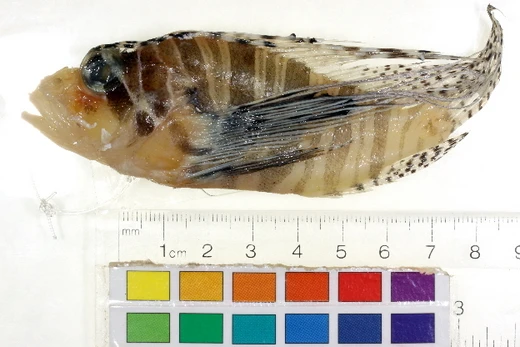
Dendrochirus zebra
A venomous, bottom-dwelling fish with striped body and fan-like fins.

Dendrochirus zebra, also called the zebra turkeyfish or zebra lionfish, is a marine fish belonging to the Scorpaenidae family. It is found across the tropical Indo-West Pacific, from the Red Sea to Indonesia and eastern Australia.
The fish has vertical orange, white, and black stripes on its body, and large, banded, fan-like pectoral fins that spread out on either side when it rests on the seabed. Its front dorsal fin consists of 13 tall, quill-like spines, while the second dorsal fin has 10 or 11 soft rays. The anal fin has three spines and about 10 soft rays. The second dorsal fin, anal fin, and rounded caudal fin are marked with black and white transverse bands. It reaches a maximum length of about 25 cm (10 in).
This bottom-dwelling species lives in inshore waters down to about 80 m (262 ft). It inhabits coral, pebble, and rock bottoms on reef flats, outer reefs, and lagoons, and can also be found in caves, sometimes in small groups.
Like other scorpionfish, it has 13 venomous spines along its back, connected by a clear, film-like membrane, used for defense. Though slow-moving and peaceful, it can be dangerous. It often rests in hidden, shaded spots such as under rocks or coral. All lionfish are immune to each other’s venom.
Originally thought to be solitary predators, zebra lionfish have been observed behaving gregariously in the wild and in labs, living and hunting in groups of two or three. When hunting together, they herd prey into a confined area using their venomous dorsal spines and flared fins as a barrier. Individuals take turns striking at prey and sometimes blow jets of water at it. Similar group hunting and water-jetting behaviors occur in invasive red lionfish in the Caribbean. Signaling turns and fin flaring during group hunts in zebra, red, and spotfin lionfish suggest that cooperative signaling and gregarious hunting may be typical of the lionfish family.
The zebra lionfish feeds on small crustaceans and fish, and is preyed upon by groupers.
Quick Facts
- Taxon
- Dendrochirus zebra
Facts from the source article.
Lore & Background
The zebra turkeyfish is a scorpaenid fish with vertical stripes in orange, white, and black on its body, and large, banded, fan-like pectoral fins that flare out on either side as the fish lies on the seabed. The front dorsal fin is made up of 13 tall, quill-like spines and the second dorsal fin has 10 or 11 soft rays. The anal fin has three spines and about 10 soft rays. The second dorsal fin, the anal fin, and the rounded caudal fin are transversely banded in black and white. This fish grows to a maximum length around 25 cm (10 in).
It is native to the Indo-Pacific region from the Red Sea to Indonesia and eastern Australia, found in inshore waters down to a depth of about 80 m (262 ft). It is a bottom-dwelling species and is found on coral, pebble, and rock bottoms on reef flats, outer reefs and lagoons and also in caves, sometimes in small groups.
This member of the scorpionfish family has 13 venomous spines along its back, used to defend itself. These spines are connected with a clear, film-like membrane. These fish are slow-moving and peaceful, but can be dangerous. They have a habit of resting in places hidden from light such as under a rock or a piece of coral. All lionfish are immune to each other's venom.
Reader's Guide
The zebra lionfish is significant as a species that exhibits both solitary and gregarious behavior. While originally described as solitary predators, zebra lionfish have more recently been observed exhibiting gregarious behavior both in the wild and in a laboratory setting, living and hunting together in groups of two or three. When hunting in groups, they herd their prey into a confined area using their venomous dorsal spines and flaring their fins to create a barrier. Individuals were observed taking turns striking at prey, and occasionally blowing jets of water at prey. Group hunting and water jet blowing behaviors have also been observed in invasive red lionfish in the Caribbean. Signaling turns in striking and fin flaring during group hunting observed in zebra lionfish, red lionfish, and spotfin lionfish may indicate that the cooperative signaling and gregarious hunting behaviors may be characteristic of the lionfish family as a whole. The zebra lionfish feeds on small crustaceans and fish, and is in turn preyed upon by groupers. Its venomous spines make it dangerous to humans, though it is slow-moving and peaceful by nature.
Did You Know?
- Zebra lionfish have been observed hunting together in groups of two or three, herding prey with their fins and spines.
- They are preyed upon by groupers.
More in Lionfish and Scorpionfish 1-24
Spotted an error? Know more?
Reader corrections go straight into our review queue. Suggest an edit · How this site is sourced