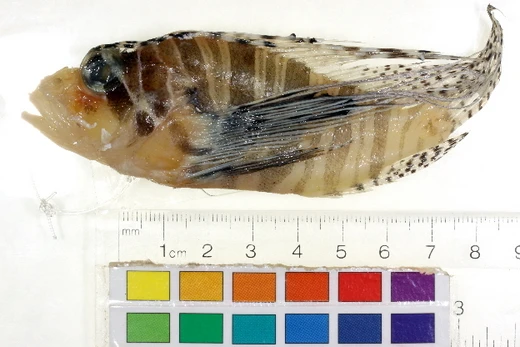
Clearfin lionfish
A venomous reef fish with clear, unbanded pectoral fins.

The clearfin lionfish (Pteropterus radiatus) goes by several common names, including tailbar lionfish, radiata lionfish, fireworks fish, and radial firefish. It belongs to the family Scorpaenidae, the group that contains scorpionfishes and lionfishes, and is a carnivorous, ray-finned fish armed with venomous spines. Its range spans the Indian and western Pacific Oceans.
French zoologist Georges Cuvier first formally described the species in 1829, with Tahiti given as the type locality. In 2023, it was reclassified into the revalidated genus *Pteropterus*. The specific name *radiatus* means "radiated" or "rayed," likely referring to the long pectoral-fin rays, which lack fin membrane at their tips.
This fish is native to the western Indo-Pacific, from South Africa and the Gulf of Aden east to Indonesia and the Society Islands, and north to the Ryukyu Islands, south to northern Australia and New Caledonia. It inhabits both inshore and offshore rocky reefs down to about 25 meters (82 feet), with juveniles sometimes found in tide pools.
Adults typically reach about 20 centimeters (8 inches) in length, though they can grow up to 24 centimeters (9 inches). The dorsal fin carries 12 or 13 long, venomous spines and 10 to 12 soft rays, while the anal fin has three spines and five or six soft rays. The large pectoral fins flare outward and are clear and unbanded; the other fins are also colorless. The head and body are reddish-brown, marked by roughly six vertical dark bands of varying color separated by thin white lines. Two white horizontal lines on the caudal peduncle distinguish this species from similar lionfishes.
Its closest relative is the Red Sea endemic *P. cinctus*, which it closely resembles. The two differ mainly in that the clearfin lionfish has shorter fin rays and slightly different markings on average, but both are easily told apart from other lionfish species.
Primarily nocturnal, the clearfin lionfish hides during the day in rock crevices, small caves, or under overhangs. At night, it emerges to feed on invertebrates like crabs and shrimps.
Quick Facts
- Taxon
- Pteropterus radiatus
Facts from the source article.
Lore & Background
The clearfin lionfish was first formally described in 1829 by the French zoologist Georges Cuvier, with the type locality given as Tahiti. In 2023, it was reclassified as a species of the revalidated genus Pteropterus. Its specific name radiatus means 'radiated' or 'rayed', thought to allude to the long pectoral-fin rays that are free of fin membrane distally.
This species is native to the western Indo-Pacific region, ranging from South Africa and the Gulf of Aden to Indonesia, the Society Islands, the Ryukyu Islands, northern Australia, and New Caledonia. It inhabits both inshore and offshore rocky reefs at depths to about 25 m (82 ft), with juveniles sometimes found in tide pools.
The clearfin lionfish grows to a length of about 24 cm (9 in), though a more usual size is 20 cm (8 in). Its dorsal fin has 12 or 13 long, venomous spines and 10 to 12 soft rays; the anal fin has three spines and five or six soft rays. The large pectoral fins flare out to the side and are clear and unbanded, while the other fins are also colourless. The head and body are reddish-brown with about six vertical dark bands separated by thin white lines, and two white horizontal lines on the caudal peduncle distinguish it from similar lionfishes. It is most closely related to the Red Sea endemic P. cinctus, differing mainly in shorter fin rays and slightly different markings.
Reader's Guide
The clearfin lionfish is a member of the family Scorpaenidae, which includes scorpionfishes and lionfishes, and is notable for its venomous spines and distinctive clear pectoral fins. Its description by Georges Cuvier in 1829 and its 2023 reclassification into the revalidated genus Pteropterus reflect ongoing taxonomic refinement within this group. The species is primarily nocturnal, hiding in rock crevices, small caves, or under overhangs during the day and emerging at night to feed on invertebrates such as crabs and shrimps. Its range across the Indian and western Pacific Oceans, from South Africa to the Society Islands and northern Australia, makes it a widespread inhabitant of rocky reefs. The clearfin lionfish's appearance—with reddish-brown body, vertical dark bands, and white horizontal lines on the caudal peduncle—helps distinguish it from other lionfishes, particularly its close relative P. cinctus. Its venomous spines serve as a defense mechanism, and its clear, unbanded pectoral fins are a key identifying feature. The species is also known by several common names, including tailbar lionfish, radiata lionfish, fireworks fish, and radial firefish.
Did You Know?
- Its specific name radiatus means 'radiated' or 'rayed', referring to its long pectoral-fin rays.
- It has 12 or 13 venomous dorsal spines and clear, unbanded pectoral fins.
- Juveniles are sometimes found in tide pools.
More in Lionfish and Scorpionfish 1-24
Spotted an error? Know more?
Reader corrections go straight into our review queue. Suggest an edit · How this site is sourced