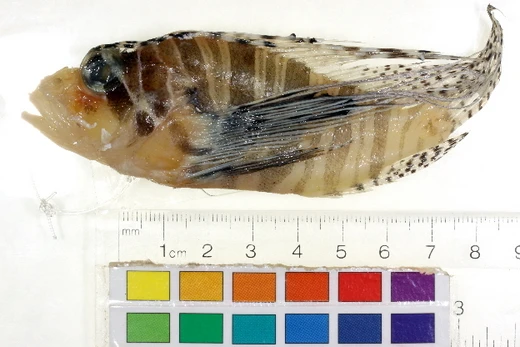
Channelled rockfish
The widest-ranging scorpaenid, now the sole species in genus Setarches.

The channelled rockfish (Setarches guentheri), also called the deepwater scorpionfish, is a ray-finned marine fish in the subfamily Setarchinae (family Scorpaenidae). It holds the widest distribution of any scorpaenid, occurring across tropical and warm temperate oceans around the globe. As of January 2022, it is the sole species left in the genus *Setarches*, which is now monotypic.
The species was first described in 1862 by English zoologist James Yate Johnson, who placed it in a new genus, *Setarches*, with the type locality of Madeira. Johnson named it after his friend, the German-born British ichthyologist Albert Günther. The genus name may come from *saeta*, meaning "bristle." Over time, other species were added to *Setarches*, but in 1966 William N. Eschmeyer and Bruce B. Collette synonymized most of them with *S. guentheri*, leaving only *S. guentheri* and *S. longimanus*. Later work recognized three species: *S. armata*, *S. guentheri*, and *S. longimanus*. A 2021 review by Wada, Kai & Motomura resurrected the genus *Lythrichthys*, moving *S. cypho*, *S. longimanus*, and two newly described species into it. *S. armata* was then considered a synonym of the flathead *Thysanophrys armata*, leaving *S. guentheri* as the only member of *Setarches*. This classification is accepted by Catalog of Fishes as of January 2022.
The body depth of the channelled rockfish is 28–37% of its standard length, with larger fish being less deep. The dorsal fin has 11–13 spines and 9–11 soft rays; the anal fin has 3 spines and 4–6 soft rays. The lateral line is nearly continuous, covered by thin, deciduous membranous scales. On the preoperculum, the second spine is longer and better developed than the first and third, which are similar in length. Live fish are pinkish red to orange with reddish black spots on the head and body. Smaller individuals are more reddish grey with black spots; the smallest (around 40 mm) have dark coloring concentrated in a patch above the pectoral fin and below the soft-rayed part of the dorsal fin, with less dark color on the caudal peduncle. Maximum total length is 31.4 cm.
This species has a circumglobal range on continental shelves in tropical and warm temperate waters.
Quick Facts
- Taxon
- Setarches guentheri
Facts from the source article.
Lore & Background
The channelled rockfish was first formally described in 1862 by English zoologist James Yate Johnson, with the type locality given as Madeira. Johnson placed the new species in the new monotypic genus Setarches. Subsequent workers added other species to this genus, but in 1966 William N. Eschmeyer and Bruce B. Collette synonymised most of these with S. guentheri, making Setarches consist only of this species and S. longimanus. This was later re-examined, and three species were accepted as belonging to the genus: S. armata, S. guentheri, and S. longimanus. A review in 2021 by Wada, Kai & Motomura resurrected the genus Lythrichthys, placing S. cypho, S. longimanus, and two newly described species in that resurrected genus, while S. armata is now considered a synonym of the flathead Thysanophrys armata. This left the channelled rockfish as the only species in the now monotypic Setarches. As of January 2022 this change has been accepted by Catalog of Fishes. The genus name Setarches was not explained by Johnson; it may be derived from saeta meaning 'bristle', while the specific name honours Johnson's friend, the German-born British ichthyologist and herpetologist Albert Günther.
Reader's Guide
The channelled rockfish is significant as the most widely distributed scorpaenid, with a circumglobal range on continental shelves in tropical and warm temperate oceans. Despite this vast distribution, there is very little genetic difference between widely separated populations. The species has a complex taxonomic history, having been the subject of multiple revisions that ultimately left it as the sole member of the genus Setarches as of January 2022. It is a benthopelagic species found over soft bottoms at depths of 150 to 780 m, with water temperatures between 5.5 and 12.5 °C. The fish feeds predominantly on pelagic invertebrates, though in the Gulf of Mexico its diet is dominated by benthic crustaceans such as shrimp and prawns in the genus Oplophorus and a variety of amphipods. The spines in its fins bear venom glands and can envenomate humans if handled. The channelled rockfish is sometimes caught in fisheries in the Gulf of Mexico and is of slight commercial value in Mexico.
Did You Know?
- The channelled rockfish has the widest distribution of any scorpaenid, found circumglobally on continental shelves.
- As of January 2022, the channelled rockfish is the only species in the genus Setarches.
Frequently Asked Questions
What is the Channelled rockfish?
The Channelled rockfish (Setarches guentheri) is a deepwater scorpionfish in the scorpaenid family, commonly nicknamed the deepwater scorpionfish. It is the last surviving member of the genus Setarches, making that genus monotypic.
Where does the Channelled rockfish live?
It has the broadest geographic range of any scorpaenid, occurring in tropical and warm-temperate oceans around the entire globe. Its typical depth window runs from about 150 to 780 m, in water between roughly 5.5 and 12.5 °C.
How big does the Channelled rockfish grow?
Adults top out at around 31.4 cm (about 12.4 in) in total length. Fin counts include 11 to 13 dorsal spines, 9 to 11 soft dorsal rays, and 3 anal spines.
Who first described the Channelled rockfish?
English zoologist James Yate Johnson published the original description in 1862, erecting the new genus Setarches with Madeira as the type locality. He named the species in honor of a German-born naturalist friend.
Why is the Channelled rockfish considered special among scorpionfish?
It holds the record for the widest distribution of any member of the scorpaenid family, spanning tropical and warm-temperate seas worldwide. On top of that, it is the sole remaining species in its genus, a fact that makes it a taxonomic one-of-a-kind.
More in Lionfish and Scorpionfish 1-24
Spotted an error? Know more?
Reader corrections go straight into our review queue. Suggest an edit · How this site is sourced