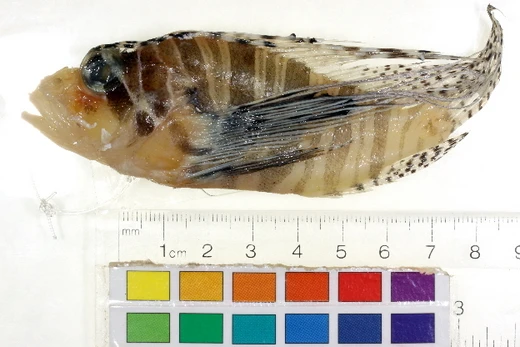
Andover lionfish
Venomous lionfish described in 2008 from Indonesian waters.

The Andover lionfish (Pterois andover) is a marine ray-finned fish in the scorpionfish and lionfish family, Scorpaenidae, native to the western Pacific Ocean.
American ichthyologists Gerald R. Allen and Mark van Nydeck Erdmann first scientifically described the species in 2008. Its type specimen came from southwestern Yapen Island in Cenderawasih Bay, Papua Province, Indonesia. The species name honors Andover Leisure Pte Ltd, a Singaporean company that builds and manages oceanaria and works to promote ocean appreciation and marine conservation in Asia. The name was requested by Sinduchajana Sulistyo, chairman of the Andover group, after he made a successful bid at a charity auction in Monaco on 20 September 2007. That auction supported Conservation International’s Bird’s Head Seascape marine conservation initiative.
The fish has 13 spines and 11 soft rays in its dorsal fin, with the first dorsal spine short—about 15% of the fish’s standard length. Its anal fin has 3 spines and 7 soft rays. The pectoral fin usually has 13 rays, though the count ranges from 12 to 14. The dorsal spines have a thin, barely noticeable membrane along their rear edges that widens into a pennant-like flap at the tip. Compared to related species, the Andover lionfish has few dark spots on its median fins: 5 to 28 on the dorsal fin, 10 to 19 on the anal fin, and 17 to 41 on the caudal fin.
This species lives in the western Pacific, in waters off Indonesia and Papua New Guinea, and ranges as far as Sabah, Malaysia, and the Philippines. It is found at depths from 3 to 70 meters, typically on or near turbid inshore reefs within areas of sandy-silty substrates, often close to river mouths.
Andover lionfish are usually solitary, though small family groups have been recorded. During the day, they hide in crevices and under rocks among coral reefs or outcrops, with their tails pointing outward. They feed at night over soft mud and sand, preying on crustaceans and small fish. Like all lionfishes, this species is protected by venomous spines.
Quick Facts
- Taxon
- Pterois andover
Facts from the source article.
Lore & Background
The Andover lionfish was first formally described in 2008 by American ichthyologists Gerald R. Allen and Mark van Nydeck Erdmann, with the type locality given as southwestern Yapen Island in Cenderawasih Bay in the Papua Province of Indonesia. The specific name refers to the Singaporean company Andover Leisure Pte Ltd, part of the Andover group of companies, which owns, builds and manages oceanaria and is dedicated to promoting greater public appreciation of the oceans and marine conservation in Asia. This name was requested by Sinduchajana Sulistyo, chairman of the Andover group, who made a successful bid to conserve the Andover lionfish at a black-tie charity auction, the Blue Auction, held in Monaco on 20 September 2007 to support Conservation International's Bird's Head Seascape marine conservation initiative.
The Andover lionfish has 13 spines and 11 soft rays in its dorsal fin, the first dorsal spine being short, around 15% of the fish's standard length. Its anal fin contains 3 spines and 7 soft rays. The pectoral fin has between 12 and 14 fin rays, typically 13. The dorsal spines have a thin, barely noticeable membrane on their rear edges which expands into a pennant-like flap at the tip. There are few dark spots on the median fins compared to related species, with 5 to 28 on the dorsal fin, 10 to 19 on the anal fin, and 17 to 41 on the caudal fin.
Andover lionfish are found in the western Pacific in marine waters off of Indonesia and Papua New Guinea and ranges as far as Sabah, Malaysia, and the Philippines. They are found at depths from 3–70 m, on or in the vicinity of turbid inshore reefs within more extensive areas of sandy-silty substrates, frequently close to river mouths. They are usually observed as solitary fish, although small family groups have been recorded. During the day they hide in crevices and under rocks, with their tails pointing outwards, among coral reefs or outcrops. They feed at night over soft mud and sand substrates, on crustaceans and small fish. Like all lionfishes this species is protected by venomous spines.
Reader's Guide
The Andover lionfish is notable primarily for its recent formal description in 2008, making it a relatively newly recognized species within the Scorpaenidae family. Its naming reflects a unique conservation funding mechanism: the specific epithet was purchased at a charity auction, the Blue Auction held in Monaco on 20 September 2007, to support Conservation International's Bird's Head Seascape marine conservation initiative. The bid was made by Sinduchajana Sulistyo, chairman of the Andover group of companies, which owns and manages oceanaria and promotes marine conservation in Asia. This species is distinguished from related lionfishes by its fin-ray counts and the pattern of dark spots on its median fins, with relatively few spots compared to other species. Its habitat preferences—turbid inshore reefs near river mouths on sandy-silty substrates—are specific and differ from clearer-water lionfish species. The Andover lionfish is venomous, like all lionfishes, and exhibits nocturnal feeding behavior on crustaceans and small fish. Its distribution is limited to the western Pacific, including Indonesia, Papua New Guinea, Sabah (Malaysia), and the Philippines. The species' biology, including solitary habits and daytime hiding in crevices, aligns with typical lionfish behavior. The conservation context of its naming highlights the intersection of commercial aquarium interests and marine conservation funding.
Did You Know?
- Its specific name honors the Singaporean company Andover Leisure Pte Ltd, which won the naming rights at a charity auction in Monaco in 2007.
- The first dorsal spine of the Andover lionfish is short, about 15% of the fish's standard length.
- This species is found at depths from 3 to 70 meters, often near river mouths on sandy-silty substrates.
More in Lionfish and Scorpionfish 1-24
Spotted an error? Know more?
Reader corrections go straight into our review queue. Suggest an edit · How this site is sourced