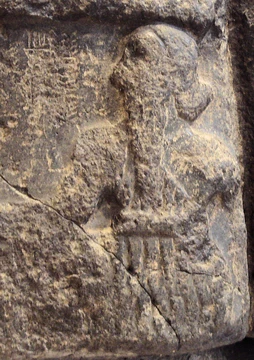
Sennacherib
Neo-Assyrian king who expanded Nineveh and destroyed Babylon.

Sennacherib (c. 745–681 BC) ruled the Neo-Assyrian Empire from 705 BC until he was killed. His name, in Neo-Assyrian Akkadian, means "Sîn has replaced the brothers." He was the second king of the Sargonid dynasty and is well known for appearing in the Hebrew Bible, which recounts his military campaign in the Levant. He also famously destroyed Babylon in 689 BC and rebuilt and expanded Nineveh, the last major Assyrian capital.
Despite being one of the most powerful Assyrian kings, Sennacherib struggled to control Babylonia, the empire’s southern region. Much of his trouble there came from the Chaldean chief Marduk-apla-iddina II, who had been Babylon’s king until Sennacherib’s father defeated him. Soon after Sennacherib took the throne in 705 BC, Marduk-apla-iddina recaptured Babylon and formed an alliance with the Elamites. Sennacherib regained the south in 700 BC, but Marduk-apla-iddina kept causing problems. He likely encouraged Assyrian vassals in the Levant to rebel, which sparked the Levantine War of 701 BC, and he also fought against Bel-ibni, Sennacherib’s appointed king in Babylonia.
When the Babylonians and Elamites captured and killed Sennacherib’s eldest son, Aššur-nādin-šumi—whom Sennacherib had made his vassal king in Babylon—Sennacherib campaigned against both regions and subdued Elam. Because Babylon, located well inside his own territory, had been the focus of so many of his campaigns and had caused his son’s death, he destroyed the city in 689 BC.
During the Levantine War, the southern states, especially the Kingdom of Judah under King Hezekiah, proved harder to subdue than those in the north. The Assyrians invaded Judah. The Bible says divine intervention ended the siege of Jerusalem when an angel destroyed the Assyrian army, but an outright defeat seems unlikely, since Hezekiah submitted to Sennacherib at the campaign’s end. Contemporary records, even from Assyria’s enemies, do not mention an Assyrian defeat at Jerusalem. Still, the siege was at least inconclusive, and the Greek historian Herodotus claimed the Assyrians failed there.
Sennacherib moved the Assyrian capital to Nineveh, where he had lived most of his time as crown prince. To make it a capital worthy of his empire, he launched one of the most ambitious building projects of the ancient world. He enlarged the city, built massive walls, many temples, and a royal garden.
Quick Facts
- Title
- King of Assyria · King of Babylon · King of the Four Corners of the World · King of the Universe
- Reign
- 705–681BC
- Dynasty
- Sargonid dynasty
- Predecessor
- Sargon II
- Successor
- Esarhaddon
- Mother
- Ra'īmâ
- Death Place
- Nineveh
- Spouse
- Tashmetu-sharrat · Naqi'a
- Issue
- Ashur-nadin-shumi · Arda-Mulissu · Esarhaddon
Facts from the source article.
Lore & Background
Sennacherib was the son and successor of Sargon II. His mother is uncertain; historically thought to be Ataliya, but a stele from Assur discovered in 1913 and read in 2014 suggests she may have been Ra'îmâ. He was probably born c. 745 BC in Nimrud and served as crown prince, exercising royal power during his father's absences. As regent, he maintained relations with governors and generals, oversaw military intelligence, and managed tribute. He accompanied his father on the campaign against Urartu in 714 BC.
Upon inheriting the throne in 705 BC, Sennacherib faced immediate trouble in Babylonia from the Chaldean chief Marduk-apla-iddina II, who retook Babylon and allied with the Elamites.
Reader's Guide
Sennacherib's significance lies in his military campaigns, his architectural legacy, and his complex relationship with Babylonia. He was one of the most powerful Assyrian kings, yet he struggled to control the southern portion of his empire. His destruction of Babylon in 689 BC, motivated by the death of his son, was a drastic act that shocked contemporaries. His renovation of Nineveh into a grand capital, including the 'Palace without Rival,' represents one of the most ambitious building projects of the ancient world. His campaign in the Levant, particularly against Judah, is recorded in the Hebrew Bible and remains a subject of historical debate; while the Bible claims divine intervention, Assyrian records and other contemporary sources do not confirm a defeat, and Hezekiah submitted. Sennacherib's assassination by his own sons highlights the internal dynastic tensions of the Sargonid dynasty. His legacy is thus a mix of imperial might, architectural ambition, and the vulnerabilities of absolute power.
Did You Know?
- Sennacherib's name means 'Sîn (the moon-god) has replaced the brothers' in Akkadian, likely because all his older brothers were dead by the time he was born.
- In 670 BC, it was illegal to give the name Sennacherib to a commoner in Assyria, as it was considered sacrilege.
- Sennacherib's only known sister, Ahat-abisha, was married to Ambaris, the king of Tabal, but probably returned to Assyria after Sargon's first successful campaign against Tabal.
- The Greek historian Herodotus stated that the Assyrians failed in their siege of Jerusalem.
More in Kings of the Universe 1-24
Spotted an error? Know more?
Reader corrections go straight into our review queue. Suggest an edit · How this site is sourced