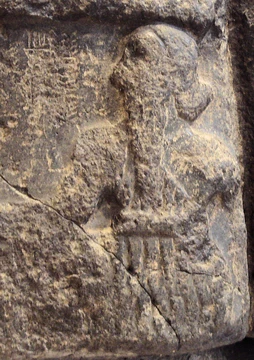
Adad-nirari III
King of Assyria from 811 to 783 BC.

Adad-nīrārī III (also Adad-nārārī, meaning 'Adad (the storm god) is my help') was the King of Assyria from 811 to 783 BC. He succeeded his father Shamshi-Adad V while apparently quite young, and for the first five years of his reign his mother Shammuramat was highly influential, a circumstance that gave rise to the legend of Semiramis. Though it is widely rejected that she acted as regent, her influence was surprising for the time period.
Quick Facts
- Title
- King of Assyria / King of the Universe
- Issue
- Ashur-nirari V / Shalmaneser IV / Ashur-dan III / Tiglath-Pileser III?
- Father
- Shamshi-Adad V
- Mother
- Shammuramat
- Succession
- King of the Neo-Assyrian Empire
- Successor
- Shalmaneser IV
- Reign
- 811–783 BC
- Death Date
- 783 BC
Facts from the source article.
Lore & Background
Adad-nīrārī's youth, and the struggles his father had faced early in his reign, caused a serious weakening of Assyrian rulership over their indigenous Mesopotamia, and made way for the ambitions of officers, governors, and local rulers. According to his inscriptions, he led several military campaigns with the purpose of regaining the strength Assyria enjoyed in the times of his grandfather Shalmaneser III. According to the eponym canon, he campaigned in all directions until the last of his 28 years of reign (783 BC).
Reader's Guide
Adad-nīrārī III is significant as a king who attempted to reverse the decline of Assyrian power after the troubled reign of his father. His military campaigns, including the siege of Damascus in 796 BC, led to the eclipse of the Aramaean Kingdom of Damascus and allowed the recovery of Israel under Jehoash (who paid tribute) and Jeroboam II. He also built the temple of Nabu at Nineveh. Despite his vigour, Assyria entered a several-decades-long period of weakness following his death. His legacy is complicated by the uncertain claim of Tiglath-Pileser III to be his son, and by the unusual influence of his mother Shammuramat, which later inspired the Semiramis legend. His sons—Ashur-nirari V, Shalmaneser IV, and Ashur-dan III—all became kings of Assyria.
Did You Know?
- Adad-nīrārī's mother Shammuramat was highly influential during the first five years of his reign, giving rise to the legend of Semiramis.
- He led a siege of Damascus in 796 BC against Ben-Hadad III.
- He was the builder of the temple of Nabu at Nineveh.
- Tiglath-Pileser III may have claimed descent from Adad-nīrārī, but a direct father-son relationship is not established in the canon and is debated among scholars.
A Young King and a Powerful Mother
Adad-nirari III ascended to the Assyrian throne in 811 BC as the son and direct successor of Shamshi-Adad V, yet he was evidently still a youth when he took the crown. The early years of his father's own reign had been marked by serious struggles, and those difficulties left a lasting mark on the kingdom. Assyrian authority over its heartland in Mesopotamia had weakened considerably, creating openings for ambitious military officers, provincial governors, and local rulers to challenge central control. Into this fractured landscape stepped a boy king whose first five years were dominated by the extraordinary influence of his mother, Shammuramat. While modern scholarship largely rejects the idea that she formally served as regent, her level of involvement in governance was remarkable for the era. Her prominence in the historical record eventually fed into the much later legend of Semiramis, a figure who would echo through centuries of Near Eastern storytelling. The young Adad-nirari thus inherited not a consolidated empire but a realm in need of reassertion, and the task of rebuilding would define his entire reign.
Campaigns in Every Direction and the Breaking of Damascus
Adad-nirari III's own inscriptions make clear that his central ambition was to restore the military prestige that Assyria had enjoyed under his grandfather Shalmaneser III. The eponym canon confirms that he waged campaigns in every direction throughout his twenty-eight-year reign, pressing his armies outward until the very final year, 783 BC. Among his most consequential operations was the siege of Damascus during the reign of Ben-Hadad III in 796 BC. That campaign proved decisive: it effectively eclipsed the Aramaean Kingdom of Damascus as a regional power and opened the door for the recovery of the Israelite kingdoms. Under King Jehoash, Israel paid tribute to the Assyrian ruler, and the broader political realignment also benefited Jeroboam II, whose reign of relative strength followed in the wake of Damascus's collapse. The young king who had inherited a weakened state thus spent nearly three decades on the march, steadily chipping away at the ambitions of officers, governors, and rival rulers who had grown bold during his father's troubled years.
A Dynasty in Motion and a Kingdom in Decline
Adad-nirari III's place in the Assyrian royal line is both clear and complicated. He was the son of Shamshi-Adad V and the father of at least three subsequent kings: Ashur-nirari V, Shalmaneser IV, and Ashur-dan III. The dynastic chain, however, becomes murkier with Tiglath-Pileser III, who in his own inscriptions styled himself a son of Adad-nirari III. Scholars remain uncertain whether this claim reflects genuine parentage or a deliberate political fabrication designed to bolster legitimacy. What is not in dispute is the trajectory that followed Adad-nirari's death in 783 BC. Despite the vigour and relentless campaigning that characterized his twenty-eight years on the throne, Assyria slipped into a period of weakness that would last for several decades. The very strength he had labored to rebuild proved fragile, and the ambitions of local powers that had been suppressed during his lifetime reasserted themselves in the years after his passing.
Storm God's Help: Name, Temple, and Stone
The name Adad-nirari III carries a theological declaration: 'Adad is my help,' invoking the Mesopotamian storm god as a personal patron and protector. That divine association finds a tangible echo in his building projects, most notably the construction of the temple of Nabu at Nineveh, a testament to his commitment to the religious life of the capital beyond mere military conquest. His reign also left a material footprint in the archaeological record. Several inscribed artifacts bear witness to his rule, including the Calah Slab, the Saba'a Stele, and the Tell al-Rimah stela, each preserving fragments of his royal narrative in stone. His own inscriptions, which detail the campaigns he launched to restore Assyrian power, serve as primary sources for historians reconstructing the political geography of the late ninth century BC. Together, these objects and texts transform Adad-nirari from a name in a king list into a figure whose words, faith, and ambitions can still be read across the millennia.
Frequently Asked Questions
Who is Adad-nirari III?
Adad-nirari III was the Assyrian monarch who held the throne from 811 to 783 BC, ascending to power at a notably young age after the death of his father Shamshi-Adad V. His name carries the meaning 'Adad is my help,' linking him to the storm god.
What is Adad-nirari III known for?
He is celebrated for the series of military campaigns that reasserted Assyria's dominance in the region, most notably the siege of Damascus in 796 BC. He also left a lasting architectural mark by commissioning the temple of the god Nabu at Nineveh.
Why is Adad-nirari III important?
He is regarded as a turning-point ruler who pulled Assyria out of a period of relative weakness and set the stage for the empire's later golden age. His combination of aggressive foreign policy and domestic building projects made him a model for subsequent Assyrian kings.
What is the Semiramis connection to Adad-nirari III?
During the first five years of his reign, his mother Shammuramat exercised a level of political influence that was extraordinary for the period, and this association later fueled the legendary tale of Queen Semiramis. Modern scholars generally dismiss the idea that she formally acted as regent, yet her behind-the-scenes role remains a striking feature of his early rule.
More in Kings of the Universe 1-24
Spotted an error? Know more?
Reader corrections go straight into our review queue. Suggest an edit · How this site is sourced