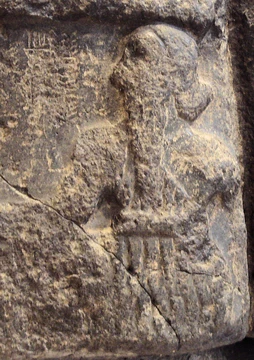
Adad-nirari I
Assyrian king who expanded the empire and claimed universal kingship.

Adad-nārārī I was a king of Assyria during the Middle Assyrian Empire, reigning either 1305–1274 BC or 1295–1263 BC according to the short chronology. His annals survive in more detail than those of most of his predecessors, and he achieved numerous major military victories that further strengthened Assyria's position as the most powerful state in the world at the time.
Quick Facts
- Title
- King of Assyria
- Reign
- 31 regnal years / 1305-1274 BC (MC) / 1295-1263 BC (SC)
- Predecessor
- Arik-den-ili
- Successor
- Shalmaneser I
- Succession
- King of the Middle Assyrian Empire
- Issue
- Shalmaneser I, Ibashi-ili
Facts from the source article.
Lore & Background
Adad-nārārī I boasted of defeating the heroic armies of the Kassites, Qutu, Lullumu, and Shubaru. His victory over the Kassite king Nazi-Maruttaš at Kar Ishtar was particularly significant, as his father had been unable to rectify calamities inflicted by the Kassites. This triumph led to a border realignment extending Assyrian territory into southern Mesopotamia. His successor Shalmaneser I agreed to a humiliating treaty, pardoning Nazi-Maruttaš's son.
With peace secured in the south, Adad-nārārī turned north and west, taking lands from the former Mitanni Empire. Conflict was triggered by a preemptive attack by Mitanni king Shattuara I, who was defeated, captured, and forced to swear fealty as a vassal. Later, Shattuara's son Wasashatta rebelled, seeking Hittite support, but Adad-nārārī counterattacked, sacking cities and deporting Wasashatta and his family to Aššur. He annexed Hanigalbat and appointed an Assyrian governor.
Adad-nārārī pronounced himself 'king of the universe' and sought equal status with the Hittite king, drawing a scathing response from Mursili II. Later, Hittite king Hattušili III, after overthrowing Urhi Teššup, sought to placate Adad-nārārī's son Shalmaneser I, requesting intervention against frontier incursions and complaining about a breach of protocol regarding inaugural gifts. Hattušili also discussed Shalmaneser I's request for iron, sending a dagger blade while promising more.
Reader's Guide
Adad-nārārī I is significant as a pivotal figure in the Middle Assyrian Empire, whose military campaigns and diplomatic maneuvers established Assyria as the dominant power of its era. His detailed annals provide a rare window into late Bronze Age statecraft, including the dynamics of vassalage, border realignment, and the personal nature of treaties between kings. His claim to the title 'king of the universe' and his insistence on being addressed as 'brother' by the Hittite king reflect the evolving language of imperial authority. The correspondence with Hattušili III illustrates the complexities of international relations, including the exchange of gifts, the importance of protocol, and the trade of luxury goods like iron. His conquest of Hanigalbat and the subsequent appointment of Assyrian governors laid the groundwork for Assyrian control over northern Mesopotamia. The survival of his annals, monumental inscriptions, and even a bronze sword in the Metropolitan Museum of Art underscores his lasting historical footprint. The discovery of brick molds at Qasr Shemamok in 2018 continues to add to the archaeological record of his building activities.
Did You Know?
- His name is rendered ideographically as mdadad-ZAB+DAḪ, meaning 'Adad (is) my helper.'
- He boasted of being the 'defeater of the heroic armies of the Kassites, Qutu, Lullumu, and Shubaru.'
- A bronze sword of Adad-nārārī I is held in the Metropolitan Museum of Art.
- In 2018, inscriptions on four brick molds celebrating the building of a palace by Adad-nirar were discovered at Qasr Shemamok.
The Young King and the Shadow of Shammuramat
Adad-nīrārī III, whose name translates to "Adad the storm god is my help," ascended the Assyrian throne in 811 BC as the son and direct successor of Shamshi-Adad V. He appears to have been quite young when he took power, a circumstance that shaped the early character of his rule. During the first five years of his reign, his mother Shammuramat wielded a degree of influence that was remarkable for the era. Although modern scholarship largely rejects the idea that she formally served as regent, her political weight was undeniable and gave rise to the legendary figure of Semiramis in later tradition. The dynastic line he established proved durable: he was the father of three subsequent Assyrian kings—Ashur-nirari V, Shalmaneser IV, and Ashur-dan III. Centuries later, Tiglath-Pileser III claimed descent from Adad-nīrārī in his own inscriptions, though scholars remain uncertain whether that genealogical assertion was historically accurate. The young king's early vulnerability thus set the stage for both his mother's prominence and the long royal lineage that followed.
Restoring Assyrian Military Dominance
The circumstances surrounding Adad-nīrārī's accession were far from favorable. His father's early struggles, combined with the new king's youth, had seriously eroded Assyrian authority over its own heartland in Mesopotamia. Officers, provincial governors, and local rulers seized the opportunity to pursue independent ambitions, fracturing the centralized control that the empire had once enjoyed. Determined to reverse this decline, Adad-nīrārī launched a sustained program of military campaigns, explicitly aiming to restore the level of power Assyria had possessed under his grandfather Shalmaneser III. The eponym canon records that he waged campaigns in every direction right up until the final year of his twenty-eight-year reign, which ended in 783 BC. Beyond the battlefield, he also invested in religious infrastructure, commissioning the construction of the temple of the god Nabu at Nineveh. His inscriptions present a ruler who viewed military projection as the essential tool for reasserting Assyrian supremacy across the region.
The Siege of Damascus and the Reshaping of the Levant
One of the most consequential episodes of Adad-nīrārī's long military career was his siege of Damascus in 796 BC, conducted during the reign of the Aramaean king Ben-Hadad III. This campaign proved decisive in the broader political landscape of the Levant. The pressure it placed on the Aramaean Kingdom of Damascus contributed to that state's gradual eclipse as a regional power. The weakening of Damascus had a cascading effect on its neighbors: the Kingdom of Israel, under King Jehoash, was able to recover its position, and Jehoash subsequently paid tribute to the Assyrian king. The recovery of Israel also coincided with the rise of Jeroboam II, whose reign marked a period of renewed strength for that kingdom. In this way, a single Assyrian military operation in the late eighth century BC rippled outward, reshaping the balance of power among the small states of the Levant. Adad-nīrārī's campaign against Damascus thus stands as a defining moment that altered the geopolitical map of the region for a generation.
A Vigorous Reign, a Fragile Legacy
Adad-nīrārī III ruled Assyria for twenty-eight years, from 811 to 783 BC, a span that allowed him to leave a substantial mark on the kingdom's military and religious life. Yet the period immediately following his death tells a different story. Despite the vigor and breadth of his campaigns, Assyria slid into a several-decades-long era of weakness after he passed from the throne. The centralization he had worked so hard to rebuild proved difficult to sustain across subsequent generations. His name, meaning "Adad the storm god is my help," carries an almost ironic resonance when set against the fragility of the political order that outlived him. Still, his dynastic footprint endured: he fathered three kings who would go on to rule Assyria, and the question of his lineage lingered in the inscriptions of later rulers such as Tiglath-Pileser III. The contrast between his active, campaign-filled reign and the prolonged decline that followed makes Adad-nīrārī a figure of both achievement and poignant limitation.
Frequently Asked Questions
Who is Adad-nirari I?
Adad-nirari I was a ruler of the Middle Assyrian Empire who held the throne for thirty-one years, dated to either 1305–1274 BC or 1295–1263 BC under the short chronology. He stands out among his predecessors because his royal annals survive in notably greater detail.
What are Adad-nirari I's powers and role?
Bearing the title šar kiššati, or 'king of the universe,' he exercised supreme military command, routing the Kassites, Qutu, Lullumu, and Shubaru in a series of crushing campaigns. His seizure of Hanigalbat locked in Assyria's status as the dominant state of the ancient Near East.
Why is Adad-nirari I important?
He is the Assyrian monarch most tightly linked to the grand claim of universal kingship, having earned that title through a string of victories that made Assyria the undisputed hegemon of its era. His annals also remain a cornerstone primary source for scholars studying Middle Assyrian politics and warfare.
Who is Adad-nirari I's father?
His own inscriptions and the Nassouhi kinglist identify Arik-den-ili as his predecessor and sire, while the Khorsabad and SDAS lists substitute the name Enlil-nirari, almost certainly a scribal mix-up. Either way, the lineage anchors him squarely within the Middle Assyrian royal house.
More in Kings of the Universe 1-24
Spotted an error? Know more?
Reader corrections go straight into our review queue. Suggest an edit · How this site is sourced