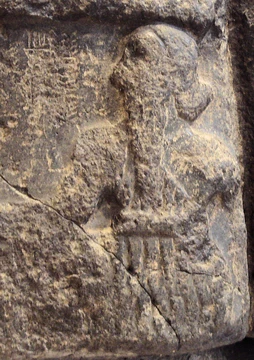
Dadusha
King of Eshnunna who expanded power through war and diplomacy.

Dadusha (Dāduša; died circa 1779 BC) ruled the central Mesopotamian city of Eshnunna, which sat in the Diyala Valley. He was the son of King Ipiq-Adad II. Earlier rulers of Eshnunna had called themselves ensi, or governor, of the city god Tishpak, but by the early 19th century BC they had started using the title king. Dadusha’s father and his brother Naram-Sin, who reigned before him, both took that title, and Dadusha did the same.
His father had expanded Eshnunna’s control to include other cities in the Diyala Valley, such as Nerebtum, Shaduppum, and Dur-Rimush. Dadusha kept up these expansionist policies, using both war and diplomacy to extend his influence. This made Eshnunna one of the most powerful states in Mesopotamia during the early 18th century BC.
Dadusha formed an alliance with Shamshi-Adad I of Upper Mesopotamia. Clay tablets from the Mari Archives and Tell Leilan suggest the two kings had a formal brotherhood treaty, called an atutu.
Around 1781 BC, Dadusha and Shamshi-Adad I worked together to besiege the city of Qabarum, located in the fertile Erbil plain. This city was a strategic hub between the Tigris River and the Zagros Mountains, part of the land of Urbilum (modern Erbil). The goal was to subdue the area between the two Zab Rivers. Records mention the use of advanced siege engines and the eventual destruction of the city’s walls. The attack happened in Dadusha’s last known regnal year and the 28th year of Shamshi-Adad I. After their victory, Dadusha had a victory stele made to commemorate the event. A fragmentary stele from Shamshi-Adad I, known as the Mardin Stele, tells the story from a different angle. Following the conquest, Qabarum became a provincial center in Shamshi-Adad’s kingdom, helping control trade and farming in the north. Archaeologists generally link Qabarum to Tell Baqrta or Kurd Qaburstan.
Dadusha is also known from a series of unsorted year-names.
The Stele of Dadusha was a tall victory monument that originally stood at the Temple of Adad in Eshnunna. It was discovered in 1983 during construction work at Tell Asmar (ancient Eshnunna) in the Diyala region of Iraq. The front side has four carved registers, and the narrow sides are inscribed with 220 lines of cuneiform text divided into 17 columns. It is 1.80 meters high, 37 cm wide, and 18.5 cm thick.
Quick Facts
- Succession
- King of Eshnunna
- Reign
- c. 1800 - c. 1779 BC
- Successor
- Ibal-pi-el II
- Father
- Ipiq-Adad II
- Death Date
- c. 1779 BC
Facts from the source article.
Lore & Background
Dadusha was the son of the Eshnunna king Ipiq-Adad II. Although previous kings of Eshnunna had referred to themselves as ensi (governor) of the city god Tishpak, in the early 19th century BC rulers began using the title king (Sumerian lugal). Dadusha's father and his brother Naram-Sin both used the title king, and Dadusha followed suit.
Dadusha had an alliance with Shamshi-Adad I in Upper Mesopotamia, formalized through an atutu (brotherhood) treaty, as recorded in cuneiform tablets from the Mari Archives and Tell Leilan archives. Around 1781 BC, the coalition besieged the city of Qabarum in the fertile Erbil plain, using advanced siege engines to destroy its walls.
Reader's Guide
Dadusha's significance lies in his role in the expansion of Eshnunna during the early 18th century BC, a period when the city became a major power in Mesopotamia. His alliance with Shamshi-Adad I of Upper Mesopotamia, formalized through a brotherhood treaty, enabled the successful siege of Qabarum, a strategic hub between the Tigris and the Zagros Mountains. The victory stele of Dadusha, discovered in 1983 at Tell Asmar, provides a rare visual and textual record of ancient warfare and royal ideology, depicting the beheading of the defeated king Bunu-Ishtar. The stele survived the looting of the Iraq Museum in 2003. Additionally, the Laws of Eshnunna, possibly from his reign, represent an early legal code that shares similarities with the later Code of Hammurabi and the biblical laws in Exodus, illustrating the continuity of legal traditions in the ancient Near East. Dadusha's reign thus marks a key moment in the political and legal history of Mesopotamia.
Did You Know?
- Dadusha's victory stele was found accidentally in 1983 while digging a well on the outskirts of ancient Eshnunna (modern Tell Asmar).
- The stele's inscription states that Dadusha beheaded the king of Qabrā, Bunu-Ishtar, and carried his head back to Eshnunna.
- The Laws of Eshnunna, found at Shaduppum, contain a law about an ox goring a man, similar to laws in Hammurabi's Code and the biblical Book of Exodus.
- Dadusha's alliance with Shamshi-Adad I is documented in cuneiform tablets from the Mari Archives and Tell Leilan archives.
Dynasty and the Ascent to Kingship
Dadusha belonged to a ruling family that transformed Eshnunna, a city in the Diyala Valley, from a modest polity into a recognized kingdom. His father, Ipiq-Adad II, had already drawn neighboring settlements such as Nerebtum, Shaduppum, and Dur-Rimush into Eshnunna's sphere of influence. A pivotal shift in royal self-presentation occurred in the early nineteenth century BC: earlier Eshnunna rulers had styled themselves merely as ensi, or governor, of the city deity Tishpak, a title implying subordination to a higher authority. Ipiq-Adad II broke with that tradition by adopting the Sumerian lugal, meaning king, and his son Naram-Sin continued the practice before his own death. Dadusha inherited a throne already crowned in royal language and carried the title forward as a matter of dynastic continuity. He died around 1779 BC, passing the kingship to his son Ibal pi'el II, who reigned until roughly 1767 or 1765 BC. The family's three-generation run thus bookended a critical moment when a mid-sized Mesopotamian city-state asserted full sovereign status.
Expansion, Diplomacy, and the Brotherhood Treaty
Dadusha inherited an aggressive territorial agenda and amplified it considerably. Where his father had absorbed cities like Nerebtum, Shaduppum, and Dur-Rimush into Eshnunna's orbit, Dadusha pursued a strategy that wove military force together with diplomatic negotiation to extend his reach across the Diyala Valley and beyond. By the early eighteenth century BC, this sustained expansionism had elevated Eshnunna to the rank of one of the most powerful polities in the broader Mesopotamian landscape. A cornerstone of his foreign policy was a formal alliance with Shamshi-Adad I, the ruler of Upper Mesopotamia. Cuneiform tablets recovered from the Mari Archives and the Tell Leilan archives reveal that the two monarchs sealed their partnership through an atutu, a brotherhood treaty binding them in mutual obligation. This coalition proved decisive in the military campaigns that followed, most notably the joint siege of Qabarum, and it positioned Eshnunna as a peer partner rather than a satellite in the political architecture of second-millennium BC Mesopotamia.
The Siege of Qabarum
In what appears to have been the final documented year of his reign, Dadusha joined forces with Shamshi-Adad I to lay siege to Qabarum, a strategically vital city in the fertile Erbil plain sitting at the crossroads between the Tigris River and the Zagros Mountains. The target was the territory between the two Zab Rivers, and the campaign was conducted with considerable military sophistication: records describe the deployment of advanced siege engines and the systematic destruction of the city's defensive walls. The operation took roughly ten days, during which the besiegers raised an enclosing wall, piled up earth, and created a breach before storming the city. The king of Qabarum, Bunu-Ishtar, was killed, and his head was carried triumphantly back to Eshnunna. Dadusha commissioned a victory stele to mark the occasion, while the fragmentary Mardin Stele preserves Shamshi-Adad I's own account of the same event. In the aftermath, Qabarum was absorbed as a provincial administrative center within Shamshi-Adad's realm, anchoring control over northern trade routes and agricultural output. Modern archaeologists generally identify the site with either Tell Baqrta, one of the largest mounds in northern Iraq, or Kurd Qaburstan.
The Stele and the Laws of Eshnunna
The Stela of Dadusha, an elongated victory stone that once stood in the Temple of Adad at Eshnunna, was discovered by accident in 1983 when workers digging a well at modern Tell Asmar in Diyala, Iraq, struck the buried monument. Standing 1.80 meters tall, 37 centimeters wide, and 18.5 centimeters thick, the stele's front face is divided into four carved registers, and the narrow sides hold 220 lines of cuneiform text arranged across seventeen columns. The upper register shows Dadusha in a slayer's pose over the defeated king Bunu-Ishtar, a standing male figure—perhaps the god Adad or a second image of the king—gazing in adoration, and the emblems of Shamash's sun-disc and Sin's crescent above. The center of the front was damaged during the dig. Dated to the Old-Babylonian period, the stele now sits in the Iraq Museum in Baghdad, where it escaped the April 2003 looting. Equally important are the Laws of Eshnunna, preserved on two tablets found at Shaduppum (Tell Harmal) in 1945 and 1947. Composed during or just before Dadusha's reign, this code predates Hammurabi's and shares notable parallels with both that later Babylonian text and the Mosaic law in Exodus, including a provision on an ox that gores a man.
Frequently Asked Questions
Who is Dadusha?
Dadusha was a king of Eshnunna, a city in the Diyala Valley of central Mesopotamia, who ruled around the late 18th century BC. He was the son of King Ipiq-Adad II and the brother of Naram-Sin, both of whom also held the title of king.
What were Dadusha's main accomplishments?
Dadusha is known for a military victory over Qabarum and for forging a diplomatic alliance with Shamshi-Adad I. He also maintained the territorial expansion his father had achieved across the Diyala Valley, keeping cities like Nerebtum, Shaduppum, and Dur-Rimush under Eshnunna's control.
Why is Dadusha important in Eshnunna's history?
He represents the era when Eshnunna's rulers had fully shifted from the older title of ensi (governor of the city god Tishpak) to the more sovereign title of king. His blend of military conquest and diplomatic alliance-making helped cement Eshnunna's regional dominance in the Diyala Valley.
Is Dadusha connected to the Laws of Eshnunna?
Some scholars have proposed a possible link between Dadusha's reign and the so-called Laws of Eshnunna, though this association remains uncertain. It is one of the more debated aspects of his legacy in Mesopotamian legal history.
More in Kings of the Universe 1-24
Spotted an error? Know more?
Reader corrections go straight into our review queue. Suggest an edit · How this site is sourced