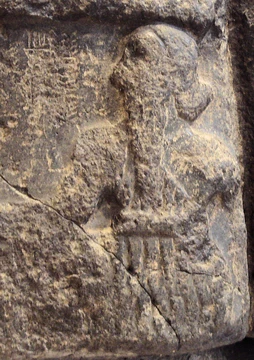
Adad-apla-iddina
Babylonian king whose reign was a golden age for scholarship.

Adad-apla-iddina, whose name means “Adad has given me an heir,” was the 8th king of the 2nd Dynasty of Isin and the 4th Dynasty of Babylon, ruling c. 1064–1043 BCE. He was a contemporary of the Assyrian king Aššur-bêl-kala, and his reign was later celebrated as a golden age for scholarship in first-millennium BCE Mesopotamia.
Quick Facts
- Title
- King of Babylon
- Predecessor
- Marduk-šapik-zeri
- Successor
- Marduk-aḫḫe-eriba
- Royal House
- 2nd Dynasty of Isin
Facts from the source article.
Lore & Background
Adad-apla-iddina was a contemporary of the Assyrian king Aššur-bêl-kala. The broken obelisk of Aššur-bêl-kala records an Assyrian raid into Babylonia early in his reign, capturing cities in the district of Dūr-Kurigalzu. The Synchronistic History states that Adad-apla-iddina was appointed by Aššur-bêl-kala, who took his daughter as a wife with a vast dowry to Assyria, suggesting Babylon had become a vassal. His ancestry is uncertain: the Synchronistic History names Esagil-Šaduni as his father, but he is described as “a son of a nobody,” while one of his own inscriptions names Nin-Duginna as his father, indicating divine provenance.
Reader's Guide
Adad-apla-iddina’s reign was marked by both destruction and cultural flourishing. An invasion of Arameans led by a usurper demolished Der, Nippur, Sippar, and Parsa (Dur-Kurigalzu), and the Suteans carried off booty from Sumer and Akkad. These attacks are confirmed in an inscription of the later king Simbar-šihu. Despite these troubles, his reign was remembered in the first millennium BCE as a golden age for scholarship. He appears twice in the Uruk List of Sages and Scholars alongside Šaggil-kīnam-ubbib and Esagil-kin-apli. The Babylonian Theodicy was attributed to Šaggil-kīnam-ubbib and believed to have been composed during his reign. Esagil-kin-apli, the chief scholar, compiled the diagnostic omen series SA.GIG, which became the received text. Adad-apla-iddina also undertook extensive rebuilding, including the Imgur-Enlil wall of Babylon, the Nīmit-Marduk rampart at Nippur, and repairs at temples in Borsippa, Isin, Larsa, Kiš, and Ur. He may have connived to replace Aššur-bêl-kala’s son with his uncle, Šamši-Adad IV, who had been in exile in Babylonia.
Did You Know?
- The Babylonian Theodicy, a dialogue on social justice, is believed to have been composed during his reign.
- He rebuilt the Imgur-Enlil city wall of Babylon, which had collapsed from old age.
- A late copy of an astrological text is dated to his eleventh year.
Origins and the Shadow of Assyrian Dominion
Adad-apla-iddina's royal name, rendered in cuneiform as a declaration that the storm god Adad granted him an heir, conceals a lineage far more tangled than the title of king implies. The Synchronistic History is blunt in calling him a "son of a nobody," confirming he had no royal parent. One of his own inscriptions invokes Nin-Duginna as father, but this reads as a claim of divine rather than human descent. The Babylonian Chronicle styles him a "son" of Itti-Marduk-balaṭu, a formula that may trace a collateral thread back to an early Isin dynasty ruler or link him to the governor captured during Assyrian raids in the Dūr-Kurigalzu district. The most revealing evidence comes from the broken obelisk of Aššur-bêl-kala, which states that the Assyrian monarch himself installed Adad-apla-iddina on the Babylonian throne and subsequently took the new king's daughter as a wife, sending her back to Assyria accompanied by a vast dowry. This arrangement cemented Babylon's status as an Assyrian vassal, a political reality that cast a long shadow over his roughly twenty-year reign and the upheavals that followed.
Invasions and the Theology of Ruin
The period of Adad-apla-iddina's rule was scarred by devastating foreign incursions that reduced major Babylonian cities to rubble. Aramean and Sutean forces swept through the heartland, leveling Der, Dur-Anki (Nippur), Sippar, and Parsa (Dur-Kurigalzu), and hauling away the accumulated wealth of Sumer and Akkad. A later inscription by the king Simbar-šihu offers a grim catalogue of the damage: the hostile groups seized the throne of Ellil in the E-kur-igi-gal, disrupted the sacred rites at Sippar, sacked the surrounding land, and razed temples across the region. The Epic of the plague-god Erra, a theologically charged composition from the late ninth century, anchors its narrative of national paralysis precisely at the start of Adad-apla-iddina's reign. In that text, the god Erra—whose very name evokes scorched earth—travels alongside Išum, the fire deity, and the disease-spreading Sibitti demons, offering a divine rationale for the catastrophe. The Assyrian obelisk of Aššur-bêl-kala also records raids into the Dūr-Kurigalzu district and the capture of the governor Kadašman-Buriaš, suggesting the political instability predated the Aramean onslaught.
A Golden Age of Scholarship and Literature
Despite the political turbulence, later generations remembered Adad-apla-iddina's reign as a flourishing era for intellectual life. He is named twice in the Uruk List of Sages and Scholars, appearing alongside figures such as Šaggil-kīnam-ubbib and Esagil-kin-apli. The Babylonian Theodicy, a profound dialogue in which a suffering man laments the state of social justice and his friend offers a theological reconciliation, was attributed to the incantation priest Šaggil-kīnam-ubbib and is believed to have been composed during this period. Originally structured as twenty-seven stanzas of eleven lines each, the work carried an acrostic identifying the author as an adorant of both god and king. Multiple copies survive from the Library of Ashurbanipal at Nineveh as well as from Assur, Babylon, and Sippar. Esagil-kin-apli, the chief scholar of Borsippa, undertook the monumental task of compiling scattered diagnostic omen tablets into the received SA.GIG edition, forty tablets organized into six chapters, prefaced by a solemn warning against neglecting knowledge. He may also have edited related physiognomic omen series. A late copy of an astrological text dated to his eleventh year further confirms the era's scholarly productivity.
Building Program and Material Legacy
Adad-apla-iddina left a substantial architectural footprint across southern Mesopotamia. A cylinder inscription records his reconstruction of the Imgur-Enlil, the great city wall of Babylon, which had crumbled with age. At Nippur, a commemorative cone marks his repair of the Nīmit-Marduk rampart. His building activities extended to Borsippa, where he presented an engraved gold belt as a votive offering to the statue of Nabû at the E-zida temple, and to Isin, where the ramp leading up to the Nin-ezena temple bears his inscriptions documenting the repairs. In Larsa he restored the Ebabbar, and in Kiš he rebuilt the Emete'ursag dedicated to Zababa. Stamped bricks attest to his construction work in Babylon, in the great Nanna courtyard at Ur, and in the pavement against the northeast face of the Ur ziggurat. Beyond architecture, seven economic texts spanning his fifth through nineteenth years survive, along with a stone tablet recording a legal transaction from his first year and fragments of kudurru boundary stones documenting land grants to individuals named Mušallimu and Marduk-akhu. Together these material records paint a picture of an active, administratively engaged ruler.
Frequently Asked Questions
Who is Adad-apla-iddina?
He was the eighth ruler of the Second Dynasty of Isin (also called the Fourth Dynasty of Babylon) who held the throne from roughly 1064 to 1043 BCE. His name translates to 'Adad has given me an heir,' a theophoric pattern common among Babylonian monarchs.
What role or 'powers' does Adad-apla-iddina hold?
As a Babylonian king, his primary domain was kingship and the patronage of learning. He is credited with rebuilding temples and city walls, and his court became a major center for scribal and scholarly activity.
Why is Adad-apla-iddina important to Mesopotamian history?
His roughly two-decade rule is remembered as a golden age for scholarship in first-millennium BCE Mesopotamia, a period when literary and scientific traditions were actively copied and preserved. Later scribes looked back on his era as a high point of Babylonian intellectual life.
Who was Adad-apla-iddina's main contemporary rival?
He ruled at the same time as the Assyrian king Aššur-bêl-kala, making the two the dominant powers in the region during the mid-eleventh century BCE.
More in Kings of the Universe 1-24
Spotted an error? Know more?
Reader corrections go straight into our review queue. Suggest an edit · How this site is sourced