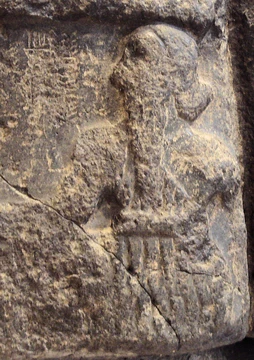
King of the Universe
Ancient Mesopotamian title claiming universal cosmological dominion.

King of the Universe is a royal title that asserts total authority over the cosmos. In history, it was employed on and off by powerful monarchs in ancient Mesopotamia as a highly prestigious designation. Similar titles later appeared in the Greco-Roman world as honors for strong rulers, and the phrase was also used for various gods in Mesopotamian, Greek, and Roman writings. Within the Abrahamic tradition, it has endured as a religious title for God and certain other figures.
The Mesopotamian term *šar kiššatim* comes from the ancient Sumerian city of Kish. Kish was considered preeminent among Mesopotamian cities, and Sumerian legend held that after the great flood, kingship was lowered from heaven to that city. The earliest known ruler to take this title was Enmebaragesi of Kish (reigned around 2600 BC). Later empires that claimed symbolic descent from Kish continued to use it. The final known ruler to bear the Mesopotamian version was the Seleucid king Antiochus III the Great (reigned 222–187 BC), though later rulers such as Antiochus I Soter also used it.
During the Early Dynastic Period in Mesopotamia (roughly 2900–2350 BC), city-states like Ur, Uruk, Lagash, Umma, and Kish often invaded distant lands to build small empires and gain an edge over rivals. The most powerful rulers could adopt prestigious styles, such as *lugal*. Most who held that title likely earned it through their own military campaigns rather than inheritance.
The drive to outshine other city-states gradually turned into ambitions for universal rule. People of that time believed Mesopotamia was the whole world, bounded by the Persian Gulf (the “lower sea”) and the Mediterranean (the “upper sea”). Since cities like Susa, Mari, and Assur lay near these perceived edges, reaching them seemed possible.
In the Early Dynastic IIIb period (around 2450–2350 BC), rulers aiming for universal dominion became more common. Two notable examples are Lugal-Anne-Mundu of Adab, who—according to the much later Sumerian King List—created an empire spanning from modern Syria to Iran, “subjugating the Four Corners,” and Lugal-zage-si of Uruk, who conquered all of Lower Mesopotamia and claimed his domain stretched from the upper to the lower sea.
- First known user
- Enmebaragesi of Kish
- Last known user (mesopotamian)
- Antiochus III the Great
Lore & Background
The title King of the Universe, in Akkadian šar kiššatim, derives from the ancient Sumerian city of Kish, which was seen as having primacy over other cities and was the legendary location where kingship was lowered from heaven after the flood. The earliest known ruler to adopt the title was Enmebaragesi of Kish (r. c. 2600 BC), who used it as a king of Kish. Under later rulers, 'King of Kish' took on the meaning 'King of the Universe,' implying divinely authorized rule over all of Sumer and beyond. Sargon of Akkad's grandson Naram-Sin introduced the similar title King of the Four Corners of the World, which referred to terrestrial dominion, while King of the Universe denoted cosmological dominion.
Reader's Guide
King of the Universe was a title of immense prestige in ancient Mesopotamia, used to assert total cosmological authority. It was most prominently employed by the Neo-Assyrian Empire (911–609 BC), where it may have required individual kings to earn it through a process possibly involving seven successful military campaigns. The title was also claimed by rivals such as the kings of Urartu and by some Babylonian and Mari rulers. After the Neo-Assyrian period, only the Neo-Babylonian king Nabonidus used it in official inscriptions, though it appears in economic documents under Nabopolassar and Nebuchadnezzar II. Cyrus the Great adopted the title after conquering Babylon, but his successors did not continue its use. The last recorded use is on the Antiochus Cylinder of Antiochus I Soter, which describes his rebuilding of the Ezida Temple in Borsippa. The title's legacy includes its later application as a religious honorific for God in the Abrahamic tradition.
Did You Know?
- The title King of the Universe derives from the Sumerian city of Kish, which was believed to be where kingship was lowered from heaven after the legendary flood.
- The first ruler to use the title was Sargon of Akkad (r. c. 2334–2279 BC).
- The last known Mesopotamian ruler to assume the title was the Seleucid king Antiochus I Soter (r. 281–261 BC).
- The title may have required each Neo-Assyrian king to earn it, possibly through seven successful military campaigns.
Roots in the City of Kish
In the Early Dynastic Period of Mesopotamia, roughly spanning 2900 to 2350 BC, a patchwork of city-states including Ur, Uruk, Lagash, Umma, and Kish vied for dominance through campaigns of expansion. Among these polities, Kish occupied a uniquely elevated position in the Sumerian imagination. According to the Sumerian King List, it was at Kish that kingship itself was lowered from the heavens following the legendary flood, making its rulers the living embodiment of human sovereignty. This mythological primacy gradually transformed into a political claim. By the Early Dynastic IIIb period, ambitious rulers like Lugal-zage-si of Uruk began adopting titles such as King of the Land to assert authority beyond their home city. The Mesopotamians of this era conceived of their world as bounded by the Persian Gulf to the south and the Mediterranean to the north, making the notion of ruling the entire known realm feel practically achievable. The prestige attached to Kish's kingship thus became the conceptual seed from which the far grander title of King of the Universe would eventually sprout.
Sargon and the Birth of a Universal Claim
Sargon of Akkad, who reigned approximately from 2334 to 2279 BC, transformed a regional title into a claim of cosmic authority. His political origins were humble: he served as a cupbearer under Ur-Zababa, the ruler of Kish, before escaping an assassination attempt and seizing power for himself. Through a series of conquests, Sargon built the first great Mesopotamian empire, the Akkadian Empire. While his primary style was King of Akkad, he also adopted the formulation lugal ki-sár-ra or lugal kiš-ki, a rendering of King of Kish that deliberately differed from the standard Sumerian lugal kiš. Crucially, Sargon and his successors never directly governed Kish itself; the city was administered by a semi-independent official titled ensik. This meant the title had shed its literal geographic anchor and acquired a broader, more abstract meaning. His grandson Naram-Sin pushed the concept further with the title King of the Four Corners of the World, which may have denoted authority over the terrestrial realm, while King of the Universe implied dominion over the entire cosmological order.
A Title Contested Across Centuries
The title King of the Universe, rendered in Akkadian as šar kiššatim, became a focal point of political rivalry spanning many centuries. While the Neo-Assyrian Empire (911–609 BC) is most closely associated with its use, earlier rulers had already claimed it sporadically. Shamshi-Adad I of Upper Mesopotamia in the Old Babylonian period and Ashur-uballit I in the Middle Assyrian period both employed it. The kings of the city-state Eshnunna, particularly Ipiq-Adad II and Dadusha, adopted the title in direct opposition to Assyrian pretensions, while their rivals had styled themselves mighty king. Rulers of Babylon and Mari also asserted the title at various points. Even during the height of Neo-Assyrian dominance, the claim was not uncontested. The kings of Urartu, beginning with Sarduri I around 834–828 BC, began using the title themselves, asserting parity with the Assyrian monarchs and staking broad territorial claims. The last known ruler to assume the Mesopotamian form of the title was the Seleucid king Antiochus I Soter, who reigned from 281 to 261 BC, marking the final chapter of its use in the ancient Near Eastern political context.
From Royal Honorific to Divine Title
The trajectory of King of the Universe extended well beyond the political arenas of Mesopotamia. In the Greco-Roman world, equivalent formulations were adopted as honorifics for powerful rulers, indicating that the concept of universal sovereignty resonated across cultural boundaries. The title also found a prominent place in religious and literary contexts: it was applied to various deities in the literary traditions of ancient Mesopotamia, Greece, and Rome, elevating divine figures to the apex of cosmic authority. Most enduringly, the title survived as a religious designation within the Abrahamic tradition, where it continues to function as a name for God and certain other sacred figures. This long arc—from the political ambitions of Sumerian city-state rulers, through the imperial claims of Akkadian, Assyrian, and Seleucid monarchs, into the theological vocabulary of later faiths—demonstrates how a title originally rooted in the prestige of a single Sumerian city could evolve into one of the most persistent expressions of absolute authority in human history.
Frequently Asked Questions
What is King of the Universe?
It is an ancient royal designation that proclaimed a ruler's absolute sovereignty over the entire cosmos. The title originated in Sumerian Mesopotamia and was reserved for monarchs who claimed supreme authority beyond any single city-state.
Who was the first known King of the Universe?
Enmebaragesi of Kish holds the distinction of being the earliest historically attested bearer of the title. His claim to universal dominion was rooted in Kish's status as the preeminent Sumerian city.
What powers or role does the title King of the Universe carry?
The designation asserted total cosmological authority, placing the holder above all other kings and territories. It functioned not merely as a political rank but as a claim to rule over the full span of the known world.
Who was the last known King of the Universe in Mesopotamian history?
Antiochus III the Great is the final ruler recorded as using the title within the Mesopotamian tradition. After his era, the specific designation fell out of active use in that cultural sphere.
How did King of the Universe spread beyond Mesopotamia?
The concept traveled into the Greco-Roman world, where analogous honors were bestowed on powerful rulers and deities. It also persisted in Abrahamic religious texts as a title applied to God and select other figures.
More in Kings of the Universe 1-24
Spotted an error? Know more?
Reader corrections go straight into our review queue. Suggest an edit · How this site is sourced