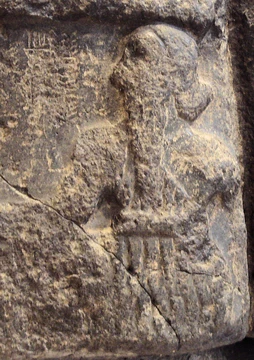
Ashur-dan II
First king of the Neo-Assyrian Empire, recaptured northern and northeastern lands.

Ashur-Dan II (Aššur-dān) was the son of Tiglath Pileser II and reigned from 934 to 912 BC. He is generally regarded as the first king of the Neo-Assyrian Empire, though some scholars see the empire as emerging gradually or being formally founded by his successor Adad-nirari II. His reign is best known for recapturing previously held Assyrian territory in the northern and northeastern frontiers, and for shoring up Assyria's natural borders.
Quick Facts
- Title
- King of Assyria · King of the Universe
- Reign
- 934–912 BC
- Predecessor
- Tiglath Pileser II
- Successor
- Adad-nirari II (Neo-Assyrian Empire)
- Succession
- King of the Middle Assyrian Empire
Facts from the source article.
Lore & Background
Ashur-Dan II's fragmentary annals suggest he was the first king to conduct regular military campaigns in over a century. His campaigns focused on northern territories along mountainous terrain, vital for controlling routes to Anatolia and sources of metals. In a significant victory, he captured the king of Katmuḫu, flayed him, and displayed his skin on the walls of Arbela, replacing him with a loyal subordinate and taking bronze, tin, and precious stones.
Reader's Guide
Ashur-Dan II's significance lies in his re-establishment of Assyria's borders and his systematic resettlement and land reclamation. He fortified reclaimed territory with horses, ploughs, and grain stores, and established government offices in all provinces, creating a strong administrative presence. His basic ideology and strategy laid the foundation for the Neo-Assyrian period, elaborated by his successors. He transformed Assyria from a territorial power to an imperial power, creating a uniformly structured political entity with well-defined borders, which his son Adad-nirari II expanded upon.
Did You Know?
- Ashur-Dan II's annals are only preserved in fragments.
- He followed his military exploits by counting wild animals he had hunted, including wild bulls, elephants, and lions.
- He claimed to have brought back Assyrians who had fled due to starvation to resettle the lands.
- He performed construction on the Craftsman’s Gate and the New Palace.
Reclaiming the Northern Frontiers
Ashur-dan II was the first Assyrian king in over a century to mount regular military campaigns, and he directed them almost entirely toward the mountainous northern territories that pressed against the heartland. These regions were doubly important: their closeness made them a perpetual source of raids, and the passes threading through them carried the trade routes that supplied Assyria with crucial metals from Anatolia. His most vividly recorded triumph involved the ruler of Katmuḫu, a northeastern state, whom he captured, flayed, and whose skin he displayed on the walls of Arbela before installing a loyal subordinate in his place and confiscating the region's bronze, tin, and precious stones. Eastward, the Zagros foothills descending to the lower Zab river formed a narrow commercial corridor through which Assyria received horses and lapis lazuli mined in northeast Afghanistan. By the close of his twenty-two-year reign, the recovered frontier stretched from Tur Abdin, Harran, Kiultepe, Merida, and Hakkari across the north, through the Khabur delta and Hassakeh region to the west, along the Zagros to the east, and across central Mesopotamia to the south.
Building Back: Administration and Resettlement
Beyond the battlefield, Ashur-dan devoted enormous energy to rebuilding the administrative and economic infrastructure of the territories he had won back. The fragmentary annals record that he undertook construction work at both the Craftsman's Gate and the New Palace, and that he deliberately channeled the spoils of conquest toward honouring the gods rather than personal enrichment. His resettlement programme was sweeping: displaced Assyrians who had fled during years of starvation were rehoused in towns across the recovered provinces, and the newly secured lands were stocked with horses, ploughs, and grain stores to jump-start agricultural production. Perhaps most consequential was his decision to establish government offices in every province, creating a systematic administrative presence that had been absent during the earlier decline. This bureaucratic scaffolding turned a patchwork of reconquered territories into a coherent political entity. The annals themselves, though preserved only in fragments, reveal a king who structured his record around the traditional Assyrian theme of hunting wild bulls, elephants, and lions, and who closed his accounts with building activities, reinforcing the image of a protective, god-serving ruler rather than a mere conqueror.
The Aramaean Question and the Rhetoric of Return
The western campaigns of Ashur-dan II were framed in the surviving annals not as conquest but as restitution. He presented himself as a king rightfully reclaiming Assyrian land that Aramaean groups had occupied in the preceding decades, and he emphasized that he had brought back Assyrians who had fled into exile because of starvation. The narrative he constructed was stark: the Aramaeans had enslaved and slaughtered Assyrians and seized their territory, and his military action was a corrective to that injustice. This ideological framing served a practical purpose. By casting the wars as a return of stability and prosperity after an unlawful period of intrusion, he legitimized the extensive resettlement that followed, in which displaced populations were rehoused and the lands were fortified with agricultural infrastructure. The broader context made this framing urgent. At the close of the millennium, Assyria was encircled by hostile powers: Babylonia to the south, Aramaean polities in Syria to the west, and the Nairi peoples to the north and east. The earlier decline of Assyrian power had been attributed largely to a failure of systematic administration combined with the Aramaean influx, and Ashur-dan's rhetoric positioned his reign as the definitive reversal of that collapse.
Seeding the Neo-Assyrian Empire
Ashur-dan II, who reigned from 934 to 912 BC as son of Tiglath-Pileser II, occupies a singular position in Assyrian history: he was the last king of the interregnum between the Middle Assyrian Empire and the Neo-Assyrian Empire, and his strategic template was replicated by four subsequent generations of rulers. His basic ideology and approach laid the groundwork for the Neo-Assyrian period, which his successors elaborated into a full imperial system. He transformed Assyria from a territorial power into an imperial one, creating a uniformly structured political entity with well-defined, well-guarded borders that the Assyrian kings regarded as a unified whole, the land of Aššur. The resulting Neo-Assyrian Empire was a diverse, multi-ethnic state drawing on people from many tribal origins, yet to the outside world it presented as a monolithic whole whose inhabitants were identified as Assyrians regardless of ethnic background. His son Adad-nirari II, who ruled from 911 to 891 BC, continued campaigning in the regions his father had attacked, pushing west to the Balikh river, south to the middle Euphrates, north to the southern reaches of Lake Van, and east into the Zagros mountains, confirming the vision his father had established proved durable enough to sustain expansion.
Frequently Asked Questions
Who is Ashur-dan II?
Ashur-dan II was the son of Tiglath-Pileser II who ruled Assyria from 934 to 912 BC. He is most commonly identified as the first sovereign of the Neo-Assyrian Empire.
What is Ashur-dan II's role in the story?
He serves as the founding monarch of the Neo-Assyrian era, stepping in to reclaim lost Assyrian lands and fortify the empire's natural borders after a period of decline.
Why is Ashur-dan II important?
He marks the pivotal transition from the Old Assyrian period into the Neo-Assyrian age, making him the figure most often cited as the empire's first true king.
What is Ashur-dan II best known for?
His legacy centers on the military recovery of previously held territory along the northern and northeastern frontiers, effectively re-establishing Assyria's natural borders.
More in Kings of the Universe 1-24
Spotted an error? Know more?
Reader corrections go straight into our review queue. Suggest an edit · How this site is sourced